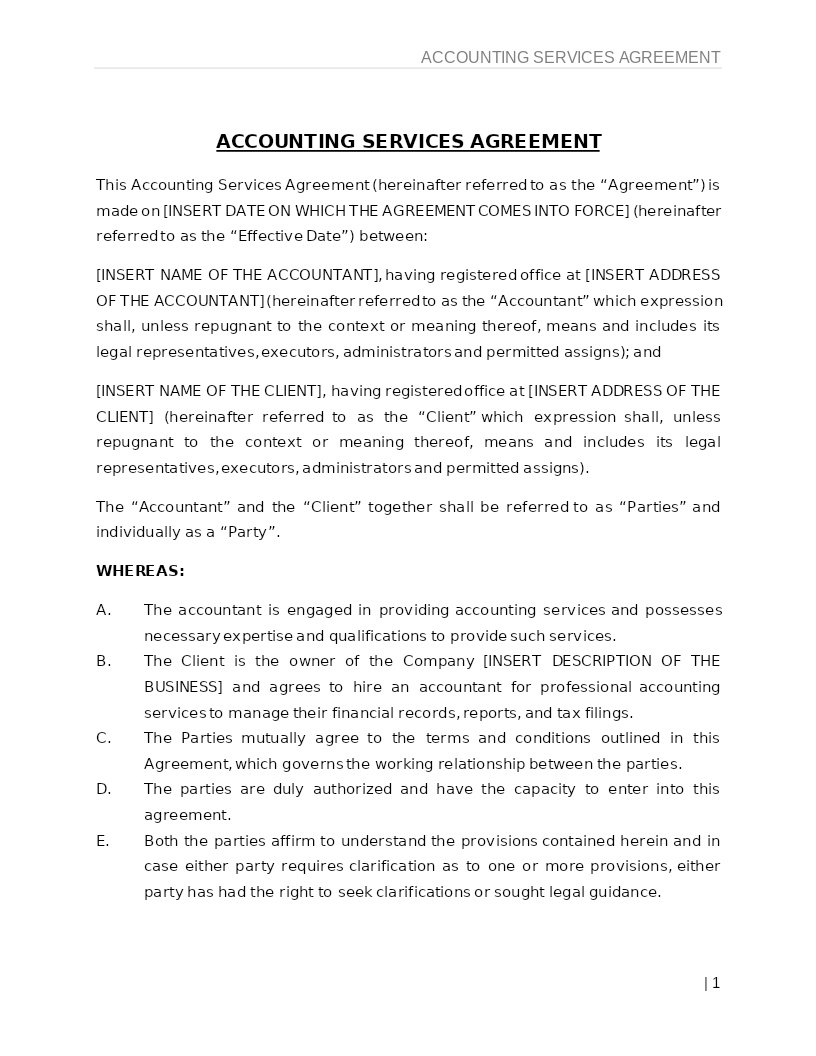
ACCOUNTING SERVICES AGREEMENT
How does it work?
1. Choose this template
Start by clicking on "Fill out the template"
2. Complete the document
Answer a few questions and your document is created automatically.
3. Save - Print
Your document is ready! You will receive it in Word and PDF formats. You will be able to modify it.
Providing Structure and Legal Protection for Professional Accounting Services in the United States
Businesses, entrepreneurs, nonprofits, and individuals across the United States frequently rely on professional accounting firms or independent CPAs for bookkeeping, tax preparation, payroll processing, auditing assistance, financial reporting, and advisory services. An Accounting Services Agreement provides a clear and legally enforceable framework governing this relationship.
This Agreement establishes the scope of accounting services, responsibilities of both the accountant and the client, fees, billing cycles, confidentiality obligations, data security requirements, compliance with U.S. tax laws, and limitations of liability.
Accounting Services Agreements are essential because accountants often handle sensitive financial information, proprietary business data, tax documents, payroll records, and compliance filings.
The Agreement ensures the accountant performs services professionally and in accordance with U.S. standards such as Generally Accepted Accounting Principles (GAAP), the Internal Revenue Code (IRC), IRS Circular 230, and, when applicable, AICPA professional standards. By using a professionally drafted Accounting Services Agreement, both parties protect themselves against misunderstandings, liability, and financial errors, while establishing a foundation for accurate, lawful, and timely financial management.
Where Accounting Services Agreements Are Commonly Used
These agreements are widely used across the United States by:
- Small businesses and startups outsourcing bookkeeping or payroll
- Mid-size and large corporations hiring external or fractional accounting support
- Nonprofit organizations requiring 990 filings or grant reporting
- Individuals seeking tax preparation or IRS representation
- E-commerce companies needing monthly reconciliation and inventory accounting
- Real estate investors or property managers requiring specialized tax planning
- Professional services firms engaging outsourced CFO or controller services
- Partnerships and LLCs needing K-1 preparation and compliance
- Companies undergoing audits, reviews, or financial analysis
Any time accounting, tax, or financial services are provided by a third party, a written Accounting Services Agreement is necessary.
Different Types of Accounting Services Agreements You May Encounter
1. Bookkeeping Services Agreement: Covers daily financial records, reconciliation, and categorization.
2. Tax Preparation & Filing Agreement: Used for preparing federal, state, and local tax returns.
3. Payroll Processing Agreement: Covers salary calculations, tax withholding, direct deposits, and filings.
4. Financial Statement Compilation & Review Agreement: For CPA-prepared statements following GAAP.
5. Fractional CFO or Controller Agreement: For executive-level financial oversight and planning.
6. Audit Support or IRS Representation Agreement: Used when accountants assist with IRS audits or inquiries.
When Legal Guidance Becomes Helpful
Legal review is recommended when:
- The accountant handles large amounts of proprietary or regulated data
- The engagement includes IRS representation or compliance risk
- Complex tax strategies or multi-state filings are involved
- The Agreement includes limitations on liability, indemnity, or error coverage
- Industry-specific accounting rules apply (healthcare, nonprofits, financial institutions)
- The client provides access to banking systems or financial software
- A CPA firm must comply with AICPA ethics and independence requirements
Proper legal drafting protects both parties from disputes, errors, and regulatory exposure.
How to Work With This Template
- Identify the accountant or CPA firm and the client
- Define the exact services to be provided (scope of work)
- Specify fees, billing schedules, retainers, and additional charges
- Describe confidentiality, data protection, and security requirements
- Address compliance with IRS, GAAP, and accounting industry standards
- Include termination, withdrawal, or suspension-of-services procedures
- Establish governing law and dispute resolution mechanisms
- Execute electronically valid and enforceable under the ESIGN Act
This structure is aligned with U.S. commercial and tax regulations governing accounting services.
Frequently Asked Questions
Q1. What is an Accounting Services Agreement in the United States?
An Accounting Services Agreement is a legally binding contract between a client and an accountant or CPA firm that outlines the financial, tax, bookkeeping, payroll, or advisory services to be performed. It sets clear expectations regarding responsibilities, fees, deadlines, confidentiality, and compliance with U.S. accounting laws and IRS regulations.
Q2. Why do I need a written accounting contract?
A written agreement protects both the accountant and the client by:
• clarifying the scope of work,
• preventing misunderstandings about fees,
• ensuring proper handling of sensitive financial data,
• defining deadlines and deliverables,
• outlining what is not included (e.g., audit services unless agreed),
• limiting liability for financial errors or misuse of information.
It also helps ensure compliance with AICPA standards and IRS rules.
Q3. Does an Accounting Services Agreement make the accountant a fiduciary?
No. Generally, accountants are independent contractors and not fiduciaries unless the agreement specifically assigns fiduciary duties.
Most contracts clarify that the accountant is responsible for performing services professionally but does not control business decisions or assume financial risk on behalf of the client.
Q4. Who owns the financial records and work product created?
Under U.S. accounting law:
• Client-provided records remain the client’s property
• Accountant-created work papers usually belong to the accountant, unless purchased or transferred
• Tax returns prepared by the accountant belong to the client, but the accountant may retain copies for compliance
The Agreement should clearly define ownership of financial data, working papers, and software-accessed information.
Q5. Are accountants legally responsible for mistakes or tax penalties?
Accountants are responsible for errors caused by negligence or failure to follow professional standards. However, clients remain responsible for timely providing accurate information, reviewing tax returns before filing, maintaining complete records, and complying with IRS requirements. Most agreements include limitation of liability clauses and may recommend errors & omissions insurance (E&O).
Q6. How do accountants charge for services?
Common U.S. billing models include hourly billing, fixed monthly packages, per-return or per-project fees, retainer-based engagements, and fractional CFO or ongoing advisory billing. The agreement should outline billing frequency, late fees, and additional charges for extra services.
Q7. Will my accountant keep my financial information confidential?
Yes. Accounting professionals must comply with AICPA confidentiality rules, IRS tax preparer confidentiality obligations (IRC §7216), state privacy laws, and cybersecurity best practices. The agreement typically includes an NDA-style confidentiality clause to protect financial data.
Q8. Can an accountant represent me before the IRS?
Yes, but only if the accountant is a Certified Public Accountant (CPA), an Enrolled Agent (EA), or an attorney. The Agreement should specify whether IRS representation is included or requires a separate engagement.
Q9. Can either party terminate the Accounting Services Agreement?
Yes. Most contracts allow termination with written notice, immediate termination for breach, suspension of services for non-payment, final invoicing, and return of client documents. Clear termination procedures prevent service interruptions and disputes.
Q10. Are electronic signatures valid on Accounting Services Agreements?
Yes. Under the ESIGN Act and UETA, accounting contracts signed electronically are fully enforceable throughout the United States.