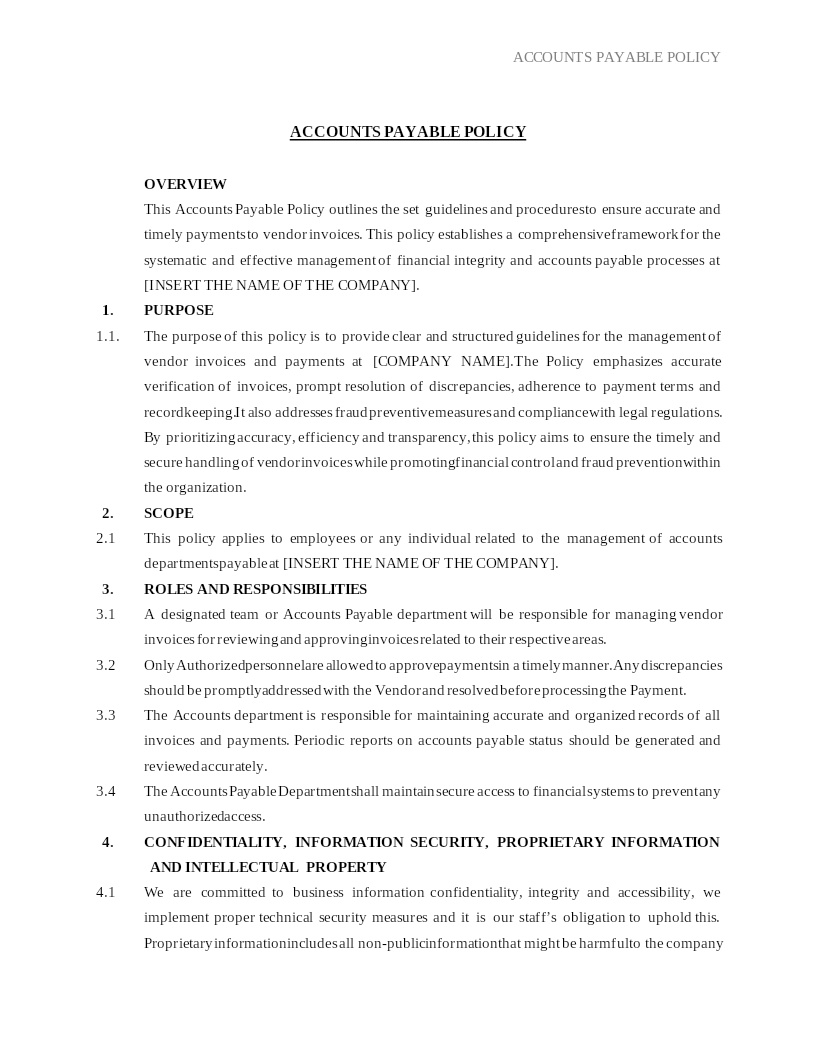
ACCOUNTS PAYABLE POLICY
How does it work?
1. Choose this template
Start by clicking on "Fill out the template"
2. Complete the document
Answer a few questions and your document is created automatically.
3. Save - Print
Your document is ready! You will receive it in Word and PDF formats. You will be able to modify it.
Understanding the Purpose and Use of an Accounts Payable (AP) Policy
When an organization handles payments to vendors, suppliers, and service providers, it becomes essential to establish a clear framework that governs how invoices are reviewed, approved, and paid. An Accounts Payable (AP) Policy provides that structure. It outlines procedures for invoice verification, documentation, internal controls, payment timelines, and dispute management while ensuring that all financial obligations are handled accurately and transparently.
Having this policy in place strengthens financial governance, minimizes risk, and promotes trust between the organization and its vendors. It helps businesses maintain organized financial processes, prevent fraud, support audit readiness, and ensure compliance with U.S. accounting and regulatory standards.
Where Accounts Payable Policies Are Commonly Used
Accounts Payable policies are widely adopted across U.S. industries, including:
- Corporations managing large volumes of vendor payments
- Retail, manufacturing, and distribution companies with recurring supplier transactions
- Government agencies and nonprofit organizations with strict financial accountability requirements
- Professional services firms and contractors requiring structured invoicing processes
- Healthcare, education, and hospitality sectors handling diverse vendor relationships
- Technology companies managing subscription, licensing, and recurring service payments
Any time a business is responsible for outgoing payments, a written policy ensures standardized financial practices and reduces operational risk.
Different Types of Accounts Payable Procedures You May Encounter
- Invoice Receipt and Validation Procedures: Ensures all invoices are accurate, legitimate, and supported by required documentation.
- Approval Workflows: Defines who can authorize payments and under what conditions, establishing internal control checkpoints.
- Payment Scheduling Systems: Outlines payment timelines, early-payment discounts, and cash flow prioritization.
- Fraud Prevention Controls: Includes segregation of duties, vendor verification, and audit trail requirements.
- Dispute Resolution Processes: Provides steps for addressing discrepancies between invoices, purchase orders, and delivered goods.
When Legal Guidance Becomes Helpful
Most Accounts Payable operations run smoothly with standard procedures, but legal counsel becomes important when:
- Multi-state or international vendor transactions require regulatory compliance.
- Vendor contracts include complex payment terms, penalties, or liability clauses.
- Industry-specific standards (e.g., healthcare, financial services, government contracting) apply.
- The company needs protection against fraud, unauthorized payments, or breach of financial controls.
- AP policies intersect with tax regulations or IRS reporting requirements.
- Disputes arise regarding payment obligations, late fees, or contract interpretation.
Legal review ensures financial procedures comply with state and federal laws while aligning with organizational risk management standards.
How to Work with This Template
- Identify required documentation for invoice approval and establish internal workflows.
- Define verification steps, payment authority limits, and approval responsibilities.
- Determine payment cycles, vendor communication processes, and dispute-handling protocols.
- Ensure compliance with governing state laws and financial regulations.
- Review the policy internally or with legal counsel (optional).
- Communicate the policy across finance, procurement, and leadership teams.
This Accounts Payable policy follows financial control standards widely recognized throughout the United States and supports integration with accounting, ERP, and auditing systems.
Frequently Asked Questions
Q1. Why is an Accounts Payable Policy important for U.S. businesses?
A structured Accounts Payable policy ensures financial accuracy, prevents unauthorized payments, and supports consistent invoice handling. It helps organizations comply with accounting laws and improves vendor trust. Clear rules also strengthen cash flow management and simplify internal operations.
Q2. How does this policy help prevent fraud?
It establishes internal controls such as segregation of duties, approval checkpoints, vendor verification, and audit trails. These procedures reduce the risk of duplicate payments, forged invoices, or unauthorized transactions. Strong oversight enhances financial security.
Q3. Does the policy help improve vendor relationships?
Yes. Timely, accurate payments reflect professionalism and build trust with suppliers. When vendors know the organization follows a consistent Accounts Payable system, disputes decrease, and long-term partnerships strengthen. This reliability also improves negotiation leverage for future contracts.
Q4. How does an Accounts Payable policy support audit readiness?
It ensures documentation such as invoices, purchase orders, receipts, approvals, and payment records are properly maintained. Consistent recordkeeping simplifies internal and external audits, minimizing compliance risks and administrative burdens. Auditors can easily track financial activity.
Q5. Can this policy reduce late fees or penalties?
Absolutely. By defining payment schedules, setting reminders, and streamlining invoice workflows, the policy helps ensure payments are made promptly. Avoiding delays prevents unnecessary penalties and improves overall financial efficiency.
Q6. Does the policy control who can authorize payments?
Yes. It clearly identifies approval authorities, spending limits, and escalation procedures. Assigning specific responsibilities prevents unauthorized payments and ensures proper oversight. This structure also supports accountability at each stage of the payment cycle.
Q7. How does the policy contribute to cash flow optimization?
It provides greater visibility into upcoming payments, allowing the finance team to manage cash reserves effectively. Prioritization of payments and strategic scheduling help the organization maintain liquidity and avoid cash shortages.
Q8. Can this policy be used for both small businesses and large organizations?
Yes. The policy is flexible and can be scaled to match the organization’s size and complexity. Small businesses benefit from basic controls and workflows, while larger organizations may integrate automated processes, approval layers, and detailed compliance requirements.