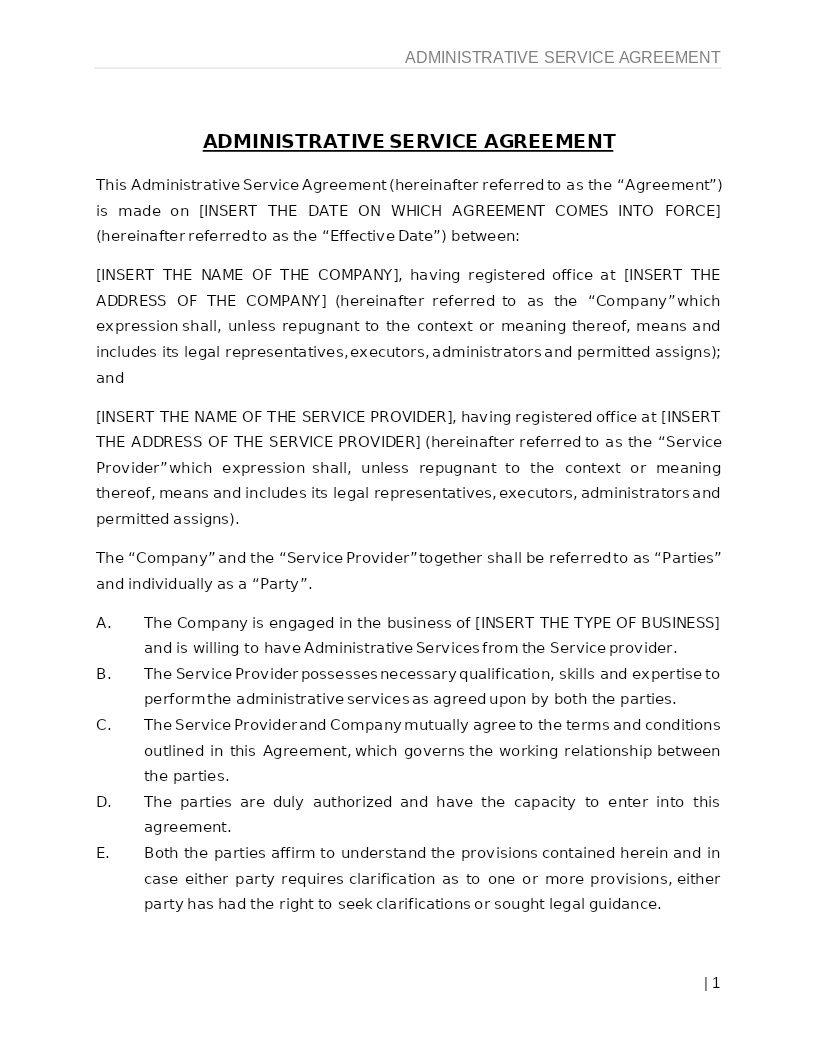
ADMINISTRATIVE SERVICE AGREEMENT
How does it work?
1. Choose this template
Start by clicking on "Fill out the template"
2. Complete the document
Answer a few questions and your document is created automatically.
3. Save - Print
Your document is ready! You will receive it in Word and PDF formats. You will be able to modify it.
Understanding Administrative Services Agreements (ASA)
When businesses outsource administrative, operational, or back-office functions, they need a clear framework that governs how such services will be delivered. An Administrative Services Agreement (ASA) provides that structure. It defines the responsibilities of each party, outlines performance expectations, and clarifies fees, timelines, and compliance requirements.
An ASA ensures that essential tasks, such as HR management, payroll, finance, IT support, or general administrative operations are handled smoothly, without confusion or unnecessary risk. It establishes trust, accountability, and transparency between the service provider and the client.
Where Administrative Services Agreements Are Commonly Used
ASAs are widely used across U.S. based commercial and organizational relationships, including:
- Corporate shared services between parent companies and subsidiaries
- Outsourcing arrangements with BPOs, HR agencies, IT support firms, and accounting providers
- Intercompany transactions within multinational corporate groups
- Startups seeking operational support for non-core functions
- Professional service firms providing administrative or operational expertise
- Healthcare and educational institutions managing sensitive administrative workflows
Any time administrative responsibilities are transferred or centralized, an ASA sets clear boundaries around performance, confidentiality, and legal compliance.
Different Types of Administrative Services Agreements
- Corporate Shared Services Agreement: Used when a parent company provides internal support, such as HR, finance, or accounting to its U.S. subsidiaries.
- Third-Party Services Agreement: Engages an external firm to deliver administrative or operational services, such as payroll processing, data management, or IT support.
- Intercompany Services Agreement: Used within corporate groups for centralized services and cost-sharing. These agreements also help maintain compliance with U.S. tax and transfer pricing rules.
When Legal Guidance Becomes Helpful
Legal review can be valuable when an ASA involves:
- Sensitive data regulated by laws such as HIPAA or the Gramm-Leach-Bliley Act
- Cross-border administrative service arrangements
- Complex service-level structures or high-value operations
- Intercompany pricing and transfer pricing compliance
- Industry-specific obligations (finance, healthcare, education, insurance, etc.)
- Situations involving confidential or proprietary information
- Multi-year service commitments with strict service-level consequences
Legal involvement isn’t always required, but it helps reduce risk when compliance or data security issues are at stake.
How to Use This ASA Template
- Identify the parties clearly, including legal names and business details
- Define the scope of administrative services (HR, IT, finance, data management, etc.)
- Establish clear service levels (SLAs), quality measures, and timelines
- Outline fees, billing cycles, and payment timelines
- Include confidentiality and data security obligations
- Specify duration, renewal terms, and termination conditions
- Add dispute resolution mechanisms such as arbitration or jurisdiction clauses
- Sign electronically or physically—both are valid under the ESIGN Act and UETA
The template is designed for U.S. businesses of all sizes and can be customized for sector-specific administrative needs.
Frequently Asked Questions
Q1. What is an Administrative Services Agreement (ASA)?
An Administrative Services Agreement (ASA) is a legally binding contract in which a service provider performs back-office, operational, or administrative functions for a client organization. It outlines responsibilities, service standards, fees, confidentiality obligations, and compliance requirements under U.S. state contract laws.
Q2. Why do U.S. businesses need an Administrative Services Agreement?
Businesses need an ASA to clearly define service responsibilities, prevent misunderstandings, ensure service quality, protect confidential information, and comply with U.S. laws. It also reduces legal risk by establishing remedies for non-performance or breach.
Q3. Are Administrative Services Agreements enforceable under U.S. law?
Yes. ASAs are enforceable under state contract laws as long as the terms are clear, lawful, and mutually agreed upon. Courts typically uphold ASAs that define obligations, performance standards, and payment terms with specificity.
Q4. Can U.S. companies outsource administrative services to foreign service providers?
Yes. U.S. businesses can outsource administrative functions internationally, but they must ensure compliance with data privacy laws, export control rules, and industry-specific regulations such as HIPAA or the Gramm-Leach-Bliley Act. Cross-border compliance and data security clauses are essential.
Q5. Are electronic signatures valid for Administrative Services Agreements in the U.S.?
Yes. Electronic signatures are legally valid under the ESIGN Act and the Uniform Electronic Transactions Act (UETA). Businesses may sign ASAs using trusted digital signature platforms without affecting enforceability.
Q6. What types of services are typically covered under an ASA?
An ASA may cover HR administration, payroll processing, accounting support, IT management, data handling, compliance support, customer service operations, and general back-office tasks. The scope can be customized based on business needs.
Q7. How long does an Administrative Services Agreement usually last?
Most ASAs have a term of 1–3 years, with options for renewal. The duration depends on the complexity of the services and how often the parties prefer to renegotiate service levels or pricing.
Q8. What remedies are available if an ASA is breached?
If one party breaches the ASA, the other party may seek damages, terminate the agreement for material non-performance, or request injunctive relief—especially for breaches involving confidential or proprietary information.
Q9. What is the difference between an Administrative Services Agreement and a Service Level Agreement (SLA)?
An ASA defines the overall relationship between the client and service provider, including roles, responsibilities, and fees.
An SLA is usually part of the ASA and focuses specifically on performance metrics, response timelines, and quality standards.
Q10. Do small businesses or startups need an Administrative Services Agreement?
Yes. Startups and small businesses often outsource HR, payroll, bookkeeping, and IT support. An ASA provides clarity, protects confidential data, and ensures accountability when relying on external administrative services.
Q11. What are common risks of not using an Administrative Services Agreement?
Without an ASA, businesses risk unclear responsibilities, data mishandling, unexpected charges, service delays, legal disputes, and potential non-compliance with privacy or employment laws.
Q12. Can an Administrative Services Agreement be terminated early?
Yes. Most ASAs include termination clauses that allow either party to end the agreement with prior notice, commonly 30 to 90 days. Immediate termination may apply in cases of material breach or security violations.