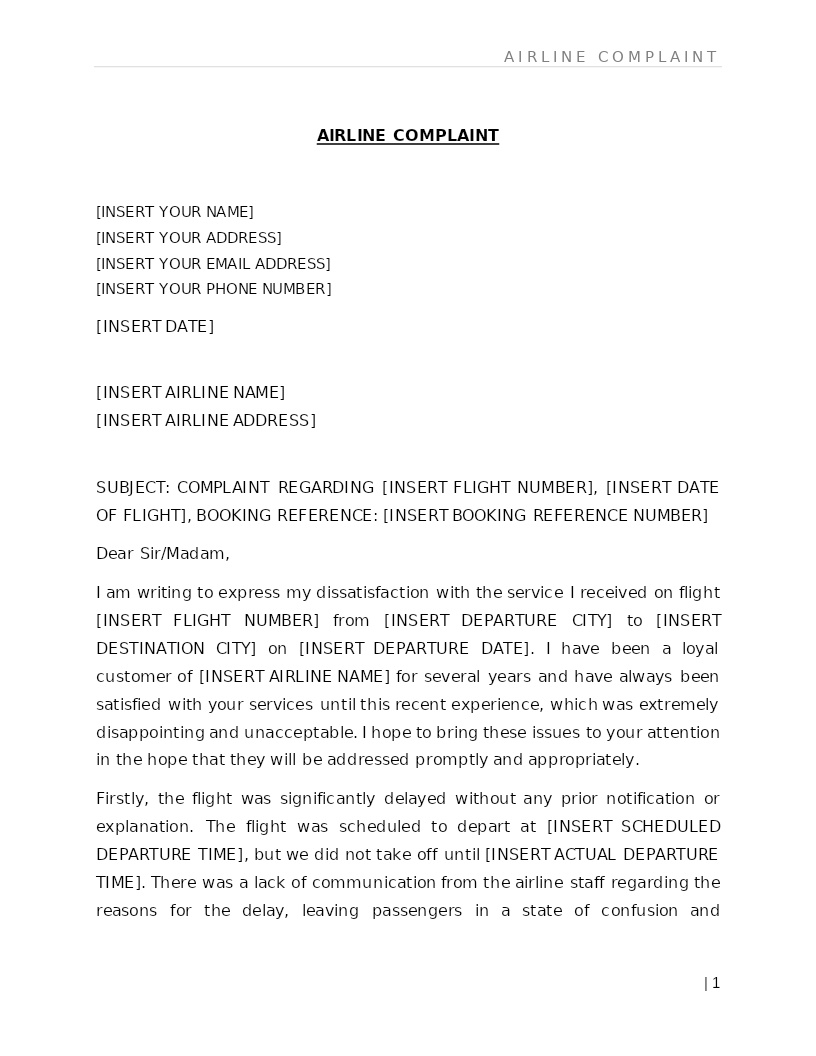
AIRLINE COMPLAINT
How does it work?
1. Choose this template
Start by clicking on "Fill out the template"
2. Complete the document
Answer a few questions and your document is created automatically.
3. Save - Print
Your document is ready! You will receive it in Word and PDF formats. You will be able to modify it.
Addressing Service Issues and Passenger Concerns in Airline Travel
Air travel comes with expectations about punctuality, safety, baggage handling, and customer service. When these expectations are not met, passengers often need a clear and organized way to raise concerns. An airline complaint provides that structure. It allows travelers to report delays, cancellations, lost baggage, service issues, or other disruptions, ensuring their concerns are documented and directed to the appropriate airline department.
Submitting a formal complaint gives passengers a voice, helps airlines identify service gaps, and creates a record that supports fair compensation and timely resolution.
Where Airline Complaints Are Commonly Used
Airline complaints are filed in a wide range of situations, including:
- Flight delays, diversions, or last-minute cancellations
- Lost, damaged, delayed, or mishandled baggage
- Poor onboard or airport customer service
- Denied boarding or overbooking issues
- Seating problems such as downgrades or allocation errors
- Refund disputes, ticketing issues, or incorrect charges
- ADA or disability-related assistance concerns
- Safety or cleanliness concerns during travel
Any time a passenger experiences service below what the airline promises, a complaint creates a clear pathway to resolution.
Different Types of Airline Complaints You May Encounter
- Service-Related Complaints: Cover rude behavior, lack of assistance, unprofessional crew responses, or unmet service expectations.
- Flight Disruption Complaints: Filed for delays, cancellations, missed connections, and compensation requests under applicable regulations.
- Baggage Complaints: Address lost, delayed, or damaged luggage, including requests for reimbursement of essential items.
- Seating or Accommodation Complaints: Involve seat changes, downgrades, paid-seat denials, or disability-related seating issues.
- Refund and Payment Complaints: Used for disputes over denied refunds, incorrect charges, duplicate bookings, or unrefunded taxes.
When Legal Guidance Becomes Helpful
Most airline complaints are routine, but legal assistance becomes valuable when:
- The airline denies compensation despite clear eligibility
- Significant financial losses occur because of delays or cancellations
- Claims involve disability accommodations or ADA compliance
- International flights fall under different rules like the Montreal Convention
- Baggage loss includes high-value items or business-critical property
- The airline is unresponsive or repeatedly rejects valid documentation
- The complaint escalates to mediation, arbitration, or small-claims court
Legal support strengthens the complaint and ensures the passenger understands their rights under federal and international aviation laws.
How to Work with This Template
- Identify the airline, flight details, and confirmation codes
- Clearly describe the issue and attach any supporting evidence
- Specify what resolution you are seeking (refund, compensation, reimbursement, apology)
- Include travel dates, receipts, and conversations with airline staff
- Submit the complaint through the airline’s official customer service portal or email
- Follow up periodically until the issue is resolved
- Maintain copies of all communications
This format aligns with the complaint procedures recognized by major U.S. airlines and the Department of Transportation (DOT).
Frequently Asked Questions
Q1. How do I file an effective airline complaint in the U.S.?
You can file a complaint directly with the airline’s customer service department through email, online forms, or app-based support channels. Include flight numbers, booking references, receipts, and a clear description of what went wrong. The more specific and factual you are, the faster your complaint can be reviewed. If the airline does not respond, you may escalate the matter to the U.S. Department of Transportation (DOT).
Q2. What issues can passengers legally complain about?
Passengers can file complaints about delays, cancellations, lost or damaged baggage, overbooking, refund denial, poor service, or accessibility failures. Airlines are required to follow federal consumer-protection rules, especially for refunds and disability accommodations. Complaints help document violations and ensure passengers are treated fairly. They also allow airlines to correct ongoing service problems.
Q3. Are airlines required to compensate passengers for delays or cancellations?
Compensation rules depend on the airline and whether the flight was domestic or international. While U.S. airlines are not required to pay cash for domestic delays, they must provide refunds if a cancellation or significant schedule change occurs. For international flights, treaties like the Montreal Convention may allow reimbursement for expenses. Filing a detailed complaint helps determine what compensation applies.
Q4. How long does it take for an airline to respond to a complaint?
Most airlines respond within 7–30 days, depending on complexity and volume. High-season travel disruptions may slow the process, but proper documentation speeds up review. If an airline fails to acknowledge your complaint, you can escalate it to DOT or request a higher-level review. Keeping copies of all communications helps support follow-up.
Q5. Can I file a complaint if my baggage is lost or delayed?
Yes. Airlines must reimburse passengers for lost or delayed luggage within limits set by federal regulations. Filing a complaint immediately at the airport and again through the airline’s system increases the chances of timely resolution. Receipts for essential items purchased during the delay help support compensation claims. Persistent follow-ups are often necessary for baggage cases.
Q6. What happens if an airline denies my complaint or refuses compensation?
If an airline rejects your claim, you can request a reconsideration with additional evidence. Passengers may also escalate disputes to DOT, arbitration, or small-claims court depending on the issue. Many denials occur due to incomplete documentation, so providing clear proof and timelines is crucial. Legal advice may help strengthen your case in more complex situations.
Q7. Is an airline complaint the same as requesting a refund?
Not exactly. A refund request is a specific action related to returning the cost of a ticket, while a complaint covers any dissatisfaction with airline service. However, refund disputes are one of the most common reasons for filing a complaint. Submitting both simultaneously ensures your concerns are officially recorded and processed.
Q8. Can I file an airline complaint for poor customer service?
Absolutely. Passengers can report rude staff behavior, lack of assistance, or unprofessional conduct. While poor service may not always lead to compensation, airlines often respond with apologies, vouchers, or corrective action. Documenting names, times, and interactions strengthens your complaint and increases the likelihood of meaningful resolution.