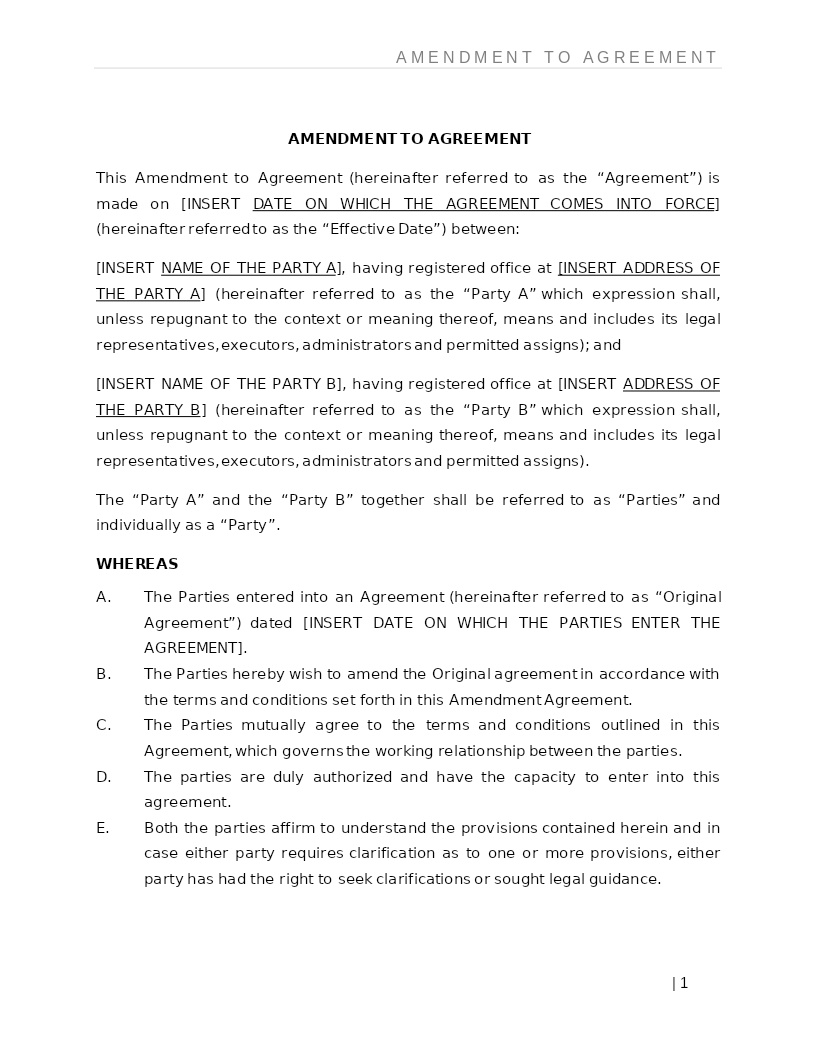
AMENDMENT TO AGREEMENT
How does it work?
1. Choose this template
Start by clicking on "Fill out the template"
2. Complete the document
Answer a few questions and your document is created automatically.
3. Save - Print
Your document is ready! You will receive it in Word and PDF formats. You will be able to modify it.
Formally Modifying Contractual Rights Through an Amendment Agreement
During a business relationship, the parties to an existing contract may find it necessary to revise certain terms due to changes in circumstances, operational requirements, or mutual business objectives. To ensure that these revisions are legally enforceable and properly documented, the parties execute a written Amendment Agreement. This document formally modifies, supplements, or replaces specific provisions of an existing contract in accordance with U.S. contract law, principles of mutual assent, consideration requirements, and applicable state and federal regulations.
An Amendment Agreement serves as a clear record of the parties’ intent to adjust the original terms without rendering the entire contract invalid. It outlines the precise modifications, identifies the sections being amended, and states whether unchanged provisions remain in full force and effect. By adopting an Amendment Agreement, both parties reduce ambiguity, strengthen enforceability, and maintain a transparent and compliant contractual framework.
Where Amendment Agreements Are Commonly Used
Amendment Agreements are frequently used across numerous business, legal, and operational contexts, including:
- Updating pricing, payment schedules, or compensation structures in service contracts
- Extending or shortening the duration of an existing agreement
- Revising deliverables, scope of work, or performance obligations
- Adding or removing parties from a contract or adjusting ownership rights
- Modifying confidentiality, intellectual property, or licensing provisions
- Revising employment or independent contractor terms
- Correcting drafting errors, clarifying misinterpretations, or addressing unforeseen circumstances
- Incorporating new regulatory or compliance requirements into a preexisting contract
Any situation requiring a change to only part of a contract rather than creating an entirely new one may warrant an Amendment Agreement.
Different Types of Amendment Agreements You May Encounter
1. Single-Term Amendment Agreements: Modify a single clause (e.g., payment date, term length, or deliverable).
2. Comprehensive or Multi-Term Amendments: Revise several sections of the original agreement simultaneously.
3. Restated Amendments: Replace entire sections with updated language while leaving the remainder unchanged.
4. Renewal or Extension Amendments: Extend the term or add renewal options without altering core provisions.
5. Regulatory or Compliance Amendments: Adjust the agreement to comply with new laws or industry standards.
When Legal Guidance Becomes Helpful
Legal consultation may be advisable when:
- The amendment significantly alters financial obligations or risk allocation
- New laws or regulatory requirements influence the agreement
- Intellectual property, confidentiality, or data protection provisions are being modified
- The amendment could impact tax status, employment classification, or compliance obligations
- One party is reluctant to agree to the revised terms or interpretation issues exist
- Multiple amendments exist and need consolidation into a coherent document
- There is uncertainty regarding whether the changes require additional consideration
Legal review helps ensure that the amendment is drafted clearly, consistent with U.S. law, and enforceable in conjunction with the original contract.
How to Work with This Template
- Identify the original agreement by title, date, and parties involved
- Specify which provisions are being amended and provide the exact replacement language
- Clarify whether any new terms, conditions, or obligations are being added
- State that all unchanged provisions remain binding and enforceable
- Confirm that the amendment does not invalidate the original agreement unless stated
- Include effective dates, execution requirements, and governing law
- Ensure signatures from all parties and authorized representatives
- Maintain the amendment alongside the original contract for future reference
This template conforms to standard U.S. contract-drafting practices and is suitable for corporate, commercial, employment, service, and intellectual property agreements.
Frequently Asked Questions
Q1. What is an Amendment Agreement, and why is it important?
An amendment agreement is a formal document used to modify specific provisions of an existing contract. It is important because it ensures that changes are legally binding, clearly documented, and enforceable without drafting an entirely new contract.
Q2. Does an Amendment Agreement replace the original contract?
No. An amendment modifies only particular terms. All other provisions of the original contract remain in force unless explicitly revised or superseded.
Q3. Do parties need to provide consideration for an amendment?
Under U.S. contract principles, consideration may be required unless the amendment falls under a category where mutual assent alone is sufficient (e.g., certain UCC-governed agreements). Legal review can determine whether consideration is necessary.
Q4. Can multiple amendments be made to the same agreement?
Yes. Parties may issue multiple amendments. However, it is often advisable to consolidate them into a restated agreement for clarity.
Q5. Are electronic signatures valid on Amendment Agreements?
Yes. Under the ESIGN Act, electronic signatures are fully enforceable, making digital execution standard practice for amendments.
Q6. What types of contract terms are most commonly amended?
Payment schedules, timelines, deliverables, confidentiality terms, licensing rights, termination provisions, and technical requirements are among the most frequently modified terms.
Q7. Can an Amendment Agreement add new obligations?
Yes. An amendment may introduce new duties, rights, or responsibilities if both parties agree to the revisions.
Q8. Is it necessary to reference the original agreement in the amendment?
Absolutely. The amendment must clearly identify the original contract by date and title to ensure enforceability.
Q9. What happens if the amendment conflicts with the original agreement?
The amendment controls. If a conflict exists, the revised language supersedes the conflicting original provision.
10. When should legal counsel review an amendment?
Whenever the amendment affects financial, legal, compliance, or operational risk or when contractual interpretation is uncertain legal counsel should review the changes before execution.