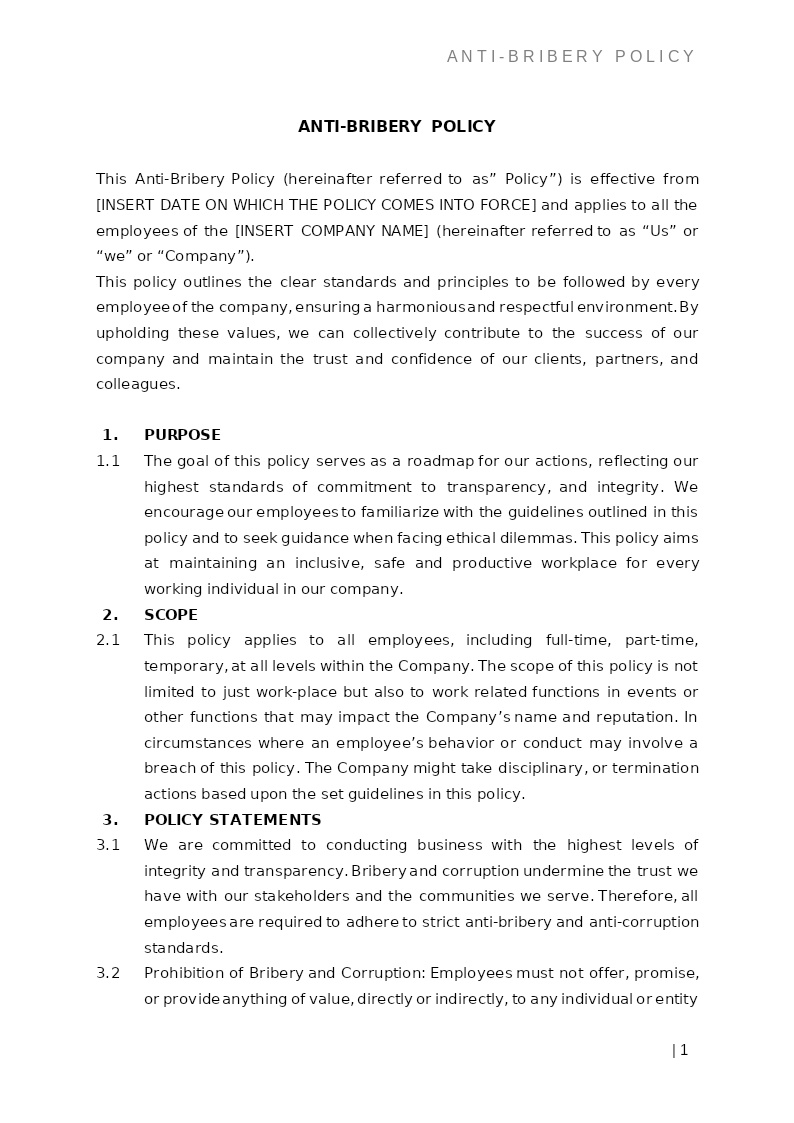
ANTI-BRIBERY POLICY
How does it work?
1. Choose this template
Start by clicking on "Fill out the template"
2. Complete the document
Answer a few questions and your document is created automatically.
3. Save - Print
Your document is ready! You will receive it in Word and PDF formats. You will be able to modify it.
Establishing Ethical Conduct and Legal Compliance Through an Anti-Bribery Policy
Organizations operating in the United States and abroad must maintain strict standards of ethical conduct to prevent bribery and improper influence in all business dealings. An Anti-Bribery Policy sets forth the organization’s commitment to comply with U.S. federal anti-bribery laws, including the Foreign Corrupt Practices Act (FCPA), 18 U.S.C. § 201, state public corruption statutes, and relevant corporate-governance regulations, as well as internationally recognized anti-corruption standards. This policy applies to employees, executives, agents, vendors, consultants, and any third parties acting on behalf of the organization.
A comprehensive Anti-Bribery Policy prohibits offering, giving, soliciting, or accepting anything of value intended to improperly influence business judgments or secure unfair advantages. It outlines acceptable conduct, details prohibited transactions, sets approval requirements for gifts and hospitality, and establishes mandatory reporting procedures for suspected misconduct. By adopting this policy, an organization ensures transparency in its operations, reduces legal and reputational risk, and reinforces a culture of accountability and lawful behavior across all activities.
Where Anti-Bribery Policies Are Commonly Used
Anti-Bribery Policies are implemented across numerous industries and organizational structures, including:
- Corporations conducting domestic and global business transactions
- Companies interacting with government officials, regulatory agencies, or public-sector entities
- Organizations employing sales agents, distributors, or intermediaries in high-risk jurisdictions
- Businesses participating in procurement, bidding, or contract-award processes
- Companies facing increased scrutiny due to international operations or cross-border payments
- Financial institutions, healthcare organizations, and technology firms under strict compliance oversight
- Employers required to maintain internal controls, ethics programs, and audit mechanisms
- Nonprofits, universities, and publicly funded organizations handling grants and public funds
Wherever risks of bribery or undue influence exist, a written Anti-Bribery Policy is essential to compliance.
Different Types of Anti-Bribery Policies
1. General Corporate Anti-Bribery Policies: Apply broadly to all employees and business activities, prohibiting direct or indirect bribery.
2. FCPA-Focused Anti-Bribery Policies: Target interactions with foreign officials and require compliance with accounting and internal control rules.
3. Gifts, Entertainment, and Hospitality Policies: Regulate permissible and prohibited gifting practices to avoid conflicts of interest.
4. Third-Party and Agent Conduct Policies: Address risks associated with consultants, intermediaries, representatives, and vendors.
5. Public-Sector Interaction Policies: Apply when employees engage with government agencies or handle public funds.
When Legal Guidance Becomes Helpful
Legal counsel may be required when:
- The organization operates internationally or interacts with foreign government officials
- Employees manage procurement, contracting, or regulatory approvals
- Third-party agents or distributors are utilized in high-risk markets
- Compliance audits reveal gaps in financial controls or reporting systems
- The policy must align with FCPA, IRS rules, SEC requirements, and internal audit standards
- Disciplinary actions, termination procedures, or whistleblower rules must be evaluated
- Potential bribery violations require internal investigations or regulatory disclosures
Legal review ensures the policy meets U.S. anti-bribery laws, international norms, and corporate compliance protocols.
How to Work with This Template
- Identify the policy's scope and specify covered individuals and business activities
- Define bribery broadly, including direct and indirect payments, gifts, or improper advantages
- Establish rules governing gifts, entertainment, sponsorships, and charitable contributions
- Create mandatory reporting procedures and whistleblower protections
- Implement due-diligence requirements for third-party agents and vendors
- Outline internal accounting controls and financial transparency obligations
- Include disciplinary actions for violations, including termination or legal consequences
- Provide training, certification requirements, and compliance audits
- Ensure the policy is approved, distributed, and acknowledged by all personnel
This template reflects widely accepted U.S. corporate compliance standards and is suitable for corporations, nonprofits, public-sector contractors, and organizations of all sizes.
Frequently Asked Questions
Q1. What is an Anti-Bribery Policy, and why is it important?
An Anti-Bribery Policy is a formal compliance document that prohibits unlawful payments, bribes, and improper influence in business activities. It is important because it helps organizations adhere to U.S. anti-bribery laws, protect their reputation, and prevent legal and financial penalties.
Q2. How does the FCPA impact Anti-Bribery Policies?
The Foreign Corrupt Practices Act prohibits bribing foreign officials and requires companies to maintain accurate books and records. Organizations with global operations must design policies that address FCPA risks and international compliance obligations.
Q3. Does the policy apply to third parties and contractors?
Yes. Companies may be held liable for corrupt acts committed by representatives, distributors, intermediaries, or vendors acting on their behalf.
Q4. Are gifts and entertainment allowed under an Anti-Bribery Policy?
Only if they are reasonable, properly recorded, and not intended to influence business decisions. Many organizations require pre-approval and strict documentation for gifts above a certain value.
Q5. Are whistleblowers protected under U.S. law?
Yes. Federal and state whistleblower laws protect employees who report suspected bribery or corruption in good faith from retaliation.
Q6. What are the consequences of violating an Anti-Bribery Policy?
Consequences may include disciplinary action, termination, civil penalties, criminal charges, and mandatory disclosures to regulatory authorities.
Q7. Do employees need to undergo training?
Yes. Regular training, certifications, and compliance monitoring help ensure ongoing understanding of anti-bribery obligations.
Q8. Should charitable donations be reviewed under the policy?
Yes. Charitable contributions may be used improperly to influence decisions and must be vetted for legitimacy.
Q9. Are electronic acknowledgments enforceable?
Yes. Under the ESIGN Act, employees may electronically acknowledge receipt and understanding of the policy.
Q10. Should legal counsel review or update the Anti-Bribery Policy periodically?
Absolutely. Laws change, risks evolve, and periodic legal review ensures the policy remains compliant, effective, and relevant.