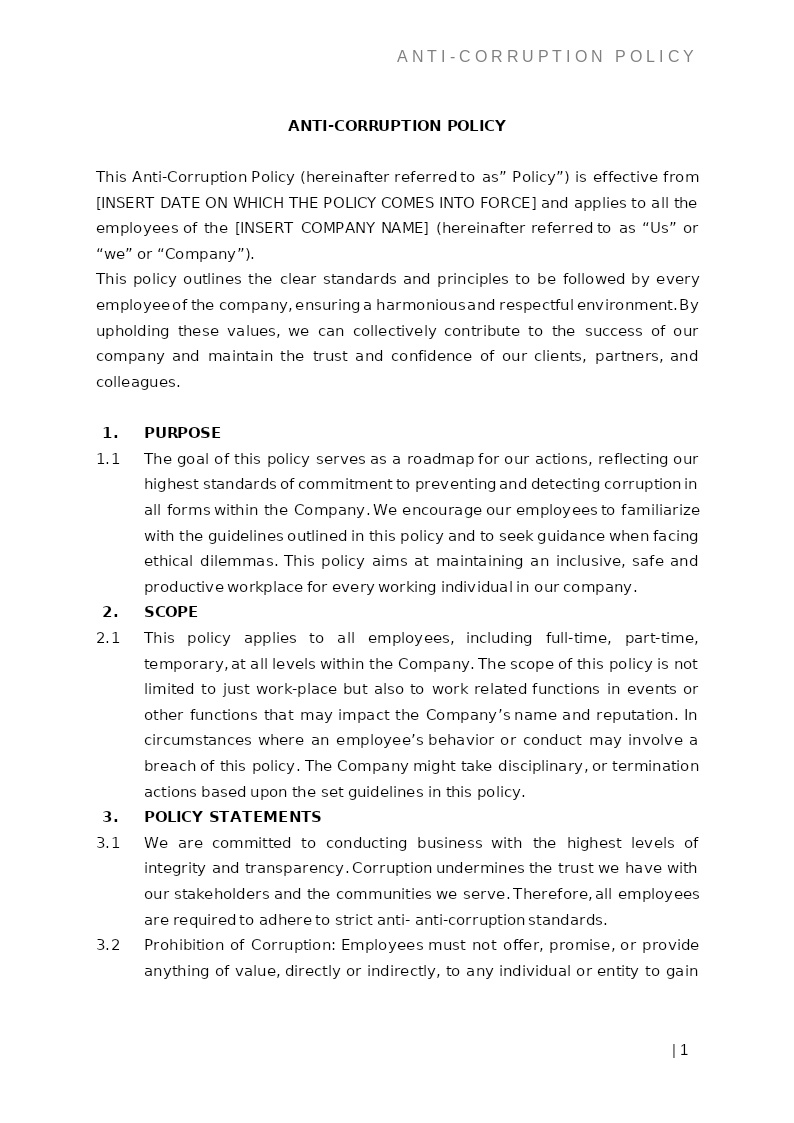
ANTI-CORRUPTION POLICY
How does it work?
1. Choose this template
Start by clicking on "Fill out the template"
2. Complete the document
Answer a few questions and your document is created automatically.
3. Save - Print
Your document is ready! You will receive it in Word and PDF formats. You will be able to modify it.
Establishing Ethical Standards Through an Anti-Corruption Policy
A robust Anti-Corruption Policy is essential for organizations seeking to prevent bribery, fraudulent practices, and improper influence across all business operations. This policy outlines the standards, responsibilities, and procedures designed to ensure compliance with U.S. anti-corruption laws, including the Foreign Corrupt Practices Act (FCPA), federal bribery statutes, state ethics rules, corporate governance requirements, and related regulatory frameworks. It applies to employees, officers, contractors, agents, and any representatives acting on behalf of the organization.
An Anti-Corruption Policy establishes a zero-tolerance approach toward offering, giving, soliciting, or accepting anything of value intended to obtain unfair business advantages. It defines prohibited conduct, sets clear reporting channels, and mandates appropriate due-diligence procedures in dealings with third parties, vendors, public officials, and international stakeholders. By adopting this policy, an organization demonstrates its commitment to ethical business conduct, reduces legal risk, and protects its reputation from regulatory penalties and compliance violations.
Where Anti-Corruption Policies Are Commonly Used
Anti-Corruption Policies are widely utilized across industries and organizational structures, including:
- Corporations engaging in domestic or international business transactions
- Government contractors subject to strict ethics and procurement rules
- Technology, finance, and healthcare companies operating under regulatory oversight
- Organizations interacting with foreign officials, embassies, or global partners
- Companies employing third-party agents, distributors, or consultants
- Businesses conducting mergers, acquisitions, or cross-border negotiations
- Industries where gifts, entertainment, and promotional activities are customary
- Nonprofits, universities, and public institutions subject to strict compliance standards
Whenever an organization faces interactions that may pose corruption or conflict-of-interest risks, a written anti-corruption policy provides necessary safeguards.
Different Types of Anti-Corruption Policies
1. General Corporate Anti-Bribery Policies: Prohibit bribery in all business activities and interactions.
2. FCPA-Focused Anti-Corruption Policies: Address foreign bribery risks, books-and-records compliance, and dealings with foreign officials.
3. Gift, Hospitality, and Entertainment Policies: Regulate the offering or acceptance of meals, travel, events, or items of value.
4. Third-Party Due-Diligence Policies: Focus on vetting agents, distributors, and vendors who represent the organization.
5. Conflict of Interest and Ethical Conduct Policies: Address internal conflicts, kickbacks, nepotism, and improper influence.
When Legal Guidance Becomes Helpful
Legal counsel may be necessary when:
The organization conducts business in high-risk countries or regulated industries
- Employees or agents interact with foreign officials or government entities
- There are concerns about third-party corruption or inadequate record keeping
- The company experiences or suspects bribery, kickbacks, or fraudulent practices
- The policy must comply with U.S. federal rules and international frameworks (e.g., OECD)
- The organization seeks to integrate whistleblower protections or reporting mechanisms
- Internal investigations or compliance audits reveal exposure to potential violations
- Disciplinary procedures, sanctions, or termination clauses require legal review
Legal review ensures the Anti-Corruption Policy complies with U.S. law, international standards, and industry-specific regulations and mitigates legal liability.
How to Work with This Template
- Define the scope of the policy, applicable individuals, and organizational units
- Identify prohibited conduct, including bribery, improper benefits, kickbacks, and facilitation payments
- Establish procedures for gifts, travel, entertainment, and sponsorships
- Outline reporting requirements, internal investigations, and whistleblower protections
- Implement third-party due-diligence standards and contract clauses
- Specify training requirements, annual certifications, and compliance monitoring
- Include disciplinary measures for violations, including termination or legal action
- Assign responsibility to compliance officers or designated administrators
- Execute and communicate the policy in accordance with organizational governance standards
This template reflects widely accepted U.S. corporate-compliance practices and may be used by private companies, nonprofits, public institutions, and multinational organizations.
Frequently Asked Questions
Q1. What is an Anti-Corruption Policy, and why is it important?
An Anti-Corruption Policy is a written compliance framework that prohibits bribery, fraud, and unethical conduct. It is important because it helps organizations comply with U.S. federal and state laws, avoid civil and criminal penalties, and maintain trust with stakeholders.
Q2. Does U.S. law prohibit corruption involving foreign officials?
Yes. The FCPA strictly prohibits giving anything of value to foreign officials to obtain improper business advantages. Violations can result in substantial fines and criminal liability.
Q3. Does this policy apply to third-party vendors and agents?
Yes. Under U.S. law, organizations may be held liable for corrupt acts committed by agents, distributors, consultants, or contractors. Proper due diligence is essential.
Q4. Are gifts and entertainment always prohibited?
Not always. Many policies allow modest, reasonable, and properly documented gifts or hospitality, but prohibit anything that could influence business decisions or violate local or federal regulations.
Q5. Are employees protected when reporting suspected corruption?
Yes. U.S. whistleblower laws protect employees who report suspected violations in good faith. Policies typically include anonymous reporting channels and anti-retaliation protections.
Q6. Does an Anti-Corruption Policy require employee training?
Yes. Effective compliance programs include periodic training, certifications, and audit procedures to ensure ongoing adherence.
Q7. Can violations lead to termination?
Absolutely. Corruption violations often result in severe disciplinary action, including termination, legal proceedings, or referral to enforcement agencies.
Q8. Are electronic acknowledgments valid for policy distribution?
Yes. Under the ESIGN Act, electronic acknowledgments and signatures are legally enforceable for policy adoption and employee certification.
Q9. Can a company be liable for corrupt acts committed by foreign subsidiaries?
Yes. Under the FCPA’s “books and records” and “internal controls” provisions, parent companies may be responsible for improper activities by affiliates.
Q10. Should legal counsel review the Anti-Corruption Policy?
Yes. Because anti-corruption laws involve complex federal and international regulations, legal counsel ensures the policy is compliant, enforceable, and tailored to organizational risk levels.