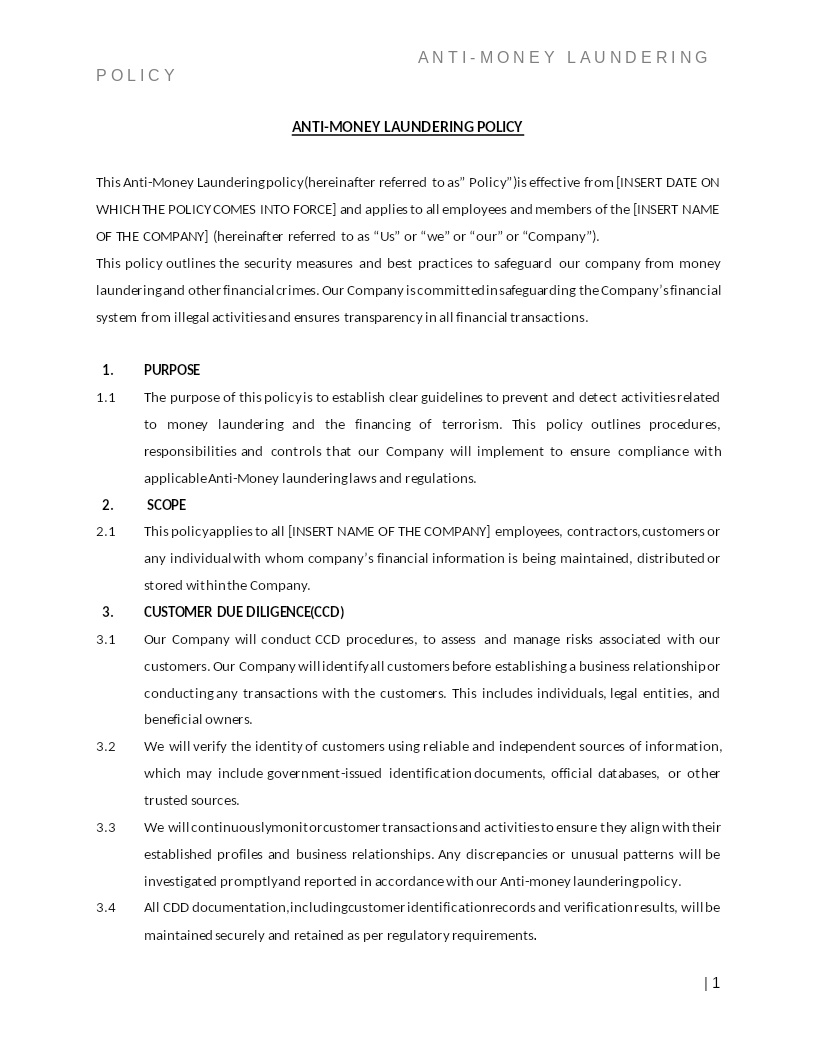
ANTI-MONEY LAUNDERING POLICY
How does it work?
1. Choose this template
Start by clicking on "Fill out the template"
2. Complete the document
Answer a few questions and your document is created automatically.
3. Save - Print
Your document is ready! You will receive it in Word and PDF formats. You will be able to modify it.
Understanding the Purpose of an AML Policy
When businesses handle financial transactions or customer funds, it is critical to establish strong safeguards that prevent illegal activity, including money laundering and terrorist financing. An Anti-Money Laundering (AML) Policy provides this structure. It sets out the procedures a company follows to detect suspicious activity, verify customer identities, and report questionable transactions to the appropriate regulatory authorities.
Putting an AML Policy in place strengthens trust, supports ethical business practices, and ensures the company operates within U.S. legal and regulatory standards. It gives employees clear instructions on how to identify red flags, escalate concerns, and maintain secure financial operations.
Where AML Policies Are Commonly Used
AML Policies are essential in a wide range of industries and financial environments, including:
- Banks, credit unions, and other financial institutions
- Fintech companies, virtual asset providers, and payment processors
- Real estate firms, law practices, and accounting firms handling client funds
- Insurance companies, investment firms, and securities dealers
- Money service businesses (MSBs) and remittance providers
- High-value dealers, brokers, and any entity processing financial transactions
Any business that deals with customer funds, payments, or financial transfers is expected to implement AML controls under U.S. regulations.
Different Types of AML Policies You May Encounter
- Standard AML Compliance Policy: Covers customer due diligence (CDD), transaction monitoring, reporting obligations, and employee responsibilities.
- Risk-Based AML Policy: Used when financial activity varies by customer type, geographical risk, or transaction patterns, requiring tailored monitoring procedures.
- Enhanced Due Diligence (EDD) Policy: Applies to high-risk clients or situations where additional verification, documentation, or monitoring is required.
- AML Policy for Digital and Fintech Companies: Focuses on virtual transactions, online identity verification, and automated suspicious activity screening tools.
- AML Policy for Non-Financial Sectors: Used by industries such as real estate, legal services, and luxury goods where regulatory obligations also apply.
When Legal Guidance Becomes Helpful
While many AML requirements follow standard regulatory rules, professional legal guidance becomes valuable when:
- Your business falls under specific U.S. regulatory frameworks such as FinCEN, OFAC, SEC, or state-level banking laws
- You onboard high-risk customers or handle large or unusual financial transactions
- Digital identity verification or automated monitoring tools raise privacy considerations
- Your operations involve multiple jurisdictions or cross-border financial transfers
- You need clarity on Suspicious Activity Reports (SARs), record-keeping requirements, or reporting thresholds
- You work in a regulated industry where penalties for non-compliance are severe
Legal review minimizes risk by ensuring your AML Policy aligns with U.S. anti-money laundering laws, reporting standards, and industry-specific obligations.
How to Work with This Template
- Identify the types of customers, transactions, or services your business handles
- Establish verification procedures such as CDD, KYC checks, and risk assessments
- Clarify the process for identifying and reporting suspicious activity
- Assign responsibilities to compliance officers or designated AML personnel
- Outline internal training requirements for staff
- Review the policy with legal counsel or compliance advisors
- Implement ongoing monitoring and update the policy as regulations evolve
This template follows widely recognized U.S. AML compliance standards and can be adapted for businesses of any size or industry.
Frequently Asked Questions
Q1. What is an AML Policy and why is it important?
An AML Policy outlines the procedures used to prevent money laundering and terrorist financing within an organization. It ensures compliance with U.S. financial laws and helps businesses detect and report suspicious transactions. By implementing a clear AML framework, companies reduce their exposure to fraud and regulatory violations. This protects the business and reinforces ethical financial practices.
Q2. Who is required to follow an AML Policy in the U.S.?
Businesses operating in or connected to financial activities, such as banks, money service businesses, fintech companies, investment firms, and real estate brokers, must follow AML rules. Many non-financial entities also fall under FinCEN guidance. Employees involved in customer verification, financial transfers, or account management are obligated to comply. Strict adherence ensures regulatory protection and reduces internal risk.
Q3. What procedures are included in an AML Policy?
Typical AML procedures include Customer Due Diligence (CDD), identity verification, transaction monitoring, risk assessments, and maintaining accurate financial records. The policy also details how to identify red flags and report suspicious activity. These safeguards ensure transparency and accountability. Strong procedures help prevent misuse of the business for illegal transactions.
Q4. How does an AML Policy protect a business from penalties?
AML regulations impose heavy fines and legal consequences for non-compliance. A strong AML Policy ensures the business meets all reporting obligations and follows mandated due diligence processes. This minimizes the risk of regulatory violations. It also demonstrates proactive compliance, which can reduce penalties in the event of an investigation.
Q5. Does an AML Policy require employee training?
Yes. Employees must be trained to recognize red flags, understand reporting obligations, and apply AML procedures correctly. Training ensures staff can identify suspicious behaviors early and act in compliance with the law. Well-informed employees strengthen the organization’s defense against financial crime. Ongoing training reinforces consistent compliance.
Q6. How often should an AML Policy be updated?
AML Policies should be reviewed annually and whenever regulatory changes occur. Financial crime methods evolve, and businesses must adjust their procedures accordingly. Updating the policy ensures your company stays compliant with U.S. AML laws and industry practices. Regular reviews help maintain strong internal controls.
Q7. What is the role of a compliance officer in an AML Policy?
A compliance officer oversees AML procedures, monitors transactions, conducts risk assessments, and ensures policies are followed. They coordinate employee training and maintain regulatory reports. Their role is essential for identifying vulnerabilities and strengthening controls. Proper oversight protects the business from fraudulent activity and legal risks.
Q8. How does an AML Policy benefit customers and clients?
Customers benefit from secure and transparent financial operations. An AML Policy protects them from fraud, identity theft, and illegal misuse of their information. It builds trust by ensuring ethical business practices. Compliance also reassures clients that the company maintains strong security and regulatory standards.