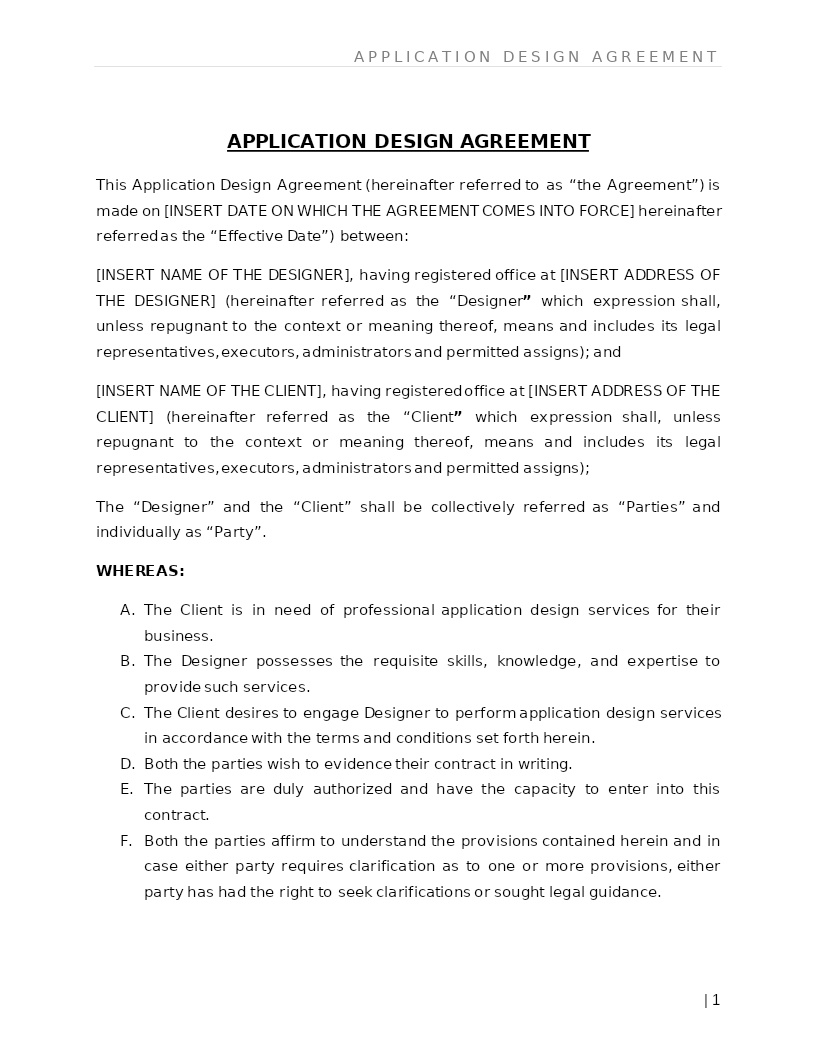
APPLICATION DESIGN AGREEMENT
How does it work?
1. Choose this template
Start by clicking on "Fill out the template"
2. Complete the document
Answer a few questions and your document is created automatically.
3. Save - Print
Your document is ready! You will receive it in Word and PDF formats. You will be able to modify it.
Understanding Application Design Agreements
An Application Design Agreement is a legally binding contract between a client and a designer or design firm that outlines the terms under which mobile app, web app, or software design services will be provided. This agreement defines the scope of design work, wireframes, UX/UI deliverables, timelines, revisions, intellectual property rights, confidentiality terms, and payment schedule, ensuring that both parties understand the creative and technical expectations.
In the United States, Application Design Agreements operate under state contract law, federal intellectual property rules, data protection standards, and industry-specific compliance requirements. This agreement provides clarity and legal protection for clients and designers by clearly documenting project milestones, ownership rights, and performance obligations.
Where Application Design Agreements Are Commonly Used
Application Design Agreements are widely used across digital and technology industries, including:
- Mobile app development for iOS and Android
- Web application design (SaaS, dashboards, platforms)
- Startup product design and MVP development
- UX/UI redesigns and product modernization
- E-commerce applications and digital marketplaces
- Fintech, healthtech, and corporate enterprise apps
- Branding and product design agencies providing app interface services
Any time a business hires a designer to create a digital product interface, an Application Design Agreement ensures clear expectations and legal protection.
Different Types of Application Design Services You May Encounter
- User Interface (UI) Design; Focuses on app aesthetics, visuals, typography, color schemes, and branding.
- User Experience (UX) Design: Covers wireframes, user flows, prototypes, and usability planning.
- Full Application Design Packages: Includes research, UX design, UI design, prototyping, and developer-ready handoff.
- Responsive Web & Mobile Design: Ensures the application works smoothly across devices.
- App Redesign & Optimization: Updates existing apps to improve usability, accessibility, and performance.
When Legal Guidance Becomes Helpful
Legal assistance is valuable when:
- The agreement involves intellectual property ownership or licensing of design assets
- Payment structures include milestones, royalties, or equity
- Sensitive data or user information is shared during the project
- The app must comply with industry regulations (HIPAA, PCI-DSS, ADA)
- Design work is part of a larger software development contract
- Confidentiality and non-disclosure terms are needed
- Multiple stakeholders or subcontractors contribute to the design
A legally reviewed agreement helps protect creative rights, prevent miscommunication, and ensure compliance with U.S. business laws.
How to Work with This Template
- Identify the client and design service provider
- Outline project scope, deliverables, and design specifications
- Define timelines, milestones, and revision allowances
- Establish payment terms—hourly, flat fee, or milestone-based
- Include ownership rights, licensing details, and IP transfer clauses
- Add confidentiality, non-disclosure, and data privacy requirements
- Choose governing U.S. state law
- Include termination rights, dispute resolution, and change-order procedures
- Sign electronically or physically following applicable contract rules
This template follows standard U.S. design industry practices and is compatible with major e-signature platforms.
Frequently Asked Questions
Q1. What is an Application Design Agreement and why is it important?
An Application Design Agreement outlines the expectations, deliverables, and responsibilities between a client and a designer. It is important because it prevents misunderstandings, protects intellectual property, and ensures that the final product aligns with the client’s vision.
Q2. What should be included in an Application Design Agreement?
A solid agreement includes scope of work, UX/UI deliverables, timelines, revisions, payment terms, IP ownership, confidentiality, and acceptance criteria. These details help ensure smooth collaboration and protect both parties.
Q3. Who owns the designs created under the agreement?
Ownership depends on the contract. Most clients require full ownership of the final design files, while designers retain rights to their pre-existing tools or portfolios. Clear IP transfer clauses help avoid disputes.
Q4. Does this agreement cover app development as well?
Not necessarily. Application design focuses on UX/UI creation, while app development involves coding and engineering. Many clients sign separate development contracts or expand the agreement to include development services.
Q5. How are revisions handled in an Application Design Agreement?
Revisions are typically limited to a set number based on the scope. Additional revisions or redesigns may incur extra charges. Clear revision rules help control project timelines.
Q6. Can an Application Design Agreement include confidentiality requirements?
Yes. Many projects involve sensitive data or proprietary concepts. Confidentiality and NDA clauses protect business information, trade secrets, and pre-launch product details.
Q7. Are electronic signatures valid for Application Design Agreements?
Yes. Under the U.S. ESIGN Act, electronic signatures are legally valid. Designers and clients commonly use digital signature platforms for convenience.
Q8. Can the agreement be terminated early?
Yes. Most agreements include termination rights for non-payment, breach of contract, or mutual consent. The contract should also specify refund policies and ownership of work completed before termination.
Q9. What if the app requires compliance with U.S. regulations like HIPAA or ADA?
If the app handles medical data, financial information, or accessibility requirements, the agreement should include compliance obligations. Designers may need to follow accessibility guidelines or work with developers on regulatory standards.
Q10. Is an Application Design Agreement suitable for startups and small businesses?
Absolutely. Startups and small businesses benefit from clear design contracts to protect their product vision, timeline, and intellectual property while working within a defined budget.