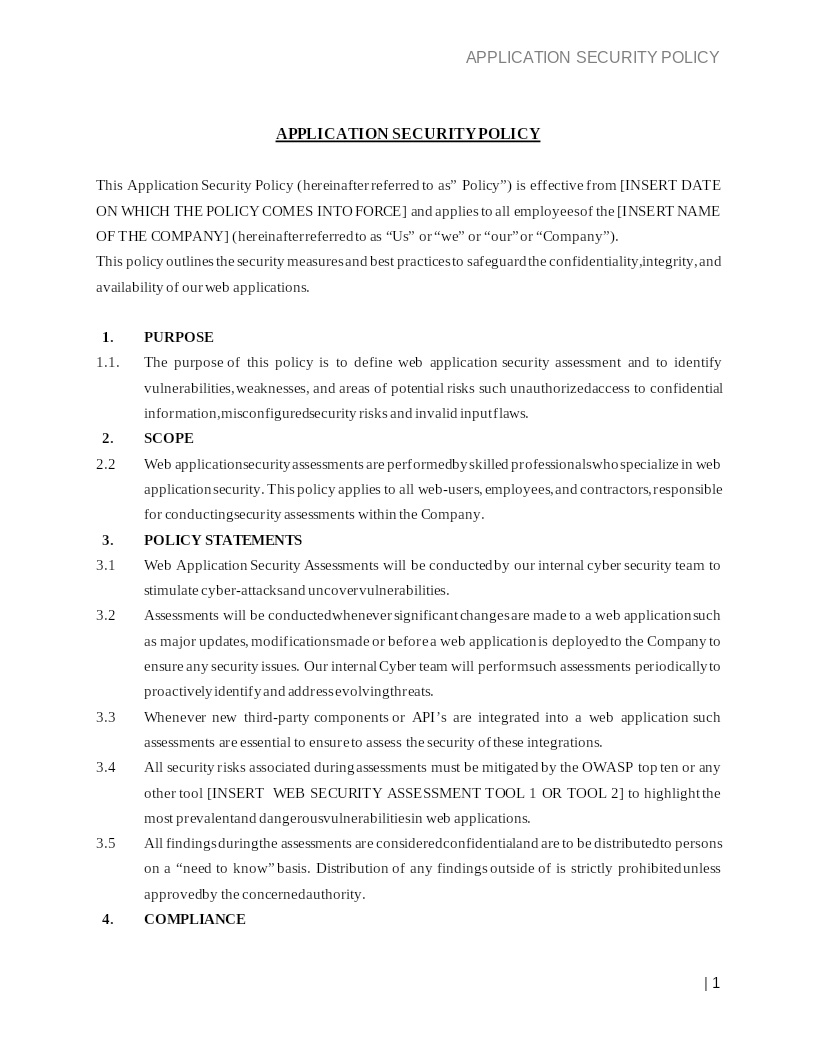
APPLICATION SECURITY POLICY
How does it work?
1. Choose this template
Start by clicking on "Fill out the template"
2. Complete the document
Answer a few questions and your document is created automatically.
3. Save - Print
Your document is ready! You will receive it in Word and PDF formats. You will be able to modify it.
Understanding Application Security Policy in U.S.
An Application Security Policy defines the standards, controls, and best practices required to safeguard software applications throughout their lifecycle. It ensures that security measures are integrated from initial design to development, testing, release, and ongoing maintenance. The policy aims to protect sensitive data, prevent unauthorized access, mitigate vulnerabilities, and ensure the reliability and integrity of both internal and externally facing applications.
By setting clear security expectations aligned with U.S. data protection laws and industry regulations, this policy strengthens organizational resilience, reduces cyber risks, and supports secure and compliant software operations across the enterprise.
Where Application Security Policies Are Commonly Used
Application Security Policies are essential across industries where software development, digital platforms, or data-driven systems are core to business operations. They are widely adopted in:
• Technology, SaaS, and cloud-service companies
• Financial institutions governed by GLBA, SEC, and PCI-DSS requirements
• Healthcare organizations requiring HIPAA compliance
• Government agencies with strict cybersecurity mandates
• E-commerce, retail, and customer-data–intensive platforms
• Manufacturing, logistics, and IoT-driven environments
• Any organization using custom-built or third-party applications
Any business relying on software applications benefits significantly from structured security guidelines.
Different Types of Application Security Controls You May Encounter
- Secure Coding and Development Standards: Define how developers write code safely, avoid common vulnerabilities, and follow recognized frameworks such as OWASP Top 10, NIST, or ISO standards.
- Access Control and Authentication Measures: Ensure applications include strong identity verification, least-privilege access, and secure authentication protocols.
- Vulnerability Management and Patch Procedures: Require regular code reviews, penetration testing, vulnerability scanning, and timely patching to eliminate risks.
- Data Protection and Encryption Rules: Safeguard sensitive information through encryption, secure storage, tokenization, and compliance with U.S. privacy laws.
- Incident Response and Monitoring Protocols: Establish procedures for detecting threats, responding to incidents, and logging security activity.
When Legal Guidance Becomes Helpful
Legal review is essential when drafting an Application Security Policy because:
• U.S. regulations, such as HIPAA, GLBA, SOX, FERPA, CCPA/CPRA, and state cybersecurity laws, impose strict data handling requirements.
• Security obligations must be aligned with contractual requirements, especially in SaaS and B2B software environments.
• Lawyers ensure IP protections, licensing issues, data ownership, and liability boundaries are clearly defined.
• Multi-state organizations must comply with varying breach-notification and data-security statutes.
• Counsel helps ensure that application monitoring, logging, and access controls comply with employee-privacy laws.
Legal expertise ensures the policy is enforceable, compliant, and tailored to the organization's technology landscape.
How to Work With This Policy Template
• Identify all applications covered by the policy, internal, external, cloud-based, or third-party.
• Define secure development requirements, testing procedures, and code-review practices.
• Establish access control rules, authentication methods, and data-protection measures.
• Align application security standards with U.S. laws, cybersecurity frameworks, and industry regulations.
• Implement continuous monitoring, patch management, and incident-response protocols.
• Train development, IT, and security teams to follow established best practices.
• Review and update the policy regularly to address new threats, technologies, or regulatory changes.
Frequently Asked Questions
Q1. Why is an Application Security Policy important for organizations?
An Application Security Policy helps protect software from vulnerabilities, data breaches, and unauthorized access. It ensures consistent security standards across development teams and applications. This strengthens system reliability, reduces cyber risks, and ensures user data remains safe.
Q2. Does this policy help organizations comply with U.S. regulations?
Yes. It supports compliance with laws such as HIPAA, GLBA, SOX, CCPA/CPRA, and state cybersecurity statutes. By defining secure application practices and data-handling requirements, organizations reduce the risk of violations, penalties, or data breaches.
Q3. What areas does an Application Security Policy typically cover?
It addresses secure coding, access control, authentication, vulnerability scanning, patching, encryption, incident response, and testing requirements. These guidelines ensure applications are developed, deployed, and maintained with strong security principles in place.
Q4. How does this policy help prevent security breaches?
By identifying vulnerabilities early, enforcing secure coding standards, and requiring continuous monitoring, the policy reduces the likelihood of hacks, malware attacks, and data breaches. It also ensures rapid response procedures are in place if incidents occur.
5. Does the policy apply only to developers?
No. Application security involves developers, IT teams, quality-assurance teams, cybersecurity specialists, and even end users. The policy outlines each group’s responsibilities to ensure comprehensive protection throughout the application lifecycle.
Q6. How does this policy improve application reliability?
Secure applications experience fewer outages, failures, or disruptions caused by security flaws. The policy defines testing, patching, and performance standards that help ensure applications run smoothly and maintain high levels of uptime and user trust.
Q7. What happens if an application doesn’t meet the required security standards?
Applications may be halted, restricted from deployment, or required to undergo additional testing and remediation. The policy ensures that no software is released without meeting the organization’s security criteria to prevent long-term vulnerabilities.
Q8. Is an Application Security Policy beneficial for small businesses as well?
Absolutely. Small businesses face growing cybersecurity threats and often lack extensive IT resources. A structured Application Security Policy helps them safeguard systems, comply with legal requirements, and build customer trust while maintaining operational continuity.