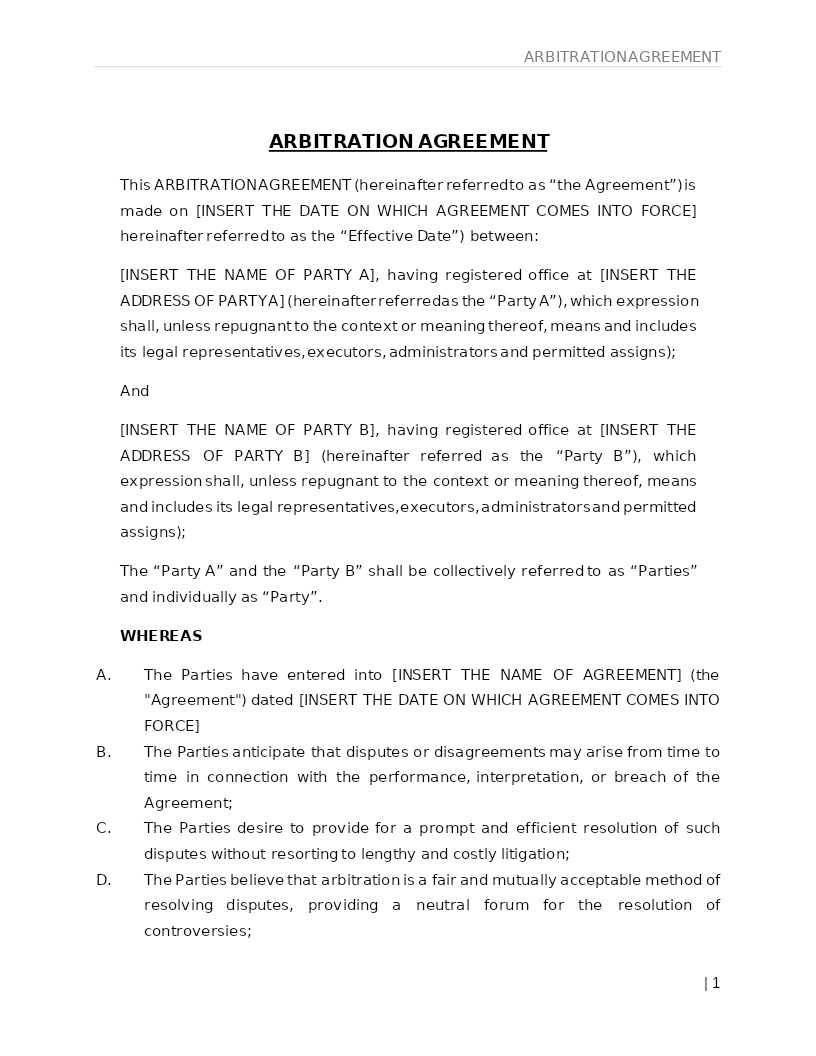
ARBITRATION AGREEMENT
How does it work?
1. Choose this template
Start by clicking on "Fill out the template"
2. Complete the document
Answer a few questions and your document is created automatically.
3. Save - Print
Your document is ready! You will receive it in Word and PDF formats. You will be able to modify it.
Understanding Arbitration Agreements
An Arbitration Agreement is a legally binding contract in which two or more parties agree to resolve disputes through arbitration instead of litigation in court. Arbitration is a private, streamlined dispute-resolution process where a neutral arbitrator or a panel of arbitrators, reviews evidence and makes a final, binding decision.
In the United States, Arbitration Agreements are governed by the Federal Arbitration Act (FAA), state arbitration laws, and industry-specific regulations. These agreements are commonly included in commercial contracts, employment relationships, consumer transactions, partnerships, and business dealings. By establishing arbitration as the preferred method of dispute resolution, parties reduce legal uncertainty, avoid lengthy court procedures, and maintain confidentiality.
Where Arbitration Agreements Are Commonly Used
Arbitration Agreements are widely used across multiple industries and contract types, including:
- Employment agreements and HR policies
- Business partnerships and joint ventures
- Commercial contracts and vendor relationships
- Consumer transactions and service agreements
- Technology, licensing, and SaaS contracts
- Real estate and construction agreements
- Healthcare, finance, and regulated industry contracts
Whenever parties want a faster, more cost-effective, and private alternative to court litigation, an Arbitration Agreement sets clear expectations and procedures.
Different Types of Arbitration You May Encounter
- Binding Arbitration: The arbitrator’s decision is final and enforceable in court, with very limited grounds for appeal.
- Non-Binding Arbitration: The arbitrator issues a recommendation, but parties may choose litigation if they do not accept the outcome.
- Mandatory Arbitration: Parties agree that arbitration is required before any legal action can be taken.
- Voluntary Arbitration: Parties mutually decide to enter arbitration after a dispute arises.
- Institutional Arbitration: Administered by organizations such as the American Arbitration Association (AAA) or JAMS, using their established rules.
- Ad-Hoc Arbitration: Conducted independently without an administrative organization; parties define their own rules and procedures.
When Legal Guidance Becomes Helpful
Arbitration Agreements affect how disputes will be handled for years, so legal review is crucial when:
- The agreement will govern complex commercial relationships
- Parties want clarity on arbitrator selection, hearing procedures, or appeal limitations
- The contract involves international parties, intellectual property, or cross-border issues
- State-specific arbitration laws or consumer protection regulations may apply
- Arbitration involves industry-specific rules (e.g., FINRA, construction, healthcare)
- The agreement includes class action waivers or confidentiality requirements
- The stakes of a potential dispute are high
Legal guidance ensures the agreement complies with the FAA, protects both parties, and holds up in court if enforcement becomes necessary.
How to Work with This Template
- Identify the parties entering the arbitration agreement
- Specify whether arbitration is binding or non-binding
- Choose the arbitration forum (AAA, JAMS, ad-hoc, etc.)
- Define how arbitrators are selected and what rules will apply
- Include procedures for notice, hearings, discovery, and evidence
- Add confidentiality requirements for dispute proceedings
- Select governing state law and FAA applicability
- Outline limitations on court actions, appeals, and class actions
- Sign electronically or in hard copy
This template is compatible with major U.S. e-signature platforms and follows commonly accepted standards used in domestic and commercial arbitration agreements.
Frequently Asked Questions
Q1. What is an Arbitration Agreement and why is it used?
An Arbitration Agreement is a contract where parties agree to resolve disputes through arbitration instead of going to court. It is used because arbitration is usually faster, more private, and less expensive than litigation. It also gives parties more control over the process, including selecting their arbitrator.
Q2. Are Arbitration Agreements enforceable in the U.S.?
Yes. Under the Federal Arbitration Act (FAA), courts generally enforce Arbitration Agreements, provided they are clear, fair, and signed voluntarily. Most commercial, employment, and consumer arbitration clauses are upheld across U.S. state and federal courts.
Q3. Does arbitration cost less than going to court?
In many cases, yes. Arbitration avoids lengthy court procedures and reduces legal fees. However, parties may still pay arbitrator fees or administrative costs. For businesses, arbitration often results in faster and less costly dispute resolution compared to traditional litigation.
Q4. Is arbitration confidential?
Yes. One of the main advantages of arbitration is privacy. Unlike court cases—which are usually public—arbitration hearings, filings, and awards can remain confidential if the agreement requires it. This is especially beneficial for sensitive business disputes.
Q5. Can an Arbitration Agreement prevent class action lawsuits?
Many U.S. Arbitration Agreements include class action waivers, which require individuals to pursue claims individually instead of joining a class lawsuit. Courts often enforce these waivers, especially in consumer and employment contracts, as long as the terms are clear and fair.
Q6. Who chooses the arbitrator?
Parties may choose the arbitrator themselves or rely on an organization like AAA or JAMS to appoint one. The agreement typically outlines how arbitrators are selected, their qualifications, and how conflicts of interest are handled.
Q7. Can arbitration decisions be appealed?
Arbitration awards are generally final and binding, with very limited grounds for court review. Appeals are only allowed in rare cases, such as fraud, arbitrator misconduct, or violation of public policy. This finality is one reason arbitration is faster and more predictable.
Q8. Is arbitration mandatory once included in a contract?
If the Arbitration Agreement is binding and clearly written, parties are typically required to resolve disputes through arbitration before pursuing litigation. Courts often compel arbitration when the agreement is valid and enforceable.
Q9. Are electronic signatures valid for Arbitration Agreements?
Yes. Under the U.S. ESIGN Act and state laws, electronic signatures are legally enforceable. Businesses and individuals commonly sign Arbitration Agreements through e-signature platforms like Docu Sign.
Q10. Can small businesses use Arbitration Agreements?
Absolutely. Arbitration Agreements are widely used by small and medium-sized businesses to protect against costly litigation. They provide a clear, predictable process for resolving disputes and help companies control legal risks.