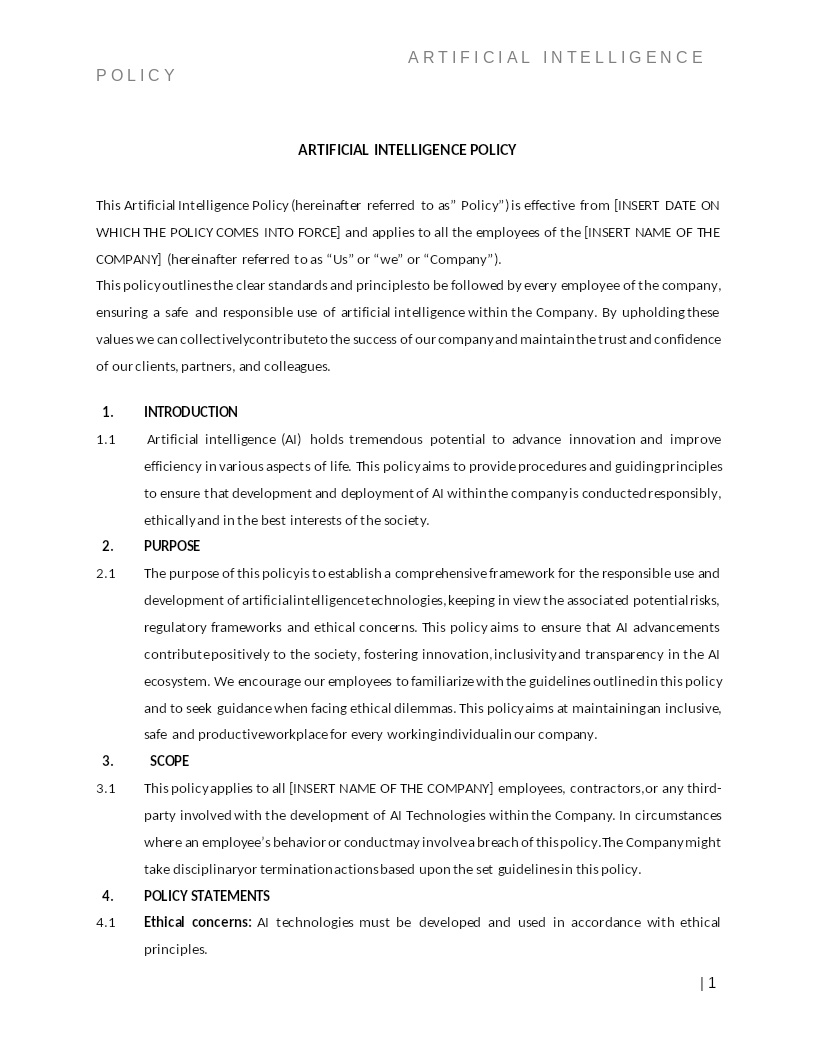
ARTIFICIAL INTELLIGENCE POLICY
How does it work?
1. Choose this template
Start by clicking on "Fill out the template"
2. Complete the document
Answer a few questions and your document is created automatically.
3. Save - Print
Your document is ready! You will receive it in Word and PDF formats. You will be able to modify it.
Managing Responsible Use of Artificial Intelligence in the Workplace
As organizations increasingly integrate Artificial Intelligence (AI) into daily operations, it becomes essential to establish a clear framework that governs how AI tools, systems, and data-driven technologies may be used. An Artificial Intelligence (AI) Policy provides this structure. It defines acceptable use, outlines ethical and compliance requirements, and clarifies responsibilities for employees, contractors, and technology partners.
Implementing an AI Policy promotes trust, transparency, and accountability. It ensures that employees understand expectations, protects the organization from risks, and establishes standards for fairness, data privacy, system accuracy, and legal compliance when interacting with AI-powered tools.
Where AI Policies Are Commonly Used
AI Policies are now standard in organizations across multiple industries, including:
• Businesses using AI for automation, analytics, or customer service
• Companies deploying machine learning models or predictive algorithms
• HR teams using AI for hiring, evaluations, or workforce analytics
• Marketing teams using AI-driven content creation and targeting
• IT departments managing AI applications, cybersecurity, and integrations
• Healthcare, finance, and education organizations handling sensitive data
• Startups building AI products or integrating third-party AI tools
Any time AI influences decision-making, processes, or data usage, an AI Policy sets the expectations for safe and compliant operation.
Different Types of AI Policies You May Encounter
- General AI Use Policy: Establishes workplace guidelines for all employees using AI tools.
- AI Ethics Policy: Focuses on fairness, bias prevention, transparency, and human oversight.
- Data Protection & AI Privacy Policy: Governs how AI manages personal, sensitive, or regulated data.
- AI System Development Policy: Sets standards for internal teams creating or training AI models.
- Vendor & Third-Party AI Policy: Regulates the use of external AI tools, platforms, or APIs.
When Legal Guidance Becomes Helpful
Professional legal assistance is recommended when:
• AI tools process personal, consumer, or regulated data
• The organization operates in highly regulated industries (finance, healthcare)
• Automated decision systems could impact rights, opportunities, or access
• AI models are trained using proprietary, licensed, or copyrighted materials
• State or federal AI regulations (e.g., FTC guidance, state AI laws) apply
• The company uses biometric data, automated hiring tools, or predictive algorithms
• AI may introduce cybersecurity, discrimination, or compliance risks
How to Work with This Template
• Identify who is covered (employees, contractors, vendors)
• Define approved and prohibited uses of AI tools
• Establish data privacy and information security standards
• Explain human oversight, accountability, and reporting expectations
• Specify compliance with U.S. federal and state regulations
• Outline AI model accuracy, transparency, and documentation requirements
• Add procedures for reviewing, updating, or approving new AI tools
• Sign or acknowledge electronically following company policy
Frequently Asked Questions
Q1. Why does my organization need an AI Policy?
An AI Policy ensures that AI tools are used safely, ethically, and legally. It protects the business from risks such as data misuse, discrimination, compliance violations, inaccurate outputs, and unauthorized AI deployments.
Q2. Does this policy apply to both internal and third-party AI tools?
Yes. Whether your team uses in-house AI models, cloud-based platforms, or third-party tools like chatbots or automation software, the policy sets consistent rules for responsible and compliant use.
Q3. How does an AI Policy address data privacy concerns?
The policy outlines strict data-handling practices, including limits on processing personal data, protection of sensitive information, compliance with privacy laws, and ensuring AI tools do not improperly store, share, or train on confidential data.
Q4. Does the AI Policy prevent bias or unfair decisions?
Yes. It requires teams to monitor AI systems for accuracy, fairness, and non-discriminatory outcomes. Regular audits, human oversight, and clear documentation help ensure systems operate ethically.
Q5. What responsibilities do employees have under this policy?
Employees must use only approved AI tools, avoid sharing confidential or personal data with unauthorized systems, comply with all guidelines, and immediately report errors, misuse, or potential risks.
Q6. Are employees allowed to use public AI tools (like ChatGPT or image generators)?
Only when authorized. The policy clarifies how external AI platforms may be used, what data can be shared, and which activities require internal review or approval.
Q7. How does the policy address intellectual property concerns?
The policy prevents employees from inputting proprietary information into AI tools without permission and ensures outputs generated using AI do not infringe on third-party copyrights or violate licensing terms.
Q8. Does the policy require human oversight of AI-generated decisions?
Yes. Human review is essential for high-impact decisions especially those affecting customers, employees, or business operations. The policy mandates clear accountability for all AI-assisted outcomes.
Q9. Can the policy support compliance with new U.S. AI laws and regulations?
Absolutely. As federal and state AI regulations evolve, the policy includes a flexible framework that can be updated to meet emerging legal standards and government guidelines.
Q10. How often should an AI Policy be updated?
AI technologies change rapidly. Most organizations review and update their AI Policy annually or sooner if the company adopts new tools, laws change, or new risks are identified.