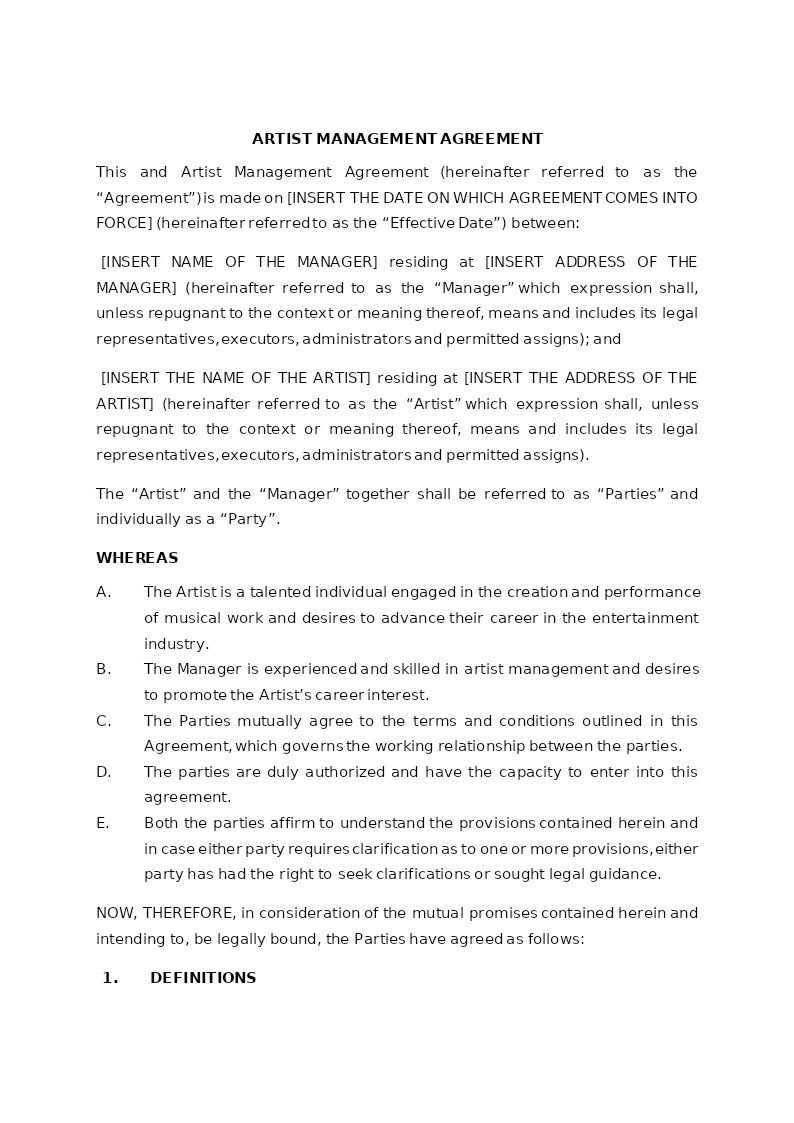
ARTIST MANAGEMENT AGREEMENT
How does it work?
1. Choose this template
Start by clicking on "Fill out the template"
2. Complete the document
Answer a few questions and your document is created automatically.
3. Save - Print
Your document is ready! You will receive it in Word and PDF formats. You will be able to modify it.
Understanding Artist Management Agreements
When an artist partners with a manager to oversee their professional career, creative direction, and business opportunities, it’s important to have a clear framework that defines roles, expectations, and financial arrangements. An Artist Management Agreement establishes that structure. It outlines how the manager will represent the artist, what services they will provide, and how compensation typically in the form of commissions will be handled.
Putting an Artist Management Agreement in place ensures transparency, protects both parties, and creates a foundation for long-term career growth. It helps avoid misunderstandings around responsibilities, revenue sharing, and decision-making authority, allowing the artist to focus on creative work while the manager handles business development.
Where Artist Management Agreements Are Commonly Used
Artist management contracts are standard in many creative industries, including:
- Music artists, bands, producers, and composers
- Actors, models, and performing artists
- Visual artists, photographers, designers, and digital creators
- Influencers, public personalities, and content creators
- Writers, authors, and multimedia creatives
- Live entertainers, comedians, and performers
Any time an artist appoints someone to guide their career, negotiate deals, or manage opportunities, an Artist Management Agreement provides the clarity needed for a successful partnership.
Different Types of Artist Management Agreements You May Encounter
- Exclusive Management Agreement: The manager is the sole representative for the artist’s professional activities.
- Non-Exclusive Management Agreement: The artist may engage additional managers or representatives for specific regions or projects.
- Project-Based Agreement: Used for a specific tour, album cycle, performance project, or collaboration.
- Business Management Add-Ons: Includes financial oversight, budgeting, tax coordination, and administrative support in addition to talent representation.
When Legal Guidance Becomes Helpful
Legal review is especially helpful when:
• Compensation structures involve royalties, touring revenue, or profit participation
• The artist has existing contracts or multiple representatives
• The agreement affects intellectual property, branding, or merchandising
• Exclusive or long-term commitments are involved
• The manager will negotiate contracts on behalf of the artist
• The relationship spans multiple states or countries
• The career impact is significant or involves substantial financial risk
How to Work with This Template
• Identify the artist and manager
• Define the scope of managerial duties
• Clarify compensation, commissions, and revenue categories
• Specify term length, renewal options, and termination rights
• Address intellectual property, branding, and promotional rights
• Select the governing U.S. state law
• Review the terms together
• Sign electronically or physically as preferred
Frequently Asked Questions
Q1. What is an Artist Management Agreement and why is it necessary?
It is a contract outlining how a manager will guide and develop an artist’s career. It is necessary because it establishes clear expectations, prevents conflicts about responsibilities and payments, and ensures both parties understand their rights and obligations.
Q2. How are managers typically paid under this agreement?
Managers are usually paid a percentage of the artist’s earnings commonly between 10% and 20% - depending on industry norms and negotiation. The agreement specifies which income streams are commissionable (music sales, bookings, brand deals, etc.) and which are excluded.
Q3. Is the agreement exclusive or can the artist hire multiple managers?
Most Artist Management Agreements are exclusive, meaning one manager oversees all professional activities. Non-exclusive arrangements are possible but must be clearly stated to avoid conflicts of interest or overlapping representation.
Q4. How long does an Artist Management Agreement usually last?
Terms commonly range from one to five years, with renewal or extension options. Shorter trial periods are sometimes used for new artist-manager relationships to ensure compatibility.
Q5. Can the manager make binding decisions for the artist?
Only if the agreement authorizes it. Some contracts allow managers to negotiate or sign deals, while others require the artist’s direct approval. Clear authority prevents misunderstandings and protects the artist’s interests.
Q6. Are creative rights or intellectual property included in management agreements?
Typically, managers do not own the artist’s creative works. However, the agreement may grant permission to use the artist’s name, image, or content for promotion, branding, and business development.
Q7. What happens if either party wants to end the relationship early?
The agreement includes termination procedures, notice periods, and post-termination commission rights. Managers are often entitled to commissions for deals they initiated even after the contract ends.
Q8. Are Artist Management Agreements enforceable across the U.S.?
Yes. These agreements are enforceable under state contract laws and must comply with talent agency regulations where applicable. Selecting a governing state law helps ensure clarity.
Q9. Should an artist hire a lawyer before signing?
It is highly recommended. Since management agreements impact the artist’s long-term career and income, legal review helps ensure the terms are fair, balanced, and aligned with industry standards.
Q10. Can this agreement be used for influencers or digital creators?
Absolutely. The same structure works for influencers, YouTubers, streamers, and social media personalities. The contract can be adapted for sponsorships, platform monetization, brand deals, and content partnerships.