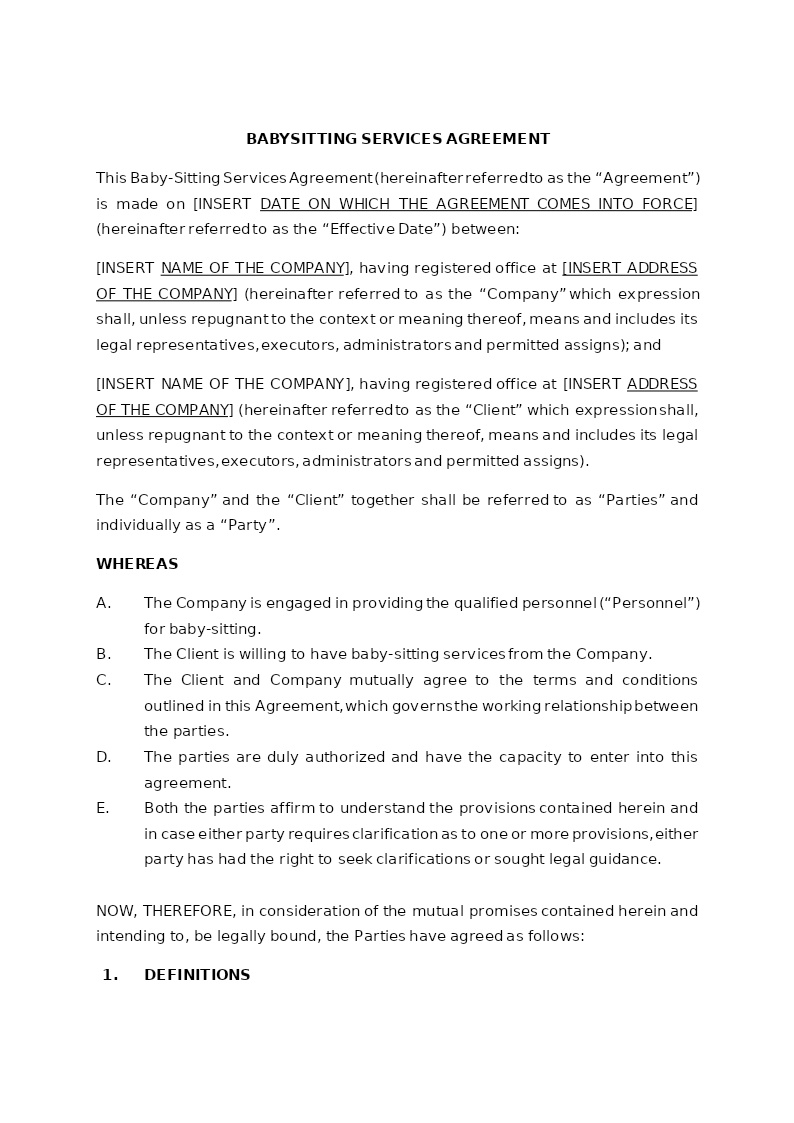
BABYSITTING SERVICES AGREEMENT
How does it work?
1. Choose this template
Start by clicking on "Fill out the template"
2. Complete the document
Answer a few questions and your document is created automatically.
3. Save - Print
Your document is ready! You will receive it in Word and PDF formats. You will be able to modify it.
Establishing Childcare Responsibilities Through a Babysitting Service Agreement
A Babysitting Service Agreement is a formal contract that defines the terms under which a babysitter provides temporary childcare services to a parent or guardian. This agreement protects both parties by outlining expectations related to safety, supervision, compensation, scheduling, and behavioral standards. It is drafted in accordance with U.S. contract law, childcare-safety regulations, emergency-response guidelines, and applicable state and local rules governing minor supervision.
By using a Babysitting Service Agreement, parents secure clarity regarding the duties the babysitter must perform, such as monitoring the child, administering basic care, enforcing household rules, handling emergencies, and maintaining confidentiality. The agreement also protects the babysitter by specifying payment terms, work hours, house rules, and liability limitations. This written contract ensures that both parties have a shared understanding of obligations, reducing misunderstandings and encouraging a safe and structured caregiving environment.
Where Babysitting Service Agreements Are Commonly Used
Babysitting Service Agreements are widely utilized in diverse environments where temporary childcare is needed, including:
- Parents seeking reliable childcare for evenings, weekends, and irregular schedules
- Families requiring routine after-school or weekend supervision
- Babysitters or nannies offering independent, part-time, or freelance childcare services
- Childcare agencies placing caregivers in residential homes
- Situations where minors require supervision due to parental work commitments
- Events such as weddings, conferences, or gatherings where childcare is provided on-site
- Parents employing babysitters for overnight or extended-hour care
- Households requiring structured agreements to ensure consistency and safety
Whenever a parent entrusts a child to a non-household caregiver, a Babysitting Service Agreement provides clarity, transparency, and legal protection.
Different Types of Babysitting Service Agreements You May Encounter
1. Standard Babysitting Agreements: Cover short-term or occasional care, typically for a few hours at a time.
2. Recurring Babysitting Agreements: Apply to regular weekly or monthly scheduling arrangements.
3. Overnight or Extended-Care Agreements: Address overnight stays, multi-day supervision, and related sleeping arrangements.
4. Agency-Provided Babysitting Agreements: Used when a childcare agency assigns certified caregivers to families.
5. Special-Needs Babysitting Agreements: Include accommodations and instructions for children requiring additional care or attention.
When Legal Guidance Becomes Helpful
Legal assistance may be warranted when:
- The babysitter provides specialized care, such as medical support or special-needs supervision
- State childcare regulations impose licensing or training requirements
- The parents request background checks, CPR certifications, or additional safety measures
- There are concerns regarding liability, emergency response, or accidental injury
- The arrangement involves overnight care, transportation, or the use of the family vehicle
- Payment terms need to comply with wage-and-hour rules for domestic workers
- Confidentiality, privacy, or nondisclosure provisions must be included
- Disputes arise concerning cancellation fees, schedule changes, or performance expectations
Legal review ensures compliance with U.S. childcare safety standards, local regulations, and contractual obligations.
How to Work with This Template
- Identify the parent/guardian, babysitter, children to be supervised, and the service address
- Specify the hours of care, scheduling expectations, and procedures for cancellations
- Outline caregiving duties, household rules, meal preparation, bedtime routines, and acceptable discipline
- Address safety standards, emergency contacts, and authorization to seek medical care
- Define compensation, payment schedule, overtime rates, and reimbursement for expenses
- Include confidentiality obligations, privacy expectations, and media-use restrictions
- Describe liability limitations, insurance requirements, and parental responsibilities
- Detail termination terms, dispute-resolution procedures, and governing state law
- Execute the agreement with written or electronic signatures under U.S. e-signature laws
This template reflects widely accepted U.S. childcare and household-employment practices and may be used by parents, babysitters, agencies, and household managers.
Frequently Asked Questions
Q1. What is a Babysitting Service Agreement, and why is it important?
A Babysitting Service Agreement is a written contract that outlines the terms for providing childcare on a temporary or scheduled basis. It is important because it defines responsibilities, ensures safety expectations, and protects both parties from misunderstandings or liability issues.
Q2. Do babysitters need certifications to sign such agreements?
Certifications are not always required by law, but many parents prefer babysitters with CPR, first aid, or childcare-training credentials, especially when caring for infants or special-needs children.
Q3. Are babysitters considered employees or independent contractors?
It depends. Some babysitters are independent contractors, while recurring or long-term babysitters may qualify as household employees under U.S. labor regulations. The agreement may specify the classification.
Q4. Can parents authorize babysitters to seek medical care in emergencies?
Yes. Agreements often include emergency-authorization clauses enabling babysitters to secure medical treatment if the child is at risk.
Q5. Are electronic signatures valid for Babysitting Service Agreements?
Yes. Under the ESIGN Act and UETA, electronically signed agreements are legally enforceable.
Q6. What safety rules should the agreement include?
Safety rules often address household hazards, authorized activities, supervision requirements, visitor restrictions, and emergency procedures.
Q7. Can babysitters transport children?
Only if expressly authorized in the agreement. Transportation requires compliance with car-seat laws, insurance rules, and parental consent.
Q8. Should babysitters have insurance?
While not always required, some babysitters carry liability insurance or coverage through childcare agencies for added protection.
Q9. What happens if the babysitter cancels at the last minute?
The agreement may include cancellation policies, late-notice fees, or rescheduling guidelines to ensure reliability.
Q10. Should parents seek legal review before using the agreement?
Yes, especially when the arrangement involves extended care, special-needs supervision, or employment-related obligations. Legal review ensures compliance with state childcare and labor laws.