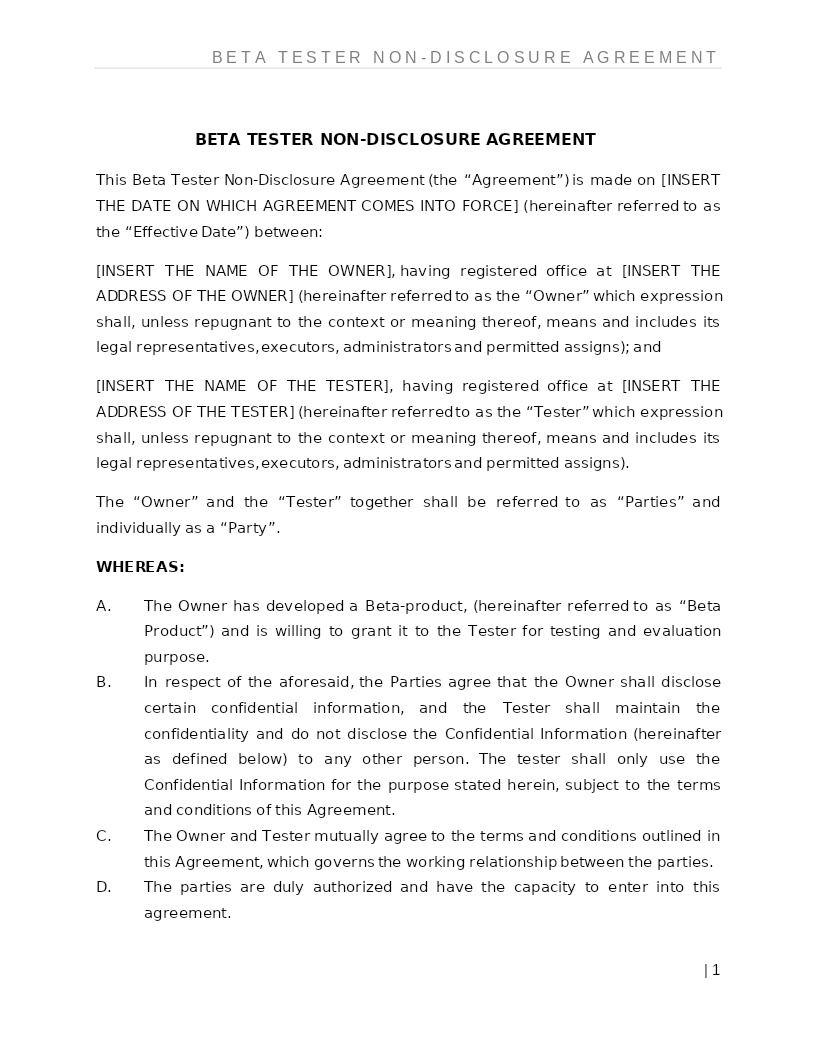
BETA TESTER NDA
How does it work?
1. Choose this template
Start by clicking on "Fill out the template"
2. Complete the document
Answer a few questions and your document is created automatically.
3. Save - Print
Your document is ready! You will receive it in Word and PDF formats. You will be able to modify it.
Understanding the Beta Tester NDA
When a company releases a pre-launch version of its product, whether software, hardware, mobile apps, or experimental technology, it must protect its confidential features and proprietary data. A Beta Tester NDA (Non-Disclosure Agreement) provides that structure. It legally binds testers to keep all product details, test results, bugs, and unreleased features confidential during and after the beta program.
Putting a Beta Tester NDA in place ensures product secrecy, prevents leaks, and protects the company’s intellectual property while allowing testers to provide meaningful feedback without jeopardizing the launch.
Where Beta Tester NDAs Are Commonly Used
Beta Tester NDAs are widely used in industries where innovation, early testing, and proprietary technology play a central role, including:
- Software development companies and SaaS platforms
- Mobile app creators conducting closed or open beta trials
- Tech companies testing hardware, devices, or IoT products
- Gaming studios offering early access to unreleased titles
- AI, machine learning, and data-driven product testing
- Startups developing prototypes or MVPs (minimum viable products)
Whenever unreleased products are shared with external testers, a Beta Tester NDA provides legal protection for sensitive information.
Different Types of Beta Tester NDAs You May Encounter
- Unilateral Beta Tester NDA: Used when only the company shares confidential information with the beta tester.
- Mutual Beta Tester NDA: Both parties share sensitive information (e.g., co-development, integration testing).
- Product-Specific NDA: Narrowly tailored for a single beta test, version, or prototype.
- Hardware/Device Testing NDA: Covers physical devices, firmware, and reverse-engineering restrictions.
- Software/App Beta NDA: Addresses access to pre-release builds, code, algorithms, and UX details.
When Legal Guidance Becomes Helpful
Legal oversight becomes essential when:
- The beta product includes proprietary technology, unpublished algorithms, or trade secrets
- Testers have access to internal data, user information, or confidential metrics
- The product involves sensitive sectors like fintech, medtech, cybersecurity, or AI
- Cross-border beta programs implicate multiple jurisdictions
- Reverse engineering, duplication, or unauthorized sharing risks are high
- The agreement must cover product usage limits, device return, or destruction of materials
- Liability, bug reporting, and IP ownership need clear definition
Legal review ensures enforceability, compliance, and comprehensive protection of pre-release products.
How to Work with This Template
- Identify the company and the beta tester clearly
- Describe the product, access level, and purpose of the beta program
- Define what constitutes confidential information
- Clarify restrictions on disclosure, copying, screenshots, or reverse engineering
- Set the duration of confidentiality and return/deletion requirements
- Choose governing U.S. state law
- Review collaboratively, legal review optional but strongly recommended
- Sign electronically or in hard copy, e-signatures are enforceable across the United States
This template follows standard testing and confidentiality practices recognized across the U.S. technology industry.
Frequently Asked Questions
Q1. Why do companies require beta testers to sign an NDA?
Companies use Beta Tester NDAs to protect unreleased product features, proprietary technology, and confidential test results. Signing an NDA prevents testers from leaking screenshots, code, or sensitive information during early testing. This safeguards the company’s competitive advantage and ensures a controlled and secure product launch. It also builds trust when sharing pre-release assets.
Q2. Does a Beta Tester NDA prevent testers from discussing bugs or performance issues publicly?
Yes. A Beta Tester NDA restricts testers from sharing any product insights, positive or negative, outside the authorized testing channels. Bug reports and feedback must be submitted privately to the company. This prevents misinformation, protects the brand’s reputation, and ensures that only verified data is used to improve the product before launch.
Q3. Can a Beta Tester NDA restrict reverse engineering or copying of the product?
Absolutely. These agreements typically prohibit decompiling, analyzing, copying, or attempting to recreate the underlying technology. Such restrictions ensure that testers cannot misuse the product for competitive gain or expose trade secrets. This protects both the intellectual property and the integrity of the innovation being tested.
Q4. What happens if a beta tester violates the NDA?
If a tester breaches the NDA, by leaking features, sharing screenshots, or exposing test data, the company may seek injunctive relief, damages, or termination of access. NDAs also require immediate deletion or return of confidential material. These remedies provide strong legal protection and discourage unauthorized disclosures.
Q5. Are Beta Tester NDAs enforceable if the tester lives in a different state?
Yes. The agreement becomes enforceable across states as long as it contains a governing law clause, typically naming the company’s home state. This ensures consistent application of confidentiality rules, even in remote testing environments. Cross-state enforcement is common in tech and SaaS testing programs.
Q6. Do Beta Tester NDAs cover screenshots, recordings, and social media posts?
Most Beta Tester NDAs explicitly ban screenshots, screen recordings, livestreams, reviews, or social media content related to the unreleased product. This prevents premature exposure and protects sensitive design elements. Clear language ensures testers understand exactly what cannot be shared publicly.
Q7. Can the NDA include ownership rights for feedback provided by testers?
Yes. Many Beta Tester NDAs include clauses stating that all feedback, suggestions, and bug reports become the company’s intellectual property. This allows the business to use tester insights for product improvement without additional permissions or compensation. It ensures a smooth and legally secure development process.
Q8. Is a Beta Tester NDA required for open or public beta testing?
For completely public betas, companies may not use NDAs, but for closed, invite-only, or pre-launch programs, NDAs are strongly recommended. Even in expanded beta programs, companies may include limited confidentiality terms to protect sensitive data. The need depends on how early and how sensitive the test version is.