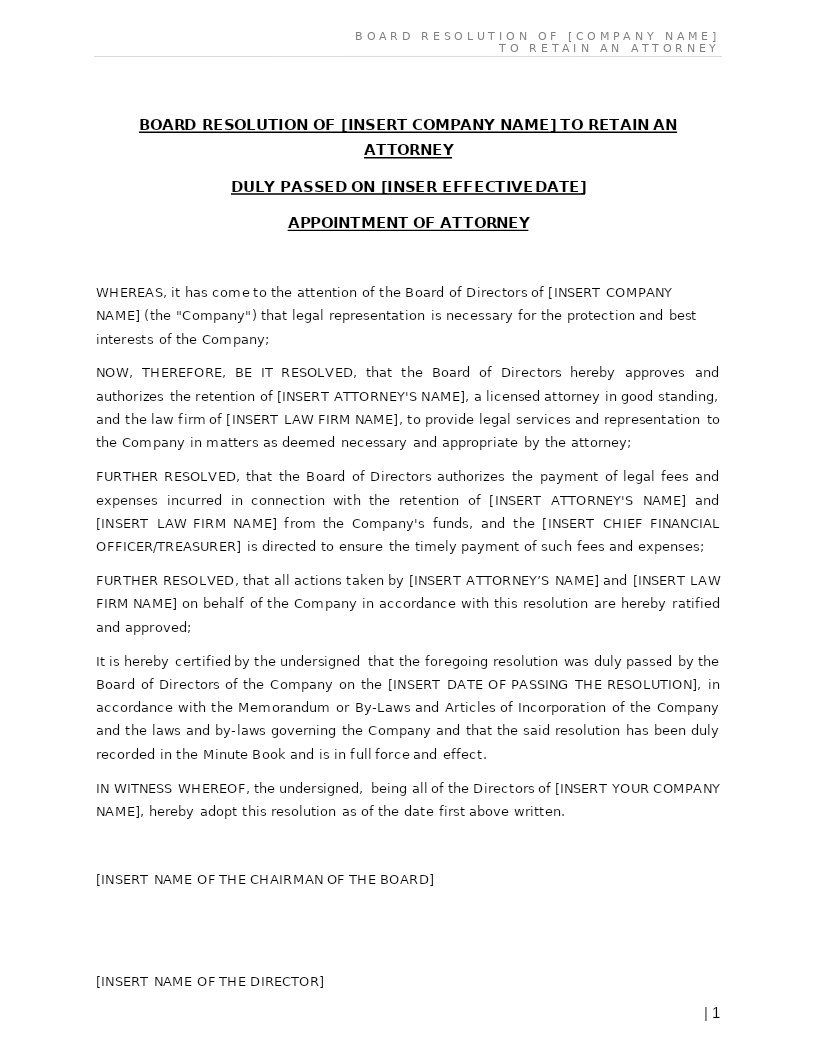
BOARD RESOLUTION OF TO RETAIN AN ATTORNEY
How does it work?
1. Choose this template
Start by clicking on "Fill out the template"
2. Complete the document
Answer a few questions and your document is created automatically.
3. Save - Print
Your document is ready! You will receive it in Word and PDF formats. You will be able to modify it.
Understanding the Purpose of a Board Resolution to Retain an Attorney
When a company needs legal representation, guidance on compliance, or support in litigation or negotiations, it is essential that the decision to hire legal counsel is properly authorized. A Board Resolution to Retain an Attorney provides that structure. It formally records the board’s approval, identifies the attorney or law firm selected, and outlines the scope of services for which they are being engaged.
By documenting this decision, the company ensures validity, accountability, and internal transparency. The resolution allows the attorney to act on behalf of the company with clear authority and protects the organization by formally recognizing the engagement in its corporate records.
Where Board Resolutions to Retain an Attorney Are Commonly Used
Such resolutions are routinely adopted across a wide range of business scenarios, including:
- Litigation matters, disputes, or regulatory investigations
- Contract negotiations, mergers, acquisitions, and financing deals
- Intellectual property filings or protection matters
- Employment-law compliance, workplace disputes, or internal investigations
- Corporate governance, restructuring, or tax-related representation
- Long-term legal advisory needs or recurring outside-counsel services
Any time a company engages legal counsel for official business, a board resolution establishes the authority and scope under which that representation occurs.
Different Types of Resolutions You May Encounter When Retaining Legal Counsel
- General Legal Representation Resolution: Used when a company intends to appoint an attorney for ongoing or wide-ranging legal matters.
- Specific-Purpose Legal Retention Resolution: Adopted for a particular lawsuit, transaction, investigation, or regulatory requirement.
- Resolution Authorizing Retainer Fees or Legal Budget: Specifies approved financial limits for legal services, including retainers or hourly billing.
- Emergency Legal Engagement Resolution: Used when immediate legal intervention is needed, often adopted through special or emergency board meetings.
- Resolution Authorizing Company Officers to Communicate with Counsel: Allows specific executives to manage legal communications and oversee representation on behalf of the company.
When Legal Guidance Becomes Helpful
Companies often rely on templates for routine board actions, but legal advice becomes valuable when:
- The company is entering litigation, arbitration, or high-risk negotiations
- Multiple jurisdictions or cross-border issues are involved
- The attorney will manage sensitive corporate records, investigations, or intellectual property
- The company is a publicly traded entity with heightened governance requirements
- Officers need clarity on their authority, duties, and liability protection
- Significant legal fees, long-term retainers, or specialized counsel are being approved
Professional guidance ensures the resolution is enforceable, compliant with corporate laws, and correctly reflects the board’s intent.
How to Work with This Template
- Identify the board, meeting date, and method of approval
- Specify the attorney or law firm being retained
- Outline the purpose or scope of legal services to be provided
- Set financial authorization limits, if applicable
- Select governing state law and maintain proper corporate records
- Review collaboratively and adopt through signatures or electronic approval
This template aligns with widely recognized U.S. corporate-governance standards and is suitable for corporations, LLCs, and nonprofit boards.
Frequently Asked Questions
Q1. What is a Board Resolution to Retain an Attorney and why is it needed?
A Board Resolution to Retain an Attorney is an official document that authorizes a company to engage legal counsel for representation or advice. It provides formal approval from the board, ensuring that the attorney’s engagement is valid and recognized. This helps the attorney act with clear authority. It also protects the company by documenting the purpose, scope, and terms of legal services.
Q2. Does adopting a resolution improve corporate governance?
Yes. Board resolutions support strong governance by ensuring major decisions, especially those involving legal affairs, are reviewed and approved at the highest level. This prevents unauthorized representation and strengthens accountability. Proper documentation helps companies comply with corporate-record requirements. It also reassures stakeholders that legal actions are well-regulated internally.
Q3. Can a resolution specify the scope and limits of legal services?
Absolutely. A board resolution can outline exactly what the attorney is retained for, whether it’s litigation, transaction review, contract drafting, or ongoing advisory work. It may also set spending caps, retainer requirements, or authorization levels. This ensures clarity, prevents miscommunication, and helps manage legal costs. It also aligns the attorney’s work with the board’s expectations.
Q4. Is a resolution required for all attorney engagements?
Not necessarily. Smaller businesses may authorize legal services informally, but a formal resolution is recommended for significant matters. For corporations and nonprofits, many states require board authorization for major professional engagements. A written resolution provides clear legitimacy, especially when legal fees or risks are substantial. It also serves as a permanent corporate record.
Q5. How does a resolution protect the company during legal disputes?
By documenting the decision to engage legal counsel, the company proves that the attorney was properly authorized to represent it. This helps avoid challenges regarding authority or representation during litigation. It also strengthens the company’s position by showing that the board acted responsibly. Additionally, it clarifies who may communicate with counsel and manage sensitive information.
Q6. Can a resolution authorize company officers to work directly with the attorney?
Yes. Many resolutions designate a CEO, CFO, or other officer to coordinate legal strategy, approve filings, and manage communications. This ensures efficiency and reduces delays in decision-making. Delegating authority also keeps legal matters organized under clear leadership. It prevents confusion about who can instruct or receive information from the attorney.
Q7. Does a Board Resolution help with financial control over legal expenses?
Definitely. The resolution can include authorization for specific budgets, retainers, or maximum spending limits. It ensures funds are used appropriately and that legal work stays aligned with corporate priorities. Clear financial controls help prevent unexpected legal bills. This transparency improves financial management and board oversight.
Q8. Can the resolution be customized for complex or multi-jurisdictional legal matters?
Yes. Companies operating across different states or countries may need special provisions addressing jurisdiction, regulatory obligations, and coordination among multiple counsel. Customization ensures the resolution fits the company’s structure and risk profile. Legal review is recommended for such scenarios. This ensures compliance with governing laws and smooth representation.