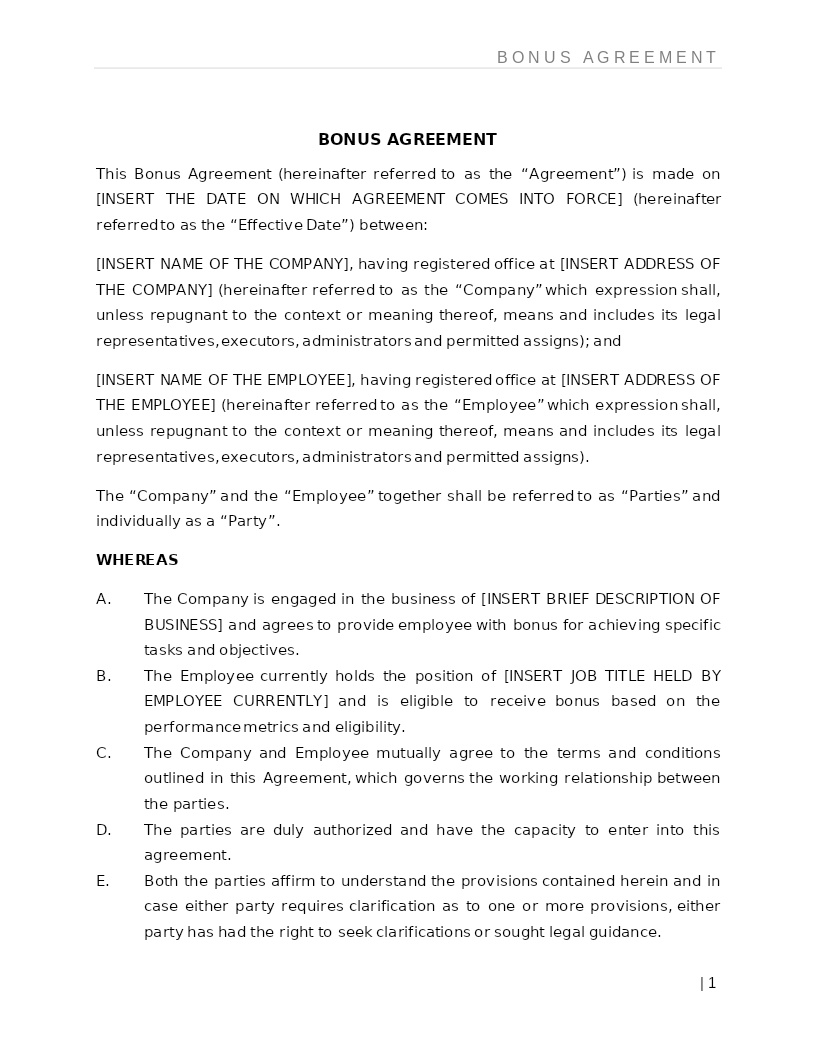
BONUS AGREEMENT
How does it work?
1. Choose this template
Start by clicking on "Fill out the template"
2. Complete the document
Answer a few questions and your document is created automatically.
3. Save - Print
Your document is ready! You will receive it in Word and PDF formats. You will be able to modify it.
Defining Performance-Based Compensation Through Bonus Arrangements
Employers often use bonus compensation as a strategic tool to reward exceptional performance, encourage retention, or incentivize employees toward defined business objectives. To govern these payments properly and comply with applicable laws, organizations must set forth the terms in a clear, detailed, and enforceable document. A Bonus Agreement serves this purpose. It outlines the conditions under which a bonus may be earned, calculated, paid, deferred, or forfeited in accordance with U.S. employment law, wage-and-hour regulations, and applicable state compensation requirements.
By implementing a Bonus Agreement, employers create a consistent and transparent framework that clarifies eligibility criteria, performance metrics, payment timelines, tax obligations, and withholding requirements. This reduces the likelihood of compensation disputes and ensures compliance with federal and state labor standards.
Where Bonus Agreements Are Commonly Used
Bonus Agreements are utilized across a wide range of employment and organizational settings, including:
- Corporate employment and executive compensation packages
- Sales, business development, and commission-based positions
- Performance-based incentive programs
- Annual review cycles or year-end bonus structures
- Retention, sign-on, referral, and discretionary bonuses
- Profit-sharing or team-based incentive programs
- Bonus pools tied to company-wide financial performance
- Startups offering milestone-based or project-based bonuses
Whenever employers provide supplemental compensation beyond base wages, a Bonus Agreement formalizes the terms.
Different Types of Bonus Agreements You May Encounter
1. Performance-Based Bonus Agreements: Tie bonuses to measurable employee or company performance metrics.
2. Discretionary Bonus Agreements: Permit the employer to award bonuses at its discretion, without a guaranteed obligation.
3. Retention or Stay-On Bonus Agreements: Offer bonuses to encourage employees to remain with the employer for a defined period.
4. Sign-On Bonus Agreements: Provide upfront bonuses to attract new hires, often with repayment obligations if employment ends early.
5. Sales or Commission-Linked Bonus Agreements: Reward employees for achieving revenue, sales targets, or client acquisition goals.
When Legal Guidance Becomes Helpful
Legal consultation may be advisable when:
- The bonus is tied to complex performance metrics or financial results
- State wage-and-hour laws impose special rules for bonus compensation
- The agreement contains forfeiture, clawback, or repayment provisions
- The bonus affects exempt/non-exempt status under FLSA
- Executive-level bonuses intersect with equity awards or long-term incentive plans
- Multi-state employees are involved with differing wage laws
- Termination or resignation scenarios require precise compensation rules
Legal review ensures the bonus structure complies with U.S. employment and compensation laws and reduces risk of claims.
How to Work With This Template
- Identify the employer and eligible employee
- Define bonus type, amount, and performance or eligibility criteria
- Specify calculation methods, payment schedules, and tax withholding obligations
- Address clawback, repayment, or forfeiture conditions
- Outline notice requirements and employer discretion, if applicable
- Identify governing federal and state wage-and-hour laws
- Review the agreement for compliance and consistency with company policy
- Execute the agreement electronically or in writing
This template aligns with U.S. employment law standards and can be integrated into employee handbooks, onboarding packages, or compensation programs.
Frequently Asked Questions
1. What is a Bonus Agreement, and why is it important?
A Bonus Agreement is a formal document that defines the conditions under which an employee may receive a bonus. It is important because it protects both parties by clearly explaining eligibility, performance criteria, payment terms, and legal obligations, reducing the likelihood of disputes.
2. Are bonuses required under U.S. law?
No. Bonuses are typically discretionary unless an employer promises or contracts for them. Once a bonus becomes contractually guaranteed, it must be paid in accordance with state wage laws.
3. Are bonuses considered wages?
Yes, most bonuses especially nondiscretionary ones are treated as wages under federal and state law. This means they must be included in overtime calculations for non-exempt employees.
4. Can an employer require an employee to stay employed to receive a bonus?
Yes. Many agreements include “active employment” requirements or conditions stating that the employee must remain employed through the bonus payout date.
5. Are bonus payments taxable?
Yes. Bonuses are taxable income subject to federal withholding, Social Security, Medicare, and applicable state taxes. Employers may use flat-rate or aggregate withholding methods.
6. Can a bonus be clawed back or forfeited?
Yes. Employers may require repayment or forfeiture if the employee resigns early, fails to meet performance criteria, or violates company policies—provided such terms are clearly documented.
7. What happens if the employee disputes bonus eligibility?
The agreement should contain dispute-resolution procedures. Disputes typically arise over metrics, timing, or eligibility, making clear documentation essential.
8. Are electronic signatures valid for Bonus Agreements?
Yes. Under the U.S. ESIGN Act, electronically signed Bonus Agreements are legally enforceable.
9. Can bonuses be prorated for part-time or partial-year employees?
Yes. Employers may prorate bonuses based on tenure, hours worked, performance periods, or company policy.
10. Does a bonus affect overtime calculations?
For non-exempt employees, nondiscretionary bonuses must be included in overtime calculations under the Fair Labor Standards Act (FLSA).