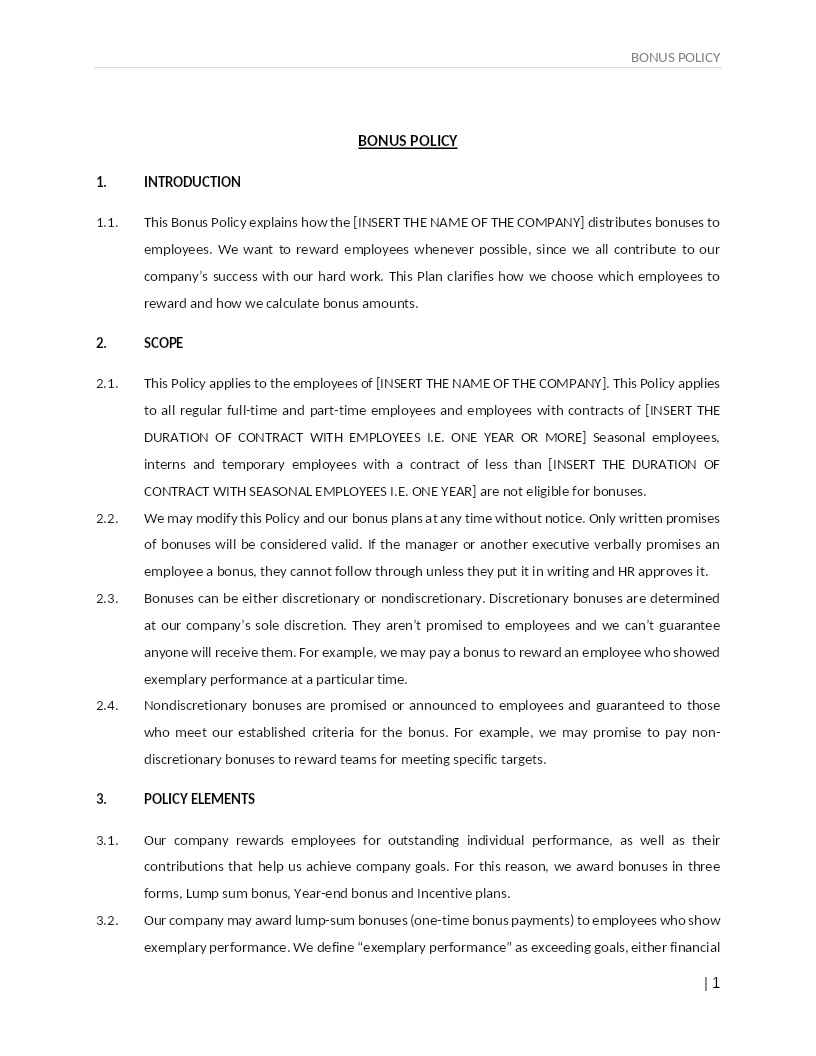
BONUS POLICY
How does it work?
1. Choose this template
Start by clicking on "Fill out the template"
2. Complete the document
Answer a few questions and your document is created automatically.
3. Save - Print
Your document is ready! You will receive it in Word and PDF formats. You will be able to modify it.
Understanding the Purpose of a Bonus Policy
When a company compensates employees with bonuses, it becomes essential to have a clear and consistent framework outlining how such rewards are earned and distributed. A Bonus Policy provides that structure. It defines eligibility requirements, performance measures, payout methods, bonus types, and the timelines for distribution.
Having this policy in place enhances transparency, improves employee trust, and ensures that bonus decisions align with company goals. It supports fair compensation practices while protecting the organization from financial inconsistencies and disputes.
Where Bonus Policies Are Commonly Used
Bonus policies are widely implemented across various business environments, including:
- Corporate offices and professional service firms
- Manufacturing units, retail chains, and sales-focused organizations
- Startups offering performance incentives or equity-linked bonuses
- Remote and hybrid workplaces needing standardized compensation rules
- Seasonal or contract-work environments with periodic bonus structures
- Nonprofit organizations providing retention or discretionary bonuses
Any time employees receive performance-based, annual, discretionary, or milestone bonuses, a written policy sets clear boundaries and expectations.
Different Types of Bonus Policies You May Encounter
- Performance-Based Bonus Policy: Rewards employees based on KPIs, targets, productivity, and individual or team accomplishments.
- Annual or Year-End Bonus Policy: Provides incentives based on company performance, profitability, or individual contributions over the fiscal year.
- Retention Bonus Policy: Used to encourage key employees to stay through critical phases such as mergers, acquisitions, or restructuring.
- Discretionary Bonus Policy: Allows management to offer bonuses at its sole discretion without fixed criteria, often for exceptional contributions.
- Signing or Hiring Bonus Policy: Provides one-time incentives to attract qualified candidates in competitive hiring markets.
When Legal Guidance Becomes Helpful
Many businesses adopt simple bonus policies, but legal review becomes valuable when:
- Bonus structures involve commission-based or incentive compensation governed by specific labor laws
- Bonuses are tied to employment contracts, union rules, or collective bargaining agreements
- The policy includes clawback provisions, equity-linked rewards, or profit-sharing components
- Bonuses impact classification under FLSA (exempt vs. non-exempt employees)
- Multi-state employees receive bonuses with differing tax or compensation regulations
- Discretionary versus non-discretionary bonus distinctions affect overtime calculations
- The company needs protection against disputes or misinterpretation of bonus criteria
Legal review ensures the policy is compliant, enforceable, and aligned with payroll, tax, and employment regulations across the U.S.
How to Work with This Template
- Identify bonus eligibility, qualifying criteria, and covered employee groups
- Define performance standards, evaluation processes, and approval rules
- Specify payout timelines, bonus calculation methods, and tax considerations
- Clarify discretionary vs. non-discretionary bonuses
- Ensure alignment with internal HR policies and applicable state/federal labor laws
- Review collaboratively with HR, finance, and legal teams before implementation
This template follows widely recognized U.S. employment and compensation standards and can be adapted for organizations of any size or industry.
Frequently Asked Questions
Q1. What is a Bonus Policy and why is it important for U.S. employers?
A Bonus Policy outlines how bonuses are awarded, calculated, and paid to employees. It ensures fairness by defining eligibility and performance criteria. For employers, it provides consistency and protects against disputes related to compensation. A well-defined policy also promotes transparency and motivates employees to meet organizational goals.
Q2. Does a Bonus Policy help reduce disputes or misunderstandings?
Yes. Clear written guidelines prevent confusion over how bonuses are earned or distributed. Employees understand the expectations, timelines, and criteria required to qualify. This reduces the chances of disagreements or claims of unfair treatment. Documentation also provides HR and management with a reliable reference point during evaluations.
Q3. Can a Bonus Policy support employee motivation and retention?
Absolutely. Bonuses tied to performance or company success incentivize employees to excel. When the policy is transparent and predictable, it helps build trust and appreciation. Competitive bonus structures also help retain high-performing employees. This strengthens workplace culture and aligns individual contributions with company objectives.
Q4. What types of bonuses should be covered in a Bonus Policy?
A comprehensive policy may include performance bonuses, annual or holiday bonuses, retention bonuses, discretionary bonuses, and signing bonuses. Each type should have clear rules regarding eligibility and payout. This ensures consistency across departments and employee levels. It also helps companies manage budgets responsibly.
Q5. Is legal review necessary before implementing a Bonus Policy?
While not mandatory, legal review is highly advisable. Bonus rules can affect wage calculations, overtime obligations, and tax requirements under federal and state laws. Lawyers ensure the policy complies with labor regulations and prevents unintended liabilities. This is especially important for multi-state employers and organizations with complex compensation structures.
Q6. How does a Bonus Policy help protect a company’s financial stability?
The policy sets budget limits, approval workflows, and payout structures. This prevents excessive or unplanned bonus spending and ensures payouts align with financial performance. Clear rules allow businesses to forecast expenses accurately. Financial discipline also supports long-term growth and operational stability.
Q7. Can the Bonus Policy be tailored for remote or hybrid employees?
Yes. Employers can define criteria that account for remote productivity measures, attendance guidelines, or digital performance metrics. This ensures fairness across all work models. Customization helps maintain equity between on-site and remote employees. It also ensures bonuses support modern workplace structures.
Q8. How often should a Bonus Policy be reviewed or updated?
Bonus policies should be reviewed annually or whenever the company undergoes structural or financial changes. Regular updates ensure compliance with evolving labor laws and tax regulations. They also allow businesses to adjust performance metrics based on current goals. Routine review keeps the policy relevant, fair, and effective.