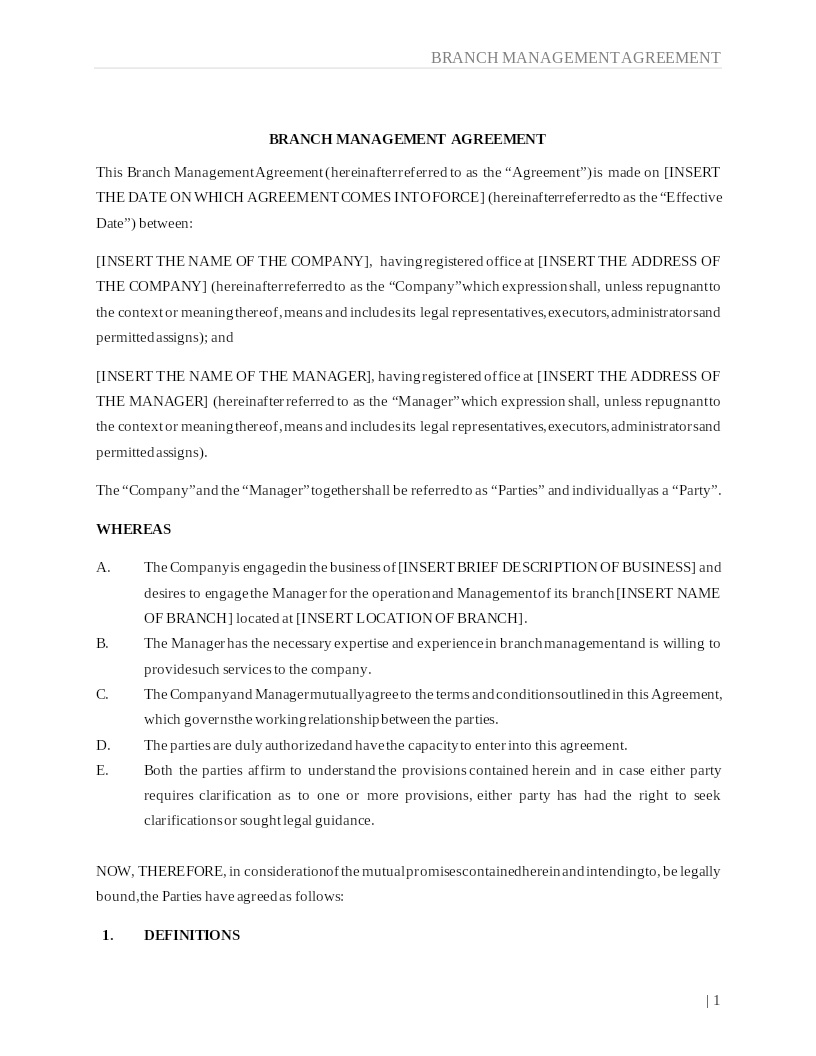
BRANCH MANAGEMENT AGREEMENT
How does it work?
1. Choose this template
Start by clicking on "Fill out the template"
2. Complete the document
Answer a few questions and your document is created automatically.
3. Save - Print
Your document is ready! You will receive it in Word and PDF formats. You will be able to modify it.
Understanding Branch Management Agreements
A Branch Management Agreement is a legally binding contract that outlines the responsibilities, operational authority, and performance expectations between a parent company (the “Principal”) and an individual or entity appointed to manage one of its branches (the “Branch Manager”). This agreement provides the framework for daily operations, branding standards, financial oversight, customer service obligations, reporting duties, and compliance with company policies and U.S. regulatory requirements.
A well-structured Branch Management Agreement ensures clear accountability, consistent brand representation, and smooth operational execution, especially when a business operates in multiple locations or states.
Where Branch Management Agreements Are Commonly Used
Branch management arrangements are widely used across industries where companies operate distributed locations, including:
- Retail chains, franchise locations, and department stores
- Banks, financial service providers, and credit unions
- Educational institutions, coaching centers, and training facilities
- Healthcare clinics, wellness centers, and therapy branches
- Gyms, fitness centers, sports clubs, and recreational facilities
- Hospitality establishments, restaurants, and service centers
- Logistics hubs, warehouses, and field service operations
Any time a company entrusts management duties to someone outside its central office, a Branch Management Agreement sets expectations and protects business interests.
Different Types of Branch Management Agreements You May Encounter
- Full Operational Management: The manager oversees staffing, customer service, reporting, compliance, and branch-level decisions.
- Administrative-Only Management: Focuses on administrative duties while strategic decisions remain with the main company.
- Revenue-Sharing Management: Branch Manager receives compensation based on branch performance, sales, or profitability.
- Franchise-Style Branch Management: The manager operates under strict brand guidelines while handling local operations.
When Legal Guidance Becomes Helpful
Legal assistance is beneficial when:
- The branch operates across different states with varying compliance rules
- The manager handles financial transactions, client data, or regulated services
- The business falls under a regulated sector (banking, medical, education, etc.)
- Intellectual property and branding protections require clarity
- The agreement includes performance incentives, penalties, or exclusivity terms
- Multiple branches or co-management structures are involved
- The Principal wants strong protections against mismanagement or misuse of company resources
Legal review ensures compliance with U.S. federal, state, and industry-specific laws while protecting both parties from operational and financial risks.
How to Work with This Template
- Identify the Principal and the Branch Manager
- Define the branch location and scope of authority
- Outline daily operational duties and reporting requirements
- Specify compensation, commission, or revenue-sharing terms
- Establish branding, confidentiality, and intellectual property obligations
- Include performance standards and audit rights
- Specify governing U.S. state law and dispute resolution mechanisms
- Add termination rights, transition processes, and management handover rules
- Sign electronically or physically according to U.S. contract standards
This template aligns with widely accepted U.S. operational management practices and is compatible with major electronic signature platforms.
Frequently Asked Questions
Q1. What is a Branch Management Agreement and why is it important?
A Branch Management Agreement defines the responsibilities and authority of an individual or entity managing a branch location. It is important because it protects the parent company’s brand, outlines operational standards, and ensures accountability for financial and performance metrics.
Q2. Is a Branch Management Agreement legally enforceable in the U.S.?
Yes. These agreements are enforceable under state contract law. When drafted clearly, they help prevent disputes related to performance failures, misuse of resources, or non-compliance with company policies.
Q3. What responsibilities are usually included in branch management?
Typical responsibilities include staff oversight, customer service, financial management, inventory control, compliance with company policies, marketing activities, and accurate reporting to the Principal.
Q4. Does the Branch Manager have full authority over the branch?
Authority depends on the agreement. Some managers handle full operations, while others have limited administrative or supervisory duties. The contract clearly defines the scope of decision-making power.
Q5. How is the Branch Manager compensated?
Compensation may be salary-based, commission-based, revenue-sharing, or performance-linked. The agreement specifies payment structure and performance indicators.
Q6. Can the Principal audit the branch?
Yes. Most agreements allow the Principal to conduct audits, review financial records, and assess compliance to ensure that the branch meets required standards.
Q7. What happens if the Branch Manager fails to meet performance standards?
The agreement may include remedies such as corrective action plans, financial penalties, suspension of authority, or termination of the management contract.
Q8. Are electronic signatures valid for these agreements?
Yes. Under the U.S. ESIGN Act, electronic signatures are legally binding and commonly used for branch management and operational contracts.
Q9. Can the agreement be terminated early?
Yes. The agreement typically includes termination clauses based on breach, non-performance, legal violations, or mutual consent. Transition procedures are also described to prevent operational disruption.
Q10. Is this agreement suitable for franchises or multi-location businesses?
Absolutely. Any organization that relies on consistent branch-level operations can use this agreement to protect its brand, maintain standards, and manage risk across multiple locations.