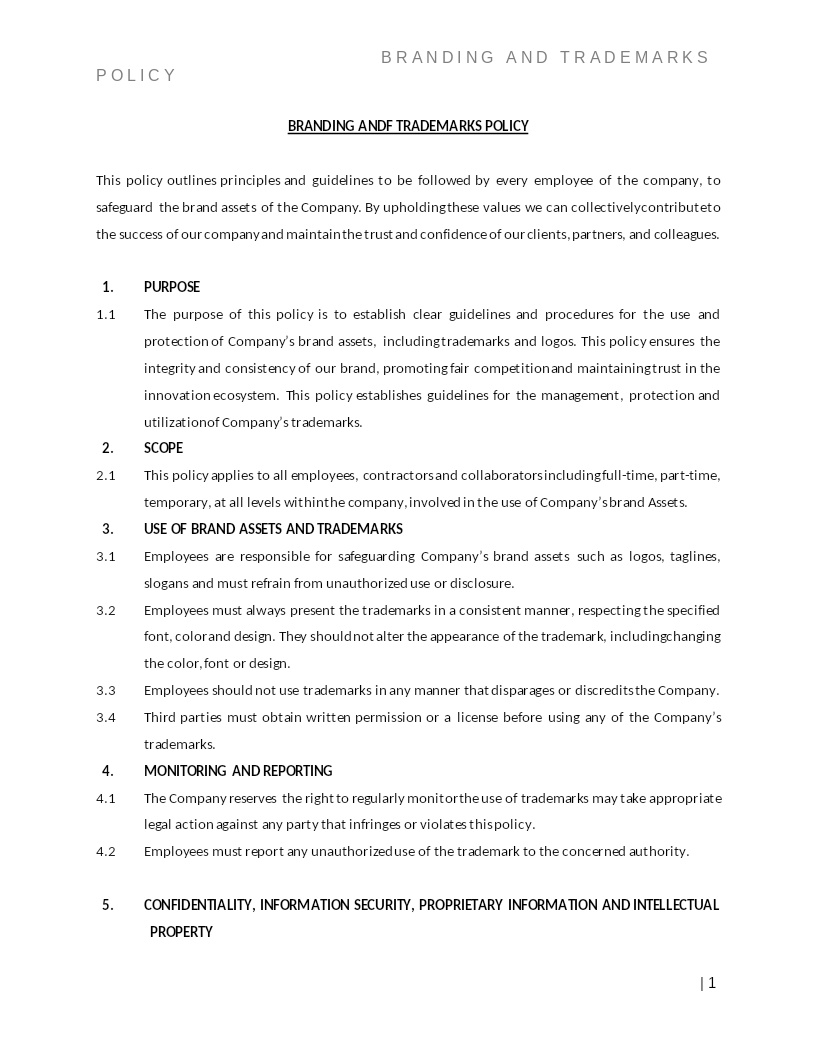
BRANDING AND TRADEMARK POLICY
How does it work?
1. Choose this template
Start by clicking on "Fill out the template"
2. Complete the document
Answer a few questions and your document is created automatically.
3. Save - Print
Your document is ready! You will receive it in Word and PDF formats. You will be able to modify it.
Establishing Brand Usage Standards Through Trademark Governance Policies
Every organization must protect its brand identity and intellectual property to maintain the integrity, recognition, and legal enforceability of its marks. To do so effectively, it is crucial to implement a written policy that establishes clear rules governing the use of logos, brand names, slogans, trade dress, and other proprietary identifiers. A Branding and Trademarks Policy fulfills this purpose. It defines the terms under which employees, contractors, partners, affiliates, and third parties may use company trademarks, consistent with U.S. trademark law, USPTO guidelines, the Lanham Act, and applicable state unfair-competition regulations.
By implementing a Branding and Trademarks Policy, businesses create a structured, enforceable framework that governs brand consistency, approval processes, licensing requirements, usage restrictions, and enforcement mechanisms. This ensures the company’s intellectual property is used appropriately, legally, and in a manner that preserves its distinctiveness and commercial value.
Where Branding and Trademark Policies Are Commonly Used
Branding and Trademarks Policies are implemented across a diverse range of organizations and industries, including:
- Corporations, startups, and emerging brands
- Franchise systems and license-based business models
- E-commerce sellers and digital platform operators
- Marketing, advertising, and creative agencies
- Universities, nonprofits, and membership associations
- Software developers, SaaS providers, and technology companies
- Retailers, manufacturers, and distribution channels
- Affiliate, influencer, and partnership programs
Any organization that owns proprietary marks or licenses brand assets should maintain a Branding and Trademarks Policy to safeguard its IP rights and ensure consistent usage.
Different Types of Branding and Trademark Policies You May Encounter
1. Internal Brand Usage Policies: Govern employee and contractor use of logos, templates, documents, and marketing assets.
2. External Trademark Usage Policies: Regulate how partners, affiliates, franchisees, or resellers may use company trademarks.
3. Co-Branding and Joint Marketing Policies: Outline rules for brand pairing, cooperative marketing, and shared promotional efforts.
4. Trademark Licensing Policies: Define how trademarks may be licensed, sublicensed, or displayed by third parties.
5. Digital and Social Media Brand Guidelines: Specify brand use across websites, apps, email marketing, and social media platforms.
When Legal Guidance Becomes Helpful
Legal review is often advisable when:
- The business licenses its trademarks to third parties or partners
- Brand assets will be used internationally or across multiple jurisdictions
- The company must enforce its rights against unauthorized use
- A new logo, slogan, or brand identity is being introduced
- Co-branding, joint ventures, or affiliate marketing programs are involved
- The business seeks federal trademark registration or portfolio expansion
- The policy intersects with contracts, franchise rules, or marketing regulations
Legal counsel ensures compliance with USPTO standards, strengthens enforceability, and reduces the risk of brand dilution or misuse.
How to Work with This Template
• Identify the company and its registered and unregistered trademarks
• Define acceptable and prohibited uses of brand assets
• Specify approval workflows for marketing or promotional materials
• Establish licensing and co-branding rules for third-party use
• Outline enforcement procedures, reporting mechanisms, and corrective measures
• Incorporate relevant provisions of U.S. trademark law
• Review the policy periodically to ensure accuracy and brand consistency
• Distribute the policy electronically or through employee handbooks
This template aligns with widely accepted U.S. branding and IP-protection practices and can be implemented within marketing departments, partner programs, and organizational compliance structures.
Frequently Asked Questions
Q1. What is a Branding and Trademarks Policy, and why is it important?
A Branding and Trademarks Policy is a formal document that outlines how a company’s name, logo, slogans, and other trademarks may be used internally and externally. It is important because it helps protect trademark rights, maintain consistent brand identity, and prevent unauthorized or improper usage.
Q2. Does U.S. law require companies to have a trademark policy?
No, but having a written policy significantly strengthens enforcement efforts, ensures consistent usage, and reduces risk of brand dilution. It supports compliance with the Lanham Act and USPTO standards.
Q3. Who is allowed to use company trademarks?
Employees, contractors, and approved third parties may use trademarks only as permitted by the policy. External use such as co-branding, affiliate marketing, or reseller activity typically requires written authorization.
Q4. Does the policy apply to digital and social media use?
Yes. Proper trademark usage must be maintained across websites, email campaigns, online advertising, mobile apps, and social media platforms to ensure brand consistency and legal compliance.
Q5. Can trademarks be modified or redesigned?
Not without express permission. Unauthorized modification, distortion, or alteration of trademarks can weaken legal protection and violate company policy.
Q6. What happens if someone misuses the company’s trademarks?
The policy should outline corrective actions, which may include warnings, removal requests, termination of partnership rights, or legal enforcement under trademark law.
Q7. Does the company have to register its trademarks for the policy to apply?
No. Both registered and unregistered (common-law) trademarks may be protected and regulated under the policy. Registration does, however, enhance legal protection.
Q8. Are electronic acknowledgments valid for accepting this policy?
Yes. Under the ESIGN Act, electronic signatures and acknowledgments are enforceable and widely used for employee handbooks and policy acceptance.
Q9. Can third parties use trademarks under a license?
Yes, but only with a written licensing agreement or authorization that defines rights, limitations, quality standards, and approval requirements.
Q10. How often should branding and trademark policies be updated?
Updates should occur whenever the company’s brand evolves, new trademarks are adopted, marketing channels change, or legal requirements shift.