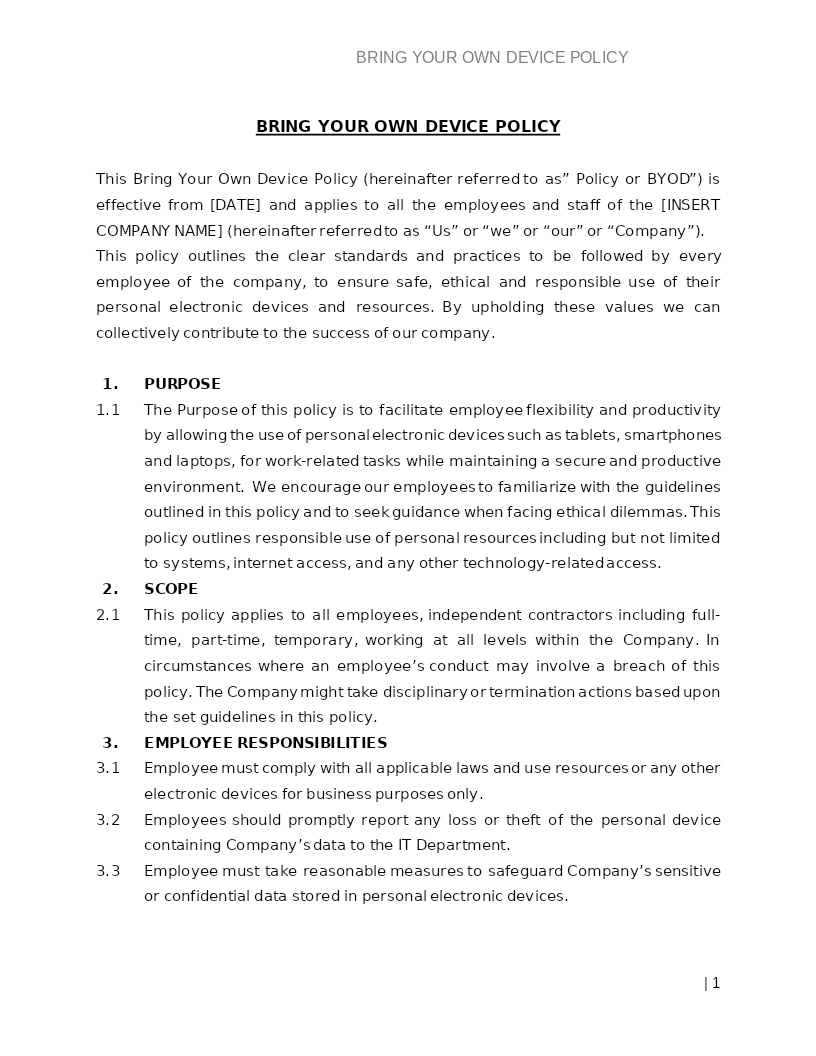
BRING YOUR OWN DEVICE POLICY
How does it work?
1. Choose this template
Start by clicking on "Fill out the template"
2. Complete the document
Answer a few questions and your document is created automatically.
3. Save - Print
Your document is ready! You will receive it in Word and PDF formats. You will be able to modify it.
Strengthening Data Security and Organizational Compliance Through a Bring Your Own Device Policy
A Bring Your Own Device (BYOD) Policy is a formal organizational directive that governs the use of personally owned electronic devices—such as smartphones, tablets, laptops, and wearable technology—when accessing company systems, networks, data, or applications. Developed in accordance with applicable U.S. federal and state privacy laws, including the Electronic Communications Privacy Act (ECPA), the Computer Fraud and Abuse Act (CFAA), state data-security statutes, the Federal Trade Commission Act (FTC Act), and industry-specific standards such as HIPAA or GLBA where relevant, this policy establishes the legal obligations, cybersecurity safeguards, and operational expectations that employees must comply with when using personal devices for work-related purposes. Its purpose is to mitigate data-security risks, prevent unauthorized access, and ensure compliance with regulatory requirements while maintaining a flexible and modern work environment.
A comprehensive BYOD Policy defines the categories of personal devices permitted for business use, sets forth mandatory security requirements such as password protection, encryption, anti-malware software, VPN usage, and multi-factor authentication, and provides clear rules regarding acceptable use, prohibited applications, data segregation, and corporate-resource access. It also outlines procedures for device registration, monitoring, support, and incident reporting. The policy further addresses the company’s rights in situations requiring remote wiping of corporate data, retrieval of confidential information, or restriction of network access following a security incident or employee separation. By implementing this policy, organizations protect sensitive information, maintain the integrity of their technology infrastructure, reduce legal exposure, and balance employee flexibility with robust cybersecurity governance.
Where Bring Your Own Device Policies Are Commonly Used
Organizations across many sectors adopt BYOD Policies, including:
- Technology companies offering flexible, remote, or hybrid work structures
- Healthcare entities subject to HIPAA confidentiality and electronic-data protections
- Financial institutions governed by strict data-handling and security regulations
- Government contractors required to comply with NIST cybersecurity standards
- Corporate enterprises with mobile or distributed workforces
- Educational institutions allowing staff or students to access academic systems
- Retail and customer-service organizations using mobile applications for workflow operations
- Professional services firms managing confidential client information on portable devices
Any organization using mobile or personal technology to conduct business operations benefits from a rigorously drafted BYOD Policy.
Different Types of Bring Your Own Device Policies
1. Standard BYOD Policies: Allow personal devices for general work purposes under basic security and compliance controls.
2. Enhanced Security BYOD Policies: Used in regulated industries requiring heightened encryption, mobile-device management, and strict monitoring.
3. Containerized or Segmented BYOD Policies: Separate personal and corporate data environments through dedicated applications or secure containers.
4. Restricted-Use BYOD Policies: Allow limited device usage only for specific tasks, systems, or low-risk operations.
5. Remote-Work BYOD Policies: Apply to employees working off-site, requiring additional cybersecurity and privacy protocols.
When Legal Guidance Becomes Helpful
Legal review is recommended when:
- The organization handles protected data subject to HIPAA, GLBA, FERPA, or industry-specific regulations
- State privacy laws (e.g., CCPA/CPRA) impose additional consent or notice requirements
- The company engages in electronic monitoring or device-usage tracking
- Remote wiping of personal devices may implicate privacy rights or data-ownership disputes
- Employee classification, wage-and-hour rules, or off-the-clock work concerns arise
- The business must implement cybersecurity frameworks such as NIST, ISO, or CMMC
- The organization engages vendors or contractors with device-access privileges
- A data breach may trigger mandatory reporting obligations
Legal oversight ensures the BYOD Policy remains compliant, enforceable, and protective of corporate and individual rights.
How to Work with This Template
Identify permitted device types and define eligibility criteria for participation in the BYOD program
- Establish security requirements, including password protocols, encryption standards, and approved applications
- Specify requirements for connecting to corporate systems and accessing confidential information
- Outline procedures for reporting lost or stolen devices, suspected breaches, or unauthorized access
- Describe rights and limitations regarding company monitoring, logging, and device-usage oversight
- Clarify the organization’s authority to remotely wipe corporate data when necessary
- Address reimbursement practices for data plans, maintenance, or approved software licenses
- Establish exit procedures for removing corporate data and revoking system access upon separation
- Require users to sign acknowledgments confirming understanding and acceptance of policy terms
- Review and update the policy regularly as technology, cybersecurity threats, and legal standards evolve
This template reflects standard U.S. cybersecurity expectations and supports responsible device integration into corporate systems.
Frequently Asked Questions
Q1. What is a Bring Your Own Device Policy, and why is it important?
A BYOD Policy governs the use of personal devices for work purposes. It is important because it protects sensitive company data, ensures compliance with cybersecurity standards, and reduces legal risks associated with unauthorized access or data breaches.
Q2. Are BYOD Policies legally required in the U.S.?
Not universally, but they are strongly recommended—especially for organizations handling confidential, regulated, or proprietary information.
Q3. Does the company monitor my personal device?
Monitoring is limited to the extent necessary to protect corporate data and enforce security requirements. The policy must clearly disclose any monitoring practices to comply with applicable privacy laws.
Q4. What happens if a personal device is lost or stolen?
Employees must report the incident immediately. The company may initiate data-protection measures, including remote wiping of corporate information, to prevent unauthorized access.
Q5. Will the company access my personal files or data?
Generally, no. Access is limited to corporate applications and information necessary for compliance and security.
Q6. Are employees reimbursed for device or data-plan expenses?
Some states require reimbursement for business-related expenses. The policy should specify whether reimbursements apply.
Q7. Does the policy apply to contractors and temporary workers?
Yes. Anyone using a personal device for business access must comply with the BYOD Policy.
Q8. What security measures are required for participating in the BYOD program?
Common requirements include strong passwords, encryption, anti-malware protection, VPN use, and installation of security updates.
Q9. Can the company wipe my entire device?
Organizations typically wipe only corporate data. Full-device wiping should occur only with explicit consent or where legally necessary.
Q10. Should legal counsel review a BYOD Policy?
Absolutely. Privacy, cybersecurity, labor, and data-protection laws vary by state and industry, and legal review ensures full compliance.