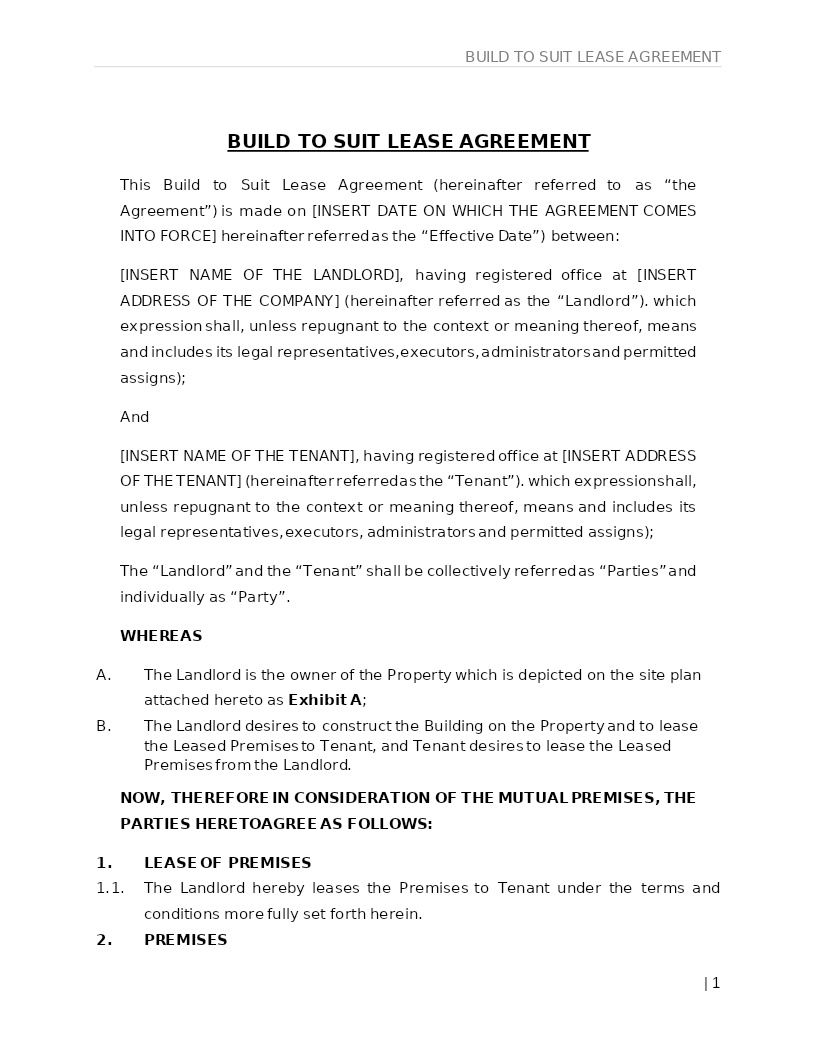
BUILD TO SUIT LEASE AGREEMENT
How does it work?
1. Choose this template
Start by clicking on "Fill out the template"
2. Complete the document
Answer a few questions and your document is created automatically.
3. Save - Print
Your document is ready! You will receive it in Word and PDF formats. You will be able to modify it.
Understanding Build-to-Suit Lease Agreements
A Build-to-Suit Lease Agreement is a commercial real estate contract where a landlord agrees to construct, customize, or substantially renovate a property according to the tenant’s specific business needs. This arrangement is common when existing buildings cannot meet operational, technical, or regulatory requirements.
In the U.S., Build-to-Suit (BTS) leases are governed by state contract law, commercial real estate standards, zoning rules, construction regulations, and building codes. The agreement outlines how the project will be designed, built, financed, delivered, and leased ensuring both parties understand their rights, obligations, and financial commitments before construction begins.
Where Build-to-Suit Leases Are Commonly Used
Build-to-Suit arrangements are widely used when businesses require a property tailored to precise operational standards, such as:
- Retail chains planning new stores
- Logistics and warehousing companies needing distribution centers
- Corporate offices and regional headquarters
- Medical and healthcare facilities with licensed build-out requirements
- Restaurants, franchise locations, and hospitality projects
- Manufacturing or industrial units requiring compliance with OSHA or EPA rules
- Technology companies with custom data centers or R&D units
A BTS lease provides the flexibility to obtain a purpose-built facility without purchasing the underlying land or funding full construction upfront.
Different Types of Build-to-Suit Arrangements You May Encounter
- Landlord-Funded Build-to-Suit: The landlord finances construction and leases the customized property to the tenant. Rent typically reflects construction costs, financing, and long-term return on investment.
- Tenant-Funded Build-to-Suit: The tenant pays for construction while the landlord provides the land and long-term lease. This structure may reduce rent but increases upfront tenant involvement.
- Turnkey Build-to-Suit: The landlord delivers a fully completed, ready-to-occupy facility based on agreed specifications, timelines, and performance standards.
- Ground Lease Build-to-Suit: The tenant leases the land long-term (often 30–99 years) and constructs the building at its own cost, retaining substantial control over the improvements.
When Legal Guidance Becomes Helpful
Legal review is important for Build-to-Suit leases because they involve construction obligations plus long-term leasing commitments. Professional guidance is especially helpful when:
- The project involves complex engineering, environmental, or zoning requirements
- Multiple contractors, architects, or lenders are involved
- Rent depends on construction costs, amortization, or escalation formulas
- The lease term is long (10–30 years) with renewal options
- There are risk-related clauses such as indemnification, delays, warranties, or force majeure
- The tenant requires industry-specific compliance (healthcare, food services, laboratories, etc.)
Since BTS leases blend construction contracts with commercial lease law, legal review helps prevent disputes, cost overruns, and delays.
How to Work with This Template
- Identify the landlord, tenant, project location, and permitted use
- Outline the design specifications, architectural plans, and construction standards
- Specify the construction timeline, delivery date, and conditions for occupancy
- Determine who pays for construction, improvements, and change orders
- Include insurance, liability, OSHA compliance, and safety obligations
- Choose a governing U.S. state law
- Establish the lease term, rent structure, and adjustment mechanisms
- Review performance obligations and remedies for delays or defects
- Sign electronically or in hard copy
The template is compatible with major U.S. e-signature platforms and follows nationally recognized commercial leasing standards.
Frequently Asked Questions
Q1. Is a Build-to-Suit Lease the same as a standard commercial lease?
No. A Build-to-Suit Lease is more detailed and customized than a traditional commercial lease. In a standard lease, the tenant rents an existing building in “as-is” condition. However, in a Build-to-Suit arrangement, the landlord constructs or customizes the property specifically for the tenant’s operational needs. This means the agreement must address construction responsibilities, design specifications, architectural plans, regulatory approvals, and completion timelines, making it far more comprehensive than a regular lease.
Q2. Who pays for the construction in a Build-to-Suit arrangement?
Construction costs in a Build-to-Suit project can be funded by either the landlord or the tenant, depending on the financial structure negotiated. In landlord-funded BTS deals, the landlord pays upfront and recovers costs through rent, amortized improvements, and long-term lease payments. In tenant-funded arrangements, the tenant covers construction but may receive rent credits or reduced base rent. The agreement clearly outlines cost allocation, financing, and reimbursement models to avoid any future disputes.
Q3. Are construction delays addressed in the agreement?
Yes. Build-to-Suit leases typically include robust construction delay clauses because timely delivery is critical for business operations. The agreement outlines acceptable delay reasons, contractor obligations, notice requirements, and potential remedies. These may include liquidated damages, revised delivery dates, rent abatement, or the right to terminate the agreement if delays materially impact the project. This ensures both parties understand how delays will be handled under U.S. commercial leasing norms.
Q4. Can the tenant request design changes during construction?
Yes, tenants may request design changes during construction, but these modifications must follow a formal change order process. Since changes often affect the project cost, construction schedule, or building permits, the agreement specifies how adjustments are approved and billed. Typically, the tenant must agree to any additional expenses, extended timelines, or rent revisions resulting from such modifications. All changes must be documented and approved in writing to maintain legal clarity.
Q5. Are electronic signatures legally enforceable in Build-to-Suit leases?
Yes. In the United States, electronic signatures are fully enforceable under the ESIGN Act, and the Uniform Electronic Transactions Act (UETA) adopted by most states. This means both electronic signatures and digital records carry the same legal weight as handwritten signatures, provided both parties consent to electronic execution. As a result, Build-to-Suit leases can be signed securely online through platforms like Docu Sign or Adobe Sign.
Q6. What happens if the building does not meet the agreed specifications?
If the completed building does not match the approved construction plans or specifications, the lease outlines a process for corrective work, warranty claims, inspections, and dispute resolution. The landlord may be required to fix defects at its own cost, extend warranties, or provide temporary accommodations until issues are resolved. In significant cases, the tenant may have rights to rent reduction, delayed occupancy, or legal remedies based on the terms of the agreement.
Q7. Can a BTS lease be used for franchised businesses?
Absolutely. Build-to-Suit leases are widely used for franchise operations such as restaurants, retail outlets, and service-based chains. These businesses often need standardized layouts, brand-specific designs, and equipment installations, which Build-to-Suit arrangements can deliver. A BTS model ensures each franchise location meets brand guidelines while complying with local zoning and building codes across different U.S. states.
Q8. Does a Build-to-Suit lease protect both parties financially?
Yes. A well-drafted Build-to-Suit Lease includes detailed provisions that protect both the landlord and tenant from financial risks. It defines who pays for construction, how costs are reimbursed, rent structure, escalation formulas, insurance coverage, indemnities, performance obligations, and remedies for delays or defects. These clauses help ensure predictable long-term occupancy costs for the tenant and stable return on investment for the landlord.
Q9. Is environmental compliance required during construction?
Yes. All Build-to-Suit projects in the U.S. must comply with federal, state, and local environmental regulations, including EPA guidelines, waste management rules, groundwater protections, and energy efficiency standards. For industrial or manufacturing facilities, compliance may also include air quality permits, hazardous material handling, and environmental impact assessments. Both the landlord and tenant should ensure the construction complies with applicable environmental and zoning laws.
Q10. How long are Build-to-Suit leases?
Most Build-to-Suit leases in the United States range from 10 to 30 years, depending on construction costs, financing needs, and the tenant’s business model. Longer lease terms allow landlords to recover their investment while providing tenants with long-term operational stability. Many agreements also include renewal options, rent reset provisions, and extensions, making the arrangement suitable for businesses seeking customized, long-term premises.