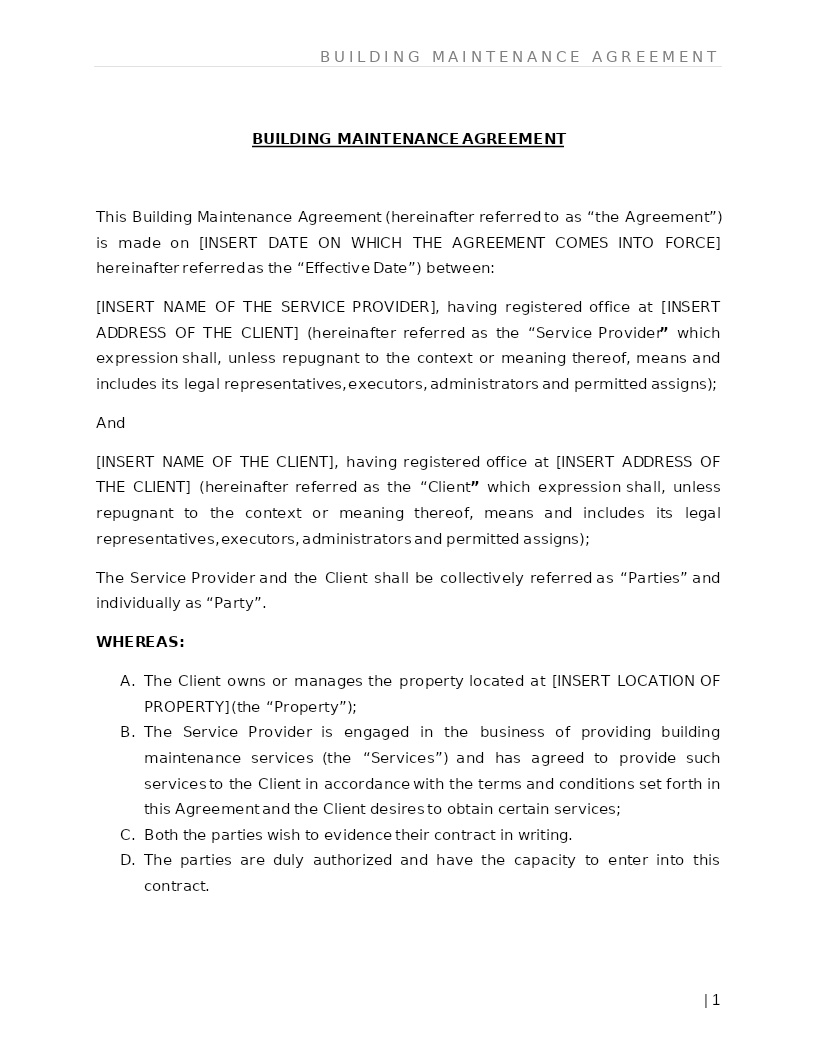
BUILDING MAINTENANCE AGREEMENT
How does it work?
1. Choose this template
Start by clicking on "Fill out the template"
2. Complete the document
Answer a few questions and your document is created automatically.
3. Save - Print
Your document is ready! You will receive it in Word and PDF formats. You will be able to modify it.
Understanding a Building Maintenance Agreement
A Building Maintenance Agreement establishes the expectations, responsibilities, and service standards between a property owner or manager and a service provider responsible for maintaining the building. It outlines the tasks to be performed, such as routine cleaning, repairs, inspections, landscaping, HVAC servicing, and emergency response, and provides clarity on timelines, staffing, equipment, and safety procedures.
By defining obligations in detail, this agreement ensures that buildings remain functional, safe, and well-preserved, while helping prevent disputes and protecting the long-term value of the property.
Where Building Maintenance Agreements Are Commonly Used
Building maintenance contracts are commonly implemented across a wide range of property types, including:
- Apartment complexes and residential communities
- Commercial office buildings and co-working spaces
- Retail centers, malls, and storefront properties
- Industrial facilities, warehouses, and distribution centers
- Hotels, hospitals, schools, and institutional buildings
- Government buildings and municipal structures
- Condominium associations and HOA-managed properties
Any property that requires ongoing upkeep benefits from a structured agreement that governs service expectations and legal responsibilities.
Different Types of Building Maintenance Agreements You May Encounter
- General Maintenance Agreements: Cover daily or weekly cleaning, trash removal, and basic repairs.
- Preventive Maintenance Agreements: Focus on scheduled inspections and servicing of equipment, HVAC systems, plumbing, and electrical components.
- Full-Service Maintenance Agreements: Provide comprehensive upkeep, including repairs, emergency support, landscaping, and seasonal maintenance.
- On-Call or Emergency Maintenance Agreements: Used when the provider is responsible for addressing urgent issues such as leaks, broken systems, or safety hazards.
- Specialized Maintenance Agreements: Tailored for elevators, fire systems, security systems, or other regulated building components that require licensed technicians.
When Legal Guidance Becomes Helpful
While many maintenance agreements are straightforward, legal review is often valuable when:
- High-value commercial or industrial properties are involved
- The maintenance provider handles complex mechanical or hazardous systems
- Multi-building campuses, HOAs, or co-ops require uniform compliance
- State regulations apply to fire safety, electrical systems, or environmental standards
- Liability, indemnity, or insurance terms carry significant financial exposure
- The agreement includes long-term commitments or automatic renewal clauses
- Multiple subcontractors or vendors are coordinated under one agreement
Legal guidance helps ensure enforceability, compliance, and clarity in complex or high-risk environments.
How to Work with This Agreement
- Identify the parties and specify whether the client is the property owner or manager
- Clearly outline all maintenance tasks, service frequency, and performance expectations
- Define payment terms, schedules, and invoice procedures
- Specify tools, equipment, staffing, and access hours
- Add safety standards, insurance requirements, and emergency procedures
- Clarify liability allocations, damages, and vendor responsibilities
- State the agreement duration and termination rules
- Review the terms together and finalize the agreement with signatures
This template is compatible with all major e-signature platforms and follows widely recognized U.S. contract drafting standards.
Frequently Asked Questions
Q1. What should a Building Maintenance Agreement include?
A strong Building Maintenance Agreement outlines the services to be performed, maintenance schedules, payment terms, access permissions, insurance requirements, and procedures for handling repairs or emergencies. By detailing these elements, both parties know exactly what to expect, reducing operational disruptions and misunderstandings.
Q2. How does a Building Maintenance Agreement help property owners?
It provides clarity on who is responsible for routine upkeep, repairs, and inspections, helping owners maintain property value and tenant satisfaction. The agreement sets clear performance standards and timelines, ensuring that maintenance tasks are conducted efficiently and professionally.
Q3. Are emergency repairs covered under this agreement?
This depends on how the agreement is drafted. Some contracts include on-call emergency response, while others treat it as an add-on service. The agreement should specify what qualifies as an emergency, expected response times, and any additional fees so both parties understand their obligations.
Q4. What liability protections should be included in a Building Maintenance Agreement?
The agreement should clarify responsibility for damages, injuries, or equipment failures caused during maintenance work. It should also include insurance requirements, indemnity clauses, and limitations of liability. These protections help reduce financial risk and ensure accountability.
Q5. How does the agreement address quality control or service standards?
Most agreements outline inspection protocols, reporting requirements, and performance benchmarks. This ensures service providers follow agreed-upon standards and gives property owners a framework for raising concerns or requesting corrections if work is not completed properly.
Q6. Can maintenance schedules be customized based on property needs?
Yes. Maintenance plans are often tailored to the building type, tenant usage, and system complexity. The agreement can detail daily, weekly, monthly, or seasonal tasks. Custom schedules ensure proper upkeep and help prevent costly system failures or safety hazards.
Q7. What happens if the service provider fails to perform required tasks?
The agreement typically includes provisions for notice, corrective action, penalties, or termination if the provider does not meet obligations. These clauses protect property owners and ensure that maintenance services remain consistent and reliable.
Q8. How often should a Building Maintenance Agreement be updated?
It is recommended to review the agreement annually or whenever the building undergoes structural changes, tenant expansion, or system upgrades. Updating the agreement ensures it remains accurate, reflects current operational needs, and aligns with evolving regulations or safety requirements.