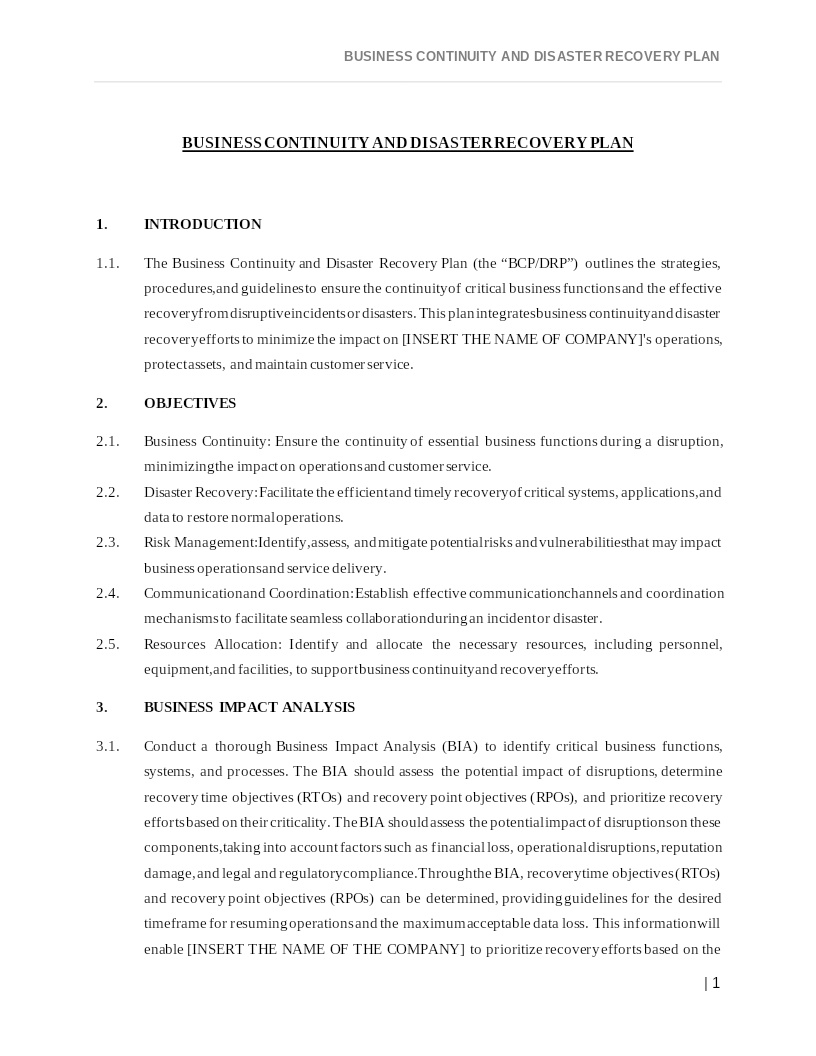
BUSINESS CONTINUITY AND DISASTER RECOVERY PLAN
How does it work?
1. Choose this template
Start by clicking on "Fill out the template"
2. Complete the document
Answer a few questions and your document is created automatically.
3. Save - Print
Your document is ready! You will receive it in Word and PDF formats. You will be able to modify it.
Strengthening Organizational Resilience Through a Business Continuity and Disaster Recovery Plan
A Business Continuity and Disaster Recovery Plan (BCDR Plan) is a comprehensive organizational framework designed to ensure the continued operation of essential business functions during and after disruptive events, including natural disasters, cyber incidents, power outages, system failures, public-health emergencies, or any event that significantly interrupts normal operations. Developed in accordance with U.S. regulatory and industry standards, including the Federal Emergency Management Agency (FEMA) Continuity Guidance, the National Institute of Standards and Technology (NIST) Special Publication 800-series, the Department of Homeland Security (DHS) resilience directives, and industry-specific requirements such as HIPAA’s contingency-planning rule, GLBA’s security mandates, and SOX internal-control obligations, this plan establishes the protocols, responsibilities, and recovery strategies necessary to protect people, data, infrastructure, and critical business assets during an emergency. Its purpose is to reduce operational risk, protect organizational reputation, ensure regulatory compliance, and facilitate timely restoration of services.
A robust BCDR Plan defines the essential functions of the business, identifies critical systems and dependencies, and classifies operational risks based on severity and likelihood. It outlines procedures for emergency communication, employee notification, evacuation, shelter-in-place protocols, remote-work transitions, data backup and restoration, alternative facility operations, and vendor coordination. The plan also establishes the organizational chain of command, roles and responsibilities, and decision-making authority during emergencies. It details technological measures such as offsite backups, redundant networks, cybersecurity incident-response strategies, and safeguards against data loss or service disruption. By implementing this plan, organizations can minimize downtime, reduce financial losses, safeguard stakeholder confidence, maintain legal compliance, and ensure rapid recovery from both anticipated and unforeseen events.
Where Business Continuity and Disaster Recovery Plans Are Commonly Used
BCDR Plans are utilized extensively across industries that require uninterrupted service or strict compliance, including:
- Financial institutions subject to GLBA and FFIEC continuity mandates
- Healthcare organizations governed by HIPAA’s data-contingency requirements
- Technology and SaaS providers managing critical digital infrastructure
- Manufacturing operations dependent on physical plants and supply-chain stability
- Government agencies and contractors subject to DHS and FEMA continuity requirements
- Educational institutions needing emergency-response protocols and remote-learning transitions
- Retail and hospitality businesses with operational dependencies on logistics and point-of-sale systems
- Nonprofits and community organizations providing essential public services
Any organization that relies on continuous operations, data integrity, or public safety benefits from a clear and legally compliant BCDR Plan.
Different Types of Business Continuity and Disaster Recovery Plans
1. IT Disaster Recovery Plans: Focus on data backups, cybersecurity incidents, server restoration, and technology continuity.
2. Operational Continuity Plans: Address physical operations, staff management, supply chain continuity, and facility access.
3. Emergency Response and Evacuation Plans: Provide procedures for immediate response, life-safety measures, and communication during emergencies.
4. Crisis Communication Plans: Define internal and external messaging strategies during disruptions.
5. Pandemic or Public Health Continuity Plans: Address workforce protection, remote operations, and compliance with CDC, OSHA, and state health guidelines.
6. Vendor and Supply Chain Continuity Plans: Ensure that key third-party services remain operational during disruptions.
When Legal Guidance Becomes Helpful
Legal counsel should be consulted when:
The organization must comply with
- specific continuity requirements under federal or state regulations
- Data-recovery protocols involve personally identifiable information (PII) or protected health information (PHI)
- Vendor contracts include continuity or disaster-recovery obligations
- The plan intersects with cybersecurity incident reporting obligations under state data-breach laws
- Workplace safety protocols must comply with OSHA emergency-preparedness standards
- Insurance-policy terms require specific disaster-mitigation procedures
- High-risk industries require certification or government review of continuity plans
Legal review ensures compliance with regulations, reduces liability, and strengthens the enforceability and effectiveness of the plan.
How to Work with This Template
- Identify essential business functions and classify them by priority
- Conduct a risk assessment to evaluate internal and external threats
- Establish emergency communication protocols and leadership decision-making authority
- Define evacuation, shelter-in-place, and personnel-protection procedures
- Create step-by-step technological recovery processes, including backup frequency, data restoration, and system testing
- Outline recovery time objectives (RTOs) and recovery point objectives (RPOs) for critical systems
- Develop alternative worksite arrangements, including remote-work procedures and facility redundancies
- Document vendor dependencies and ensure continuity obligations are included in contracts
- Schedule routine plan testing, tabletop exercises, and regular updates
- Train employees on emergency-response procedures and ensure acknowledgment of responsibility
This template reflects leading U.S. continuity-planning standards and supports organizational resilience across all operational functions.
Frequently Asked Questions
Q1. What is a Business Continuity and Disaster Recovery Plan, and why is it important?
It is a comprehensive plan that outlines how an organization will continue operations during and after a disruptive event. It is important because it minimizes downtime, reduces financial losses, ensures safety, and supports compliance with regulatory and industry standards.
Q2. Is a BCDR Plan required by U.S. law?
In many industries such as healthcare, finance, government contracting, and utilities continuity planning is legally required. Other businesses adopt BCDR Plans to reduce risk and enhance organizational preparedness.
Q3. Does a BCDR Plan cover cybersecurity incidents?
Yes. Most plans include cybersecurity incident-response procedures, data-restoration steps, and compliance with state data-breach notification laws.
Q4. What types of events does a BCDR Plan address?
Natural disasters, power outages, cyberattacks, equipment failure, public-health emergencies, civil unrest, supply-chain disruptions, and any event that interrupts business operations.
Q5. Does the plan include communication protocols?
Absolutely. Clear communication procedures for employees, vendors, customers, and regulators are a cornerstone of effective continuity planning.
Q6. Should employees be trained on the BCDR Plan?
Yes. Training ensures employees understand their responsibilities, evacuation routes, reporting requirements, and continuity procedures.
Q7. How often should a BCDR Plan be updated?
Plans should be reviewed and updated at least annually, or sooner if significant operational, technological, or regulatory changes occur.
Q8. Does the plan include backup locations or remote-work procedures?
Most plans include alternative worksites, remote-work readiness, and redundancy options to maintain operations during disruptions.
Q9. Are vendors included in continuity planning?
Yes. Vendors and third parties are often critical to business operations, and continuity obligations should be incorporated into vendor contracts.
Q10. Should legal counsel review a BCDR Plan?
Yes. Legal review ensures compliance with federal and state laws and reduces liability associated with emergency-response decisions.