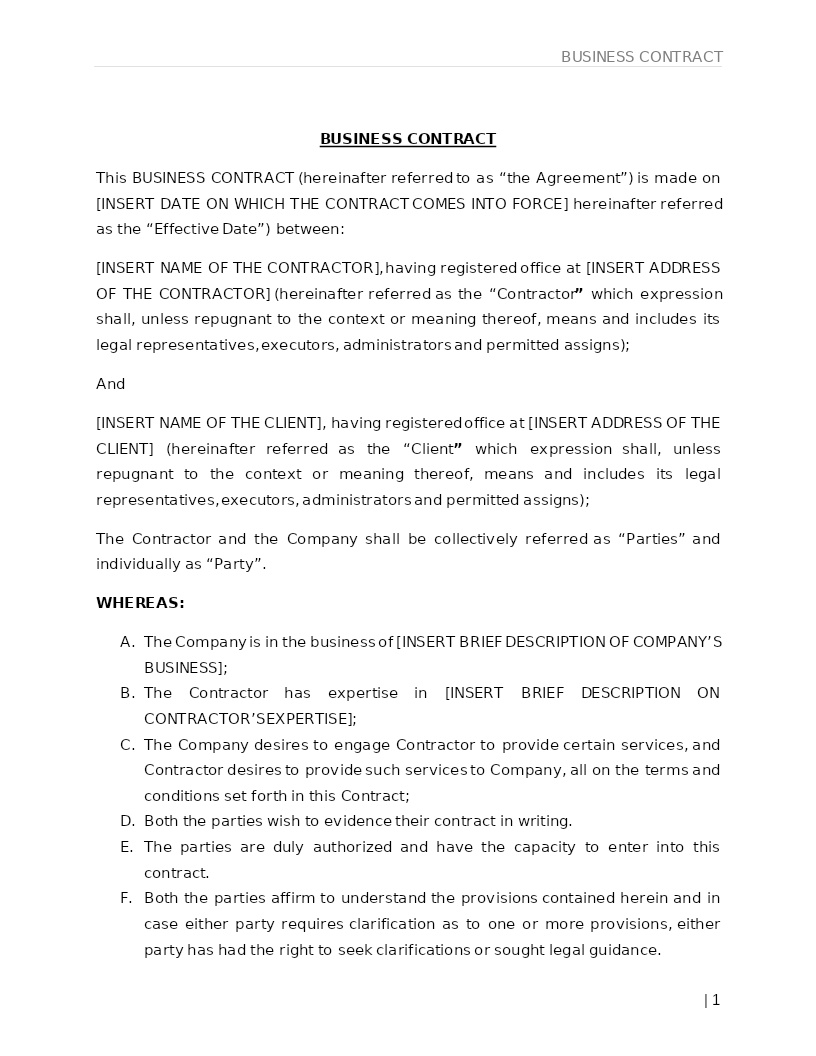
BUSINESS CONTRACT
How does it work?
1. Choose this template
Start by clicking on "Fill out the template"
2. Complete the document
Answer a few questions and your document is created automatically.
3. Save - Print
Your document is ready! You will receive it in Word and PDF formats. You will be able to modify it.
Establishing Legally Binding Commercial Relationships Through a Business Contract
A Business Contract is a foundational legal document used to formalize commercial relationships, protect the interests of the parties involved, and ensure compliance with U.S. federal and state contract laws. It establishes mutually agreed-upon obligations, rights, timelines, and remedies related to the goods, services, or commercial arrangements being exchanged. Whether formed between corporations, small businesses, vendors, contractors, or professional partners, a Business Contract provides a legally enforceable framework that governs interactions and reduces the risk of disputes.
A well-drafted Business Contract outlines essential terms such as payment structures, performance obligations, delivery timelines, confidentiality duties, intellectual-property rights, indemnification, warranties, termination procedures, and governing law. By creating a clear and comprehensive agreement, the parties ensure their expectations are documented and enforceable, reducing ambiguity and establishing a strong legal foundation for their commercial activities. This promotes accountability, reduces liability, and strengthens commercial stability.
Where Business Contracts Are Commonly Used
Business Contracts are utilized across nearly all sectors and industries, including:
- Service providers engaging with clients for professional, consulting, or technical work
- Vendors supplying goods, materials, or inventory to commercial buyers
- Manufacturers and distributors entering supply or logistics relationships
- Startups securing essential business partnerships or collaborations
- Agencies, freelancers, and independent contractors formalizing project terms
- Companies licensing technology, IP, or proprietary systems
- Retailers and wholesalers entering into purchase or resale agreements
- Businesses working with marketing firms, software developers, real-estate agents, or contractors
Any commercial interaction involving payment, performance, or exchange of value benefits from a written, legally compliant Business Contract.
Different Types of Business Contracts
1. Service Agreements: Outline the nature of services, payment terms, deadlines, and performance standards.
2. Sales of Goods Contracts: Govern commercial transactions involving physical products and often rely on the Uniform Commercial Code (UCC).
3. Partnership and Joint-Venture Agreements: Formalize shared business operations, profit distribution, and decision-making rights.
4. Independent Contractor Agreements: Define project deliverables, ownership rights, and contractor responsibilities.
5. Licensing and Intellectual Property Contracts: Address use of trademarks, copyrights, patents, or proprietary materials.
6. Vendor and Supplier Agreements: Establish procurement requirements, delivery schedules, and quality standards.
7. Non-Disclosure and Confidentiality Addendums: Protect commercially sensitive or proprietary information.
When Legal Guidance Becomes Helpful
Legal consultation is advisable when:
- The transaction involves substantial financial value or long-term commitments
- Intellectual property, proprietary data, or trade secrets are included
- State laws impose specific requirements (e.g., UCC provisions)
- The parties negotiate liability limitations or complex indemnification clauses
- Employment classification or independent-contractor issues arise
- The agreement involves international transactions or cross-border regulations
- There is uncertainty regarding warranties, risk allocation, or termination rights
- Government contracts or regulated industries are involved
Legal review ensures the Business Contract complies with U.S. contract principles, avoids conflicting obligations, and protects both parties’ commercial interests.
How to Work with This Template
- Identify the parties, their business structures, and their legal authority to contract
- Define the purpose of the agreement and the goods/services being exchanged
- Establish detailed compensation terms, timelines, and payment procedures
- Outline performance obligations, delivery standards, warranties, and service levels
- Address ownership of IP, confidentiality, data protection, and usage rights
- Include indemnification, limitations of liability, and dispute-resolution clauses
- Specify the governing state law and jurisdiction for resolving disputes
- Detail renewal terms, termination conditions, and notice periods
- Execute the agreement with written or electronic signatures in accordance with U.S. e-signature laws
This template adheres to widely accepted U.S. commercial-contract drafting standards and is suitable for businesses, startups, contractors, service providers, and corporate entities.
Frequently Asked Questions
Q1. What is a Business Contract, and why is it important?
A Business Contract is a legally binding agreement outlining the obligations and rights of parties engaged in commercial activities. It is important because it reduces the risk of disputes, ensures enforceability of terms, and establishes clear expectations.
Q2. Are Business Contracts enforceable if signed electronically?
Yes. Under the ESIGN Act and UETA, electronic contracts and signatures are fully enforceable in the U.S.
Q3. Can a Business Contract be oral instead of written?
Some oral agreements can be legally binding, but written contracts provide stronger protection and are required for certain transactions under the Statute of Frauds.
Q4. What happens if one party breaches the contract?
The non-breaching party may pursue remedies such as damages, specific performance, termination, or other legal relief depending on the contract terms.
Q5. Are all Business Contracts subject to the Uniform Commercial Code (UCC)?
Only contracts involving the sale of goods fall under UCC regulations. Service agreements are governed by general contract law.
Q6. Should small businesses use Business Contracts?
Absolutely. Regardless of size, formal agreements protect small businesses from misunderstandings, nonpayment, or liability.
Q7. Can a Business Contract include confidentiality provisions?
Yes. Confidentiality clauses or separate NDAs can be incorporated to protect sensitive information shared during the relationship.
Q8. Do Business Contracts require notarization?
Not typically. Most business contracts do not require notarization unless mandated by specific state laws or transaction types.
Q9. Can the contract be modified after signing?
Yes. Contracts may be amended by mutual agreement through written modifications.
Q10. Should a lawyer review a Business Contract?
It is advisable, especially for agreements involving high-value transactions, intellectual property, or complex obligations.