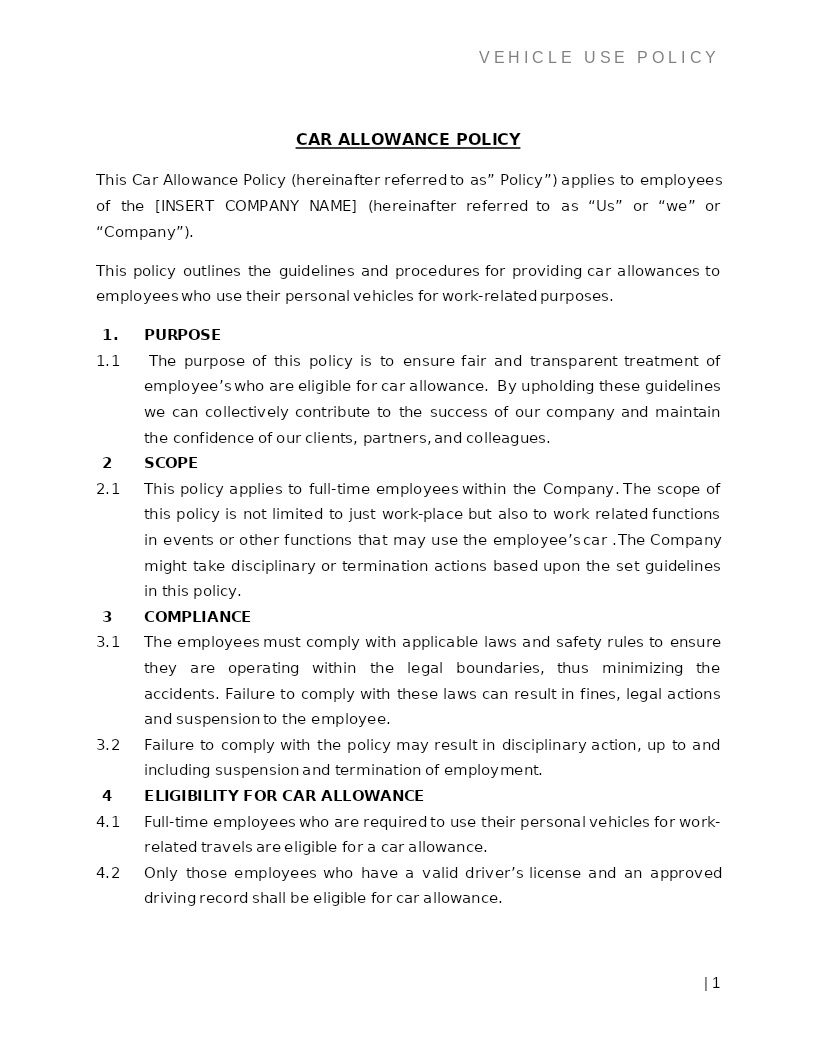
CAR ALLOWANCE POLICY
How does it work?
1. Choose this template
Start by clicking on "Fill out the template"
2. Complete the document
Answer a few questions and your document is created automatically.
3. Save - Print
Your document is ready! You will receive it in Word and PDF formats. You will be able to modify it.
Understanding Car Allowance Policy In U.S.
A Car Allowance Policy is an internal company policy that outlines the terms under which employees receive a fixed monthly or periodic allowance for business-related vehicle use. This allowance helps cover expenses such as fuel, maintenance, insurance, and depreciation associated with using a personal vehicle for work. The policy also clarifies eligibility criteria, reimbursement structure, tax implications under U.S. IRS guidelines, and employee responsibilities. By establishing clear rules, the company ensures fair compensation, consistent application of benefits, and compliance with employment and tax regulations.
Where a Car Allowance Policy Is Generally Used
A Car Allowance Policy is typically implemented in organizations where employees are required to travel for work-related purposes, such as:
- Sales and field service teams
- Real estate professionals
- Executives and managers with frequent off-site meetings
- Delivery, inspection, or customer service roles
- Remote employees tasked with site visits
- Employees working across multiple office or client locations
Different Types of Car Allowance Policies
- Fixed Monthly Car Allowance: Provides a set monthly payment to cover general vehicle expenses.
- Mileage Reimbursement Policy: Compensates employees based on miles driven, typically using the IRS standard mileage rate.
- Hybrid Car Allowance Program: Combines a fixed allowance with mileage tracking to balance cost and fairness.
- Vehicle Stipend for Executives: Higher-level allowance designed for senior leadership roles with expanded travel obligations.
- Company Fuel & Maintenance Reimbursement Policy: Adds specific reimbursements on top of the general allowance for fuel or repairs.
When Legal Guidance Becomes Helpful
Consulting legal professionals becomes important when:
- Employees operate across multiple states with varying labor and tax requirements
- The company manages large numbers of drivers or high-mileage roles
- Allowances need to comply with IRS accountable plan rules for tax-free reimbursements
- The policy must be integrated into employment contracts or handbooks
- Liability issues arise based on employee vehicle accidents during work travel
- The company wants to avoid misclassification of taxable vs. non-taxable allowances
Real-time legal guidance ensures your policy is compliant, enforceable, and tailored to your operational and state-specific needs.
How to Work With This Car Allowance Policy
- Apply eligibility criteria consistently across all departments
- Maintain clear documentation for mileage, vehicle condition, and insurance
- Use IRS guidelines to calculate taxable and non-taxable portions
- Ensure employees understand maintenance and insurance requirements
- Periodically review and adjust allowances based on fuel costs and inflation
- Include compliance instructions within your employee handbook
A well-managed policy ensures operational efficiency, employee satisfaction, and proper financial control.
Frequently Asked Questions
Q1. Is a car allowance taxable in the U.S.?
Yes, a car allowance is generally considered taxable income unless it qualifies under an IRS “accountable plan,” which requires mileage logs and proof of expenses. Many companies choose taxable allowances for simplicity, while others structure the policy to minimize tax burden for employees.
Q2. What is the difference between a car allowance and mileage reimbursement?
A car allowance is a fixed payment given regardless of distance driven, while mileage reimbursement is paid based on actual miles logged. Mileage reimbursement, when aligned with IRS mileage rates, is often non-taxable and preferred for fairness and accuracy.
Q3. Do employees need insurance to receive a car allowance?
Most U.S. employers require employees to maintain valid auto insurance with minimum state-required coverage. Some companies also request proof of enhanced liability insurance if employees drive frequently for work.
Q4. How is the car allowance amount determined?
Companies typically base allowance amounts on expected travel frequency, fuel prices, maintenance costs, and regional cost differences. Employers may also review IRS mileage guidelines to estimate reasonable monthly payments.
Q5. Can a company require mileage logs even with a fixed allowance?
Yes. Many employers require documentation to ensure the allowance is used for legitimate business travel. This also helps support tax compliance and internal audits.
Q6. What happens if an employee damages their personal vehicle during work travel?
Since the vehicle belongs to the employee, insurance claims must usually be filed through their personal auto policy. However, employers may offer supplemental coverage or reimburse deductibles depending on the company’s policy and state laws.
Q7. Are employees required to use their personal vehicle for work?
This depends on company policy. Some employers mandate personal vehicle use and provide an allowance, while others offer company vehicles as an alternative. Clear communication in the policy helps avoid disputes.
Q8. Can a car allowance policy be customized for different roles?
Absolutely. Companies often tailor allowances based on job functions, mileage expectations, and seniority levels. Customization ensures fairness, cost-effectiveness, and compliance with employment guidelines.