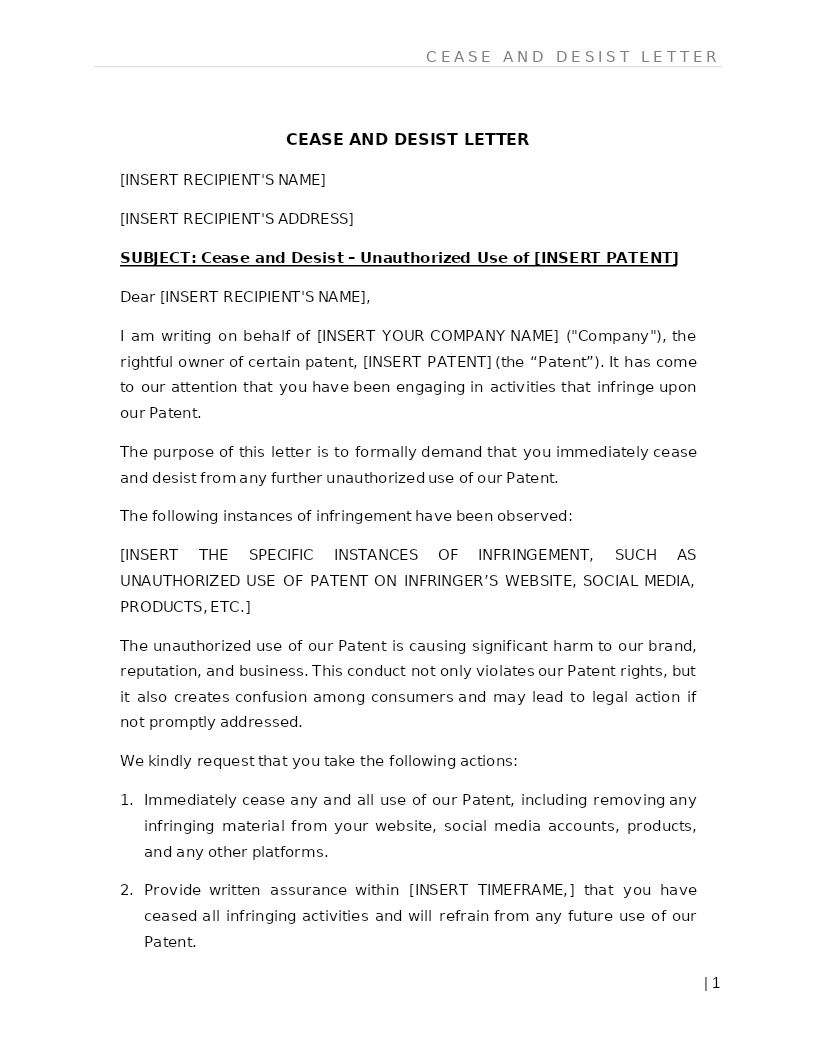
CEASE AND DESIST LETTER (PATENT)
How does it work?
1. Choose this template
Start by clicking on "Fill out the template"
2. Complete the document
Answer a few questions and your document is created automatically.
3. Save - Print
Your document is ready! You will receive it in Word and PDF formats. You will be able to modify it.
Formally Enforcing Patent Rights Through a Cease and Desist Letter (Patent)
Patent holders must protect their exclusive intellectual property rights when third parties engage in unauthorized use, manufacture, sale, importation, or distribution of patented inventions. A Cease-and-Desist Letter (Patent) is a formal written communication sent to an alleged infringer demanding that they immediately stop the infringing activities and comply with U.S. patent laws. This letter serves as a critical first step in asserting patent rights under Title 35 of the United States Code, USPTO rules, federal infringement standards, and applicable case law defining unlawful use of patented inventions.
A patent cease-and-desist letter documents the patent owner’s legal claims, identifies the relevant patent(s), summarizes the infringing conduct, and provides the recipient with notice of potential legal action. The letter also seeks voluntary compliance without initiating litigation by outlining corrective measures, deadlines for response, and potential remedies available to the patent owner. It establishes a legally significant record that the patent owner attempted to resolve the matter amicably before pursuing enforcement actions in federal court.
Where Cease and Desist Letters (Patent) Are Commonly Used
Patent-related cease-and-desist letters are used in numerous commercial and technological circumstances, including:
- Manufacturers producing goods that embody patented processes or components
- Sellers or distributors offering infringing products in physical stores or online marketplaces
- Technology companies deploying software or systems that include patented algorithms
- Startups unknowingly incorporating patented mechanisms into their products
- Businesses importing goods that infringe U.S. patents
- Competitors replicating innovative designs, devices, or functional improvements
- Industry participants violating exclusive licensing or assignment terms
- Parties misusing patented materials in research, development, or production
Any instance involving unauthorized use of a patented invention may require a cease-and-desist letter as an initial enforcement measure.
Different Types of Patent Cease and Desist Letters
1. Standard Patent Infringement Cease-and-Desist Letters: Notify an infringer of unauthorized use and demand immediate cessation.
2. Pre-Litigation Demand Letters: Detail infringement claims and warn of pending lawsuits if corrective action is not taken.
3. Licensing Offer Letters: Notify the infringer while offering an opportunity to negotiate a license instead of litigation.
4. Online Marketplace Infringement Notices: Used to alert e-commerce platforms of sellers offering infringing goods.
5. Post-Termination Patent Rights Enforcement Letters: Sent when a former licensee or partner continues using patented materials after a contract ends.
When Legal Guidance Becomes Helpful
Legal consultation is strongly recommended when:
- The alleged infringement is substantial or commercially significant
- The patent is part of an ongoing licensing or investment arrangement
- The facts are complicated, requiring a detailed infringement analysis
- Sending a letter may trigger a declaratory-judgment action by the recipient
- The patent owner seeks licensing revenue or settlement negotiations
- The infringer is located overseas or operating across multiple jurisdictions
- The matter involves multiple patents, claims, or competing intellectual property rights
- Evidence of infringement must be preserved for potential litigation
Patent attorneys ensure that the letter complies with U.S. patent law, avoids unlawful threats, and maximizes the patent owner’s enforcement position.
How to Work with This Template
- Identify the patent owner, the infringing party, and the relevant U.S. patent number(s)
- Describe the infringing activities with sufficient detail to put the recipient on notice
- Demand immediate cessation of infringing actions and removal of related products
- Outline corrective steps, such as halting sales, destroying inventory, or disclosing suppliers
- Provide a deadline for response and warn of possible litigation if ignored
- Consider whether to offer licensing terms or settlement opportunities
- Include confidentiality, preservation-of-evidence, and verification requirements
- Reference legal rights under federal patent law and governing jurisdiction
- Send the letter via traceable means (certified mail or electronic delivery)
This template reflects standard U.S. patent-enforcement practices and is suitable for patent owners, licensors, technology companies, manufacturers, and businesses seeking to protect their intellectual property.
Frequently Asked Questions
Q1. What is a Patent Cease and Desist Letter, and why is it important?
A Patent Cease and Desist Letter is a formal enforcement communication demanding that an infringer stop unauthorized use of a patented invention. It is important because it protects patent rights, documents notice of infringement and may avoid the time and expense of litigation.
Q2. Is sending a cease-and-desist letter required before filing a lawsuit?
No, but it is often advisable. Sending a letter demonstrates good-faith efforts to resolve the matter and may support claims for willful infringement if the infringer ignores it.
Q3. Can a cease-and-desist letter lead to a declaratory judgment action?
Yes. If drafted aggressively, the recipient may preemptively file a lawsuit seeking a court ruling that they are not infringing. This risk is why careful legal drafting is critical.
Q4. What information should be included in a patent cease-and-desist letter?
The letter should identify the patent, describe the infringement, demand cessation, outline corrective steps, and specify the consequences of noncompliance.
Q5. Are electronic signatures valid on cease-and-desist letters?
Yes. Under the ESIGN Act, electronically executed letters are valid, though many senders prefer written signatures for formality.
Q6. Can the letter offer a licensing option instead of demanding cessation?
Absolutely. Many patent owners use cease-and-desist letters as an opportunity to negotiate licensing terms rather than pursue litigation.
Q7. What happens if the infringer ignores the letter?
The patent owner may pursue federal litigation, seek damages, request injunctive relief, or file complaints with e-commerce platforms and import authorities.
Q8. Do I need proof of infringement before sending the letter?
You do not need full litigation-level proof, but you must have a reasonable basis to believe infringement is occurring to avoid making false claims.
Q9. Can a cease-and-desist letter be used to enforce expired patents?
No. Patent rights terminate after expiration. Attempting to enforce expired patents is unlawful and may violate federal regulations.
Q10. Should a patent attorney draft the letter?
Yes. Patent enforcement involves technical and legal complexities, and an attorney can ensure the letter is legally sound, strategically appropriate, and compliant with federal law.