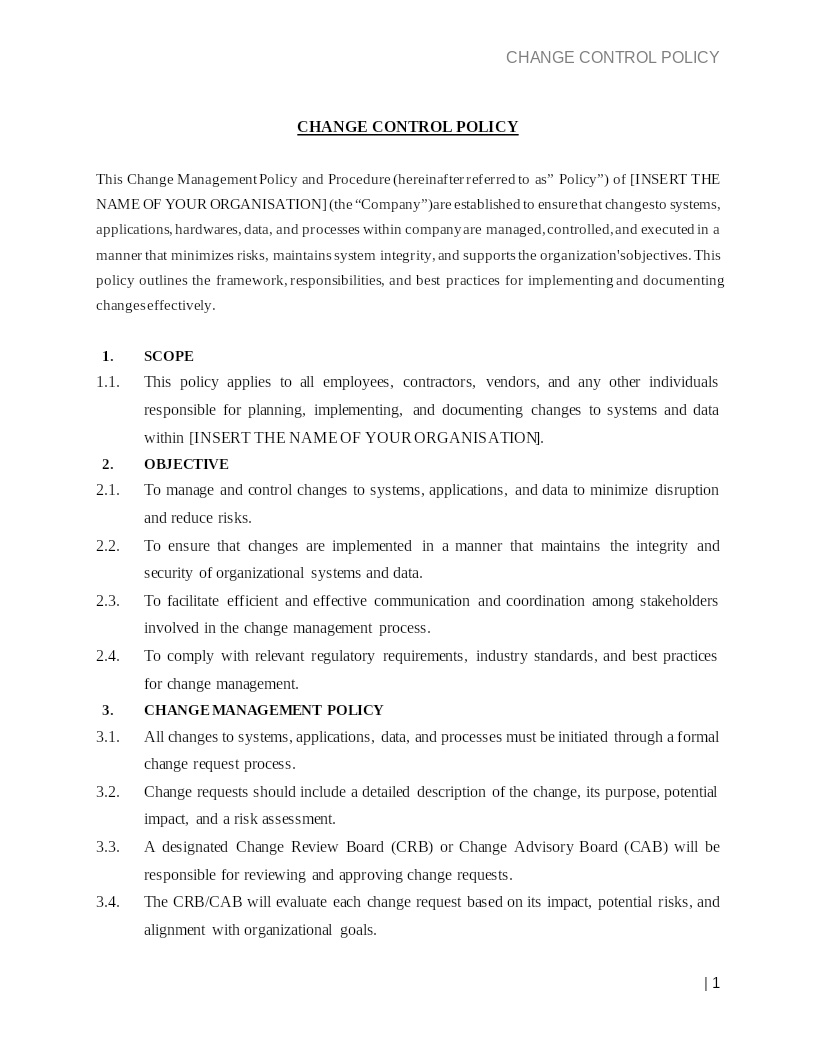
CHANGE CONTROL POLICY
How does it work?
1. Choose this template
Start by clicking on "Fill out the template"
2. Complete the document
Answer a few questions and your document is created automatically.
3. Save - Print
Your document is ready! You will receive it in Word and PDF formats. You will be able to modify it.
Ensuring Operational Stability and Regulatory Compliance Through a Change Control Policy
A Change Control Policy is an organizational governance document that establishes the legal, procedural, and technical requirements for evaluating, approving, implementing, and documenting changes to systems, processes, infrastructure, and technology environments. Developed in accordance with U.S. regulatory obligations and industry best practices, including the NIST Change and Configuration Management Standards, Sarbanes Oxley (SOX) internal-control requirements, the Federal Trade Commission’s (FTC) data-security guidelines, and applicable state data-protection and breach-notification laws, this policy ensures that all modifications whether operational, technical, or administrative are introduced in a controlled, documented, and auditable manner. It outlines the processes for reviewing risks, testing proposed changes, validating implementation steps, tracking approvals, and maintaining regulatory documentation. By adopting this policy, organizations reduce operational disruptions, strengthen security posture, and enhance compliance with federal cybersecurity requirements.
A comprehensive Change Control Policy defines the categories of changes subject to formal review such as emergency changes, routine modifications, system patches, configuration adjustments, software deployments, infrastructure upgrades, and process revisions and outlines the steps required to vet each change type. It describes procedures for initiating a change request, conducting impact assessments, evaluating cybersecurity vulnerabilities, assessing compliance risks, obtaining review and approval from designated authorities, and performing pre-deployment testing. The policy also mandates thorough documentation of implementation timelines, rollback procedures, and post-change validation. Further, it establishes the roles and responsibilities of employees, managers, IT personnel, and compliance officers, ensuring accountability throughout the lifecycle of a change. Through these controls, the organization minimizes errors, prevents unauthorized alterations, maintains system integrity, and demonstrates adherence to audit, regulatory, and cybersecurity standards.
Where Change Control Policies Are Commonly Used
Change Control Policies are essential across industries that rely on stable and secure operations, such as:
- Technology firms managing software releases, patches, and configurations
- Healthcare organizations governed by HIPAA’s administrative and technical safeguards
- Financial institutions subject to GLBA, SOX, and cybersecurity audits
- Government contractors required to comply with NIST 800-53 and DFARS requirements
- Manufacturing and logistics companies operating automated and connected systems
- Educational institutions overseeing IT systems and data management
- Retail and e-commerce enterprises handling sensitive customer data
- Nonprofits relying on cloud or hybrid infrastructures for service delivery
Any organization that manages systems or processes requiring stability and auditability benefits from a Change Control Policy.
Different Types of Change Control Policies You May Encounter
1. IT Change Management Policies: Regulate software updates, infrastructure changes, and configuration adjustments.
2. Operational Change Policies: Address changes to business processes, workflows, or organizational structures.
3. Emergency Change Policies: Outline procedures for expedited, high-risk, or mission-critical changes.
4. Regulated-Industry Change Policies: Apply stricter documentation and validation rules for industries like finance and healthcare.
5. Vendor and Third-Party Change Policies: Set expectations for service providers whose changes impact the organization’s systems.
When Legal Guidance Becomes Helpful
Legal consultation may be necessary when:
- Changes impact regulated data, such as PHI, financial information, or student records
- Modifications affect compliance with SOX, HIPAA, GLBA, FERPA, or state privacy laws
- System updates risk creating cybersecurity weaknesses or data-breach liabilities
- Vendor contracts impose obligations for change notification or approval
- Significant operational changes trigger employment-law or contractual considerations
- Security incidents require proof of change-management compliance
- Audits or regulatory inquiries demand documentation of change-control practices
Legal review ensures that change-management procedures align with federal, state, and industry-specific requirements.
How to Work with This Template
- Identify the types of changes that require formal review and approval
- Establish procedures for change requests, including documentation and risk assessment
- Define testing requirements and pre-implementation validation steps
- Implement authentication, authorization, and approval workflows
- Clarify responsibilities for IT teams, compliance staff, and managers
- Document emergency-change procedures and escalation protocols
- Require post-change testing, monitoring, and verification
- Maintain audit trails, logs, and records consistent with regulatory guidelines
- Incorporate rollback plans and contingency measures for failed changes
- Conduct periodic training on change-control responsibilities and compliance
- Update the policy regularly to reflect updated laws, technology shifts, or organizational changes
This template supports operational stability, cybersecurity readiness, and regulatory compliance.
Frequently Asked Questions
Q1. What is a Change Control Policy, and why is it important?
A Change Control Policy establishes procedures for safely and formally managing changes to systems and processes. It is important because it maintains stability, minimizes errors, and ensures compliance with U.S. regulatory and cybersecurity standards.
Q2. What types of changes are covered?
Software updates, security patches, infrastructure modifications, configuration changes, process updates, third-party system changes, and emergency fixes.
Q3. Who is responsible for initiating a change request?
Any employee proposing a change must follow documented procedures and submit a formal request for review and approval.
Q4. Does the policy require testing before implementation?
Yes. All non-emergency changes must undergo validation and testing to ensure they do not introduce vulnerabilities or system failures.
Q5. Are emergency changes allowed?
Yes, but they must follow expedited review procedures and be documented, tested, and validated immediately afterward.
Q6. Does the policy apply to cloud-based systems?
Absolutely. Any cloud service, SaaS application, or hosted infrastructure is subject to this policy’s requirements.
Q7. How does the policy support compliance?
It provides audit-ready documentation demonstrating that systems are modified in accordance with NIST, SOX, HIPAA, and other regulatory frameworks.
Q8. What happens if an unauthorized change occurs?
Unauthorized changes may result in disciplinary action and require immediate remediation to restore system integrity.
Q9. Does the policy address vendor-managed changes?
Yes. Vendors must comply with organizational requirements, including notification, approval, and documentation standards.
Q10. Should legal counsel review the Change Control Policy?
Yes. Legal review ensures alignment with regulatory obligations and reduces liability related to system failures or cybersecurity incidents.