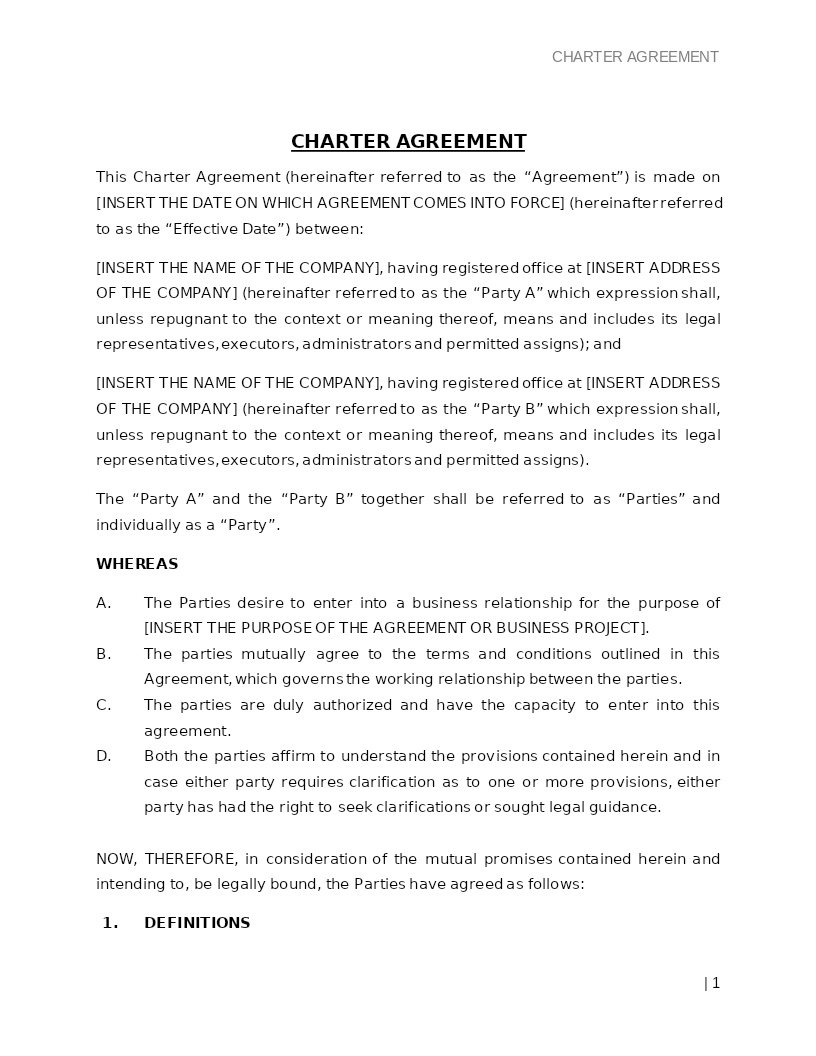
CHARTER AGREEMENT
How does it work?
1. Choose this template
Start by clicking on "Fill out the template"
2. Complete the document
Answer a few questions and your document is created automatically.
3. Save - Print
Your document is ready! You will receive it in Word and PDF formats. You will be able to modify it.
Understanding a Charter Agreement in U.S. Commercial Operations
When your business needs temporary access to a vessel, aircraft, truck fleet, or specialized transportation asset, you need a clear framework that defines how that asset will be used. A Charter Agreement provides that structure. It sets out the commercial, operational, and legal terms governing the hire of a vessel or vehicle covering usage rights, payment schedules, crew responsibilities (if applicable), liabilities, maintenance duties, and restrictions.
Putting a Charter Agreement in place gives both parties the confidence to move forward. It ensures the asset owner knows how and when the vessel or vehicle will be used, while the charterer gains predictable access under clearly defined conditions.
Where Charter Agreements Are Commonly Used
Charter agreements are widely used across transportation-heavy industries, especially when ownership is not feasible or flexibility is needed. Common scenarios include:
- Commercial shipping and freight operations requiring vessels for cargo movement
- Logistics companies needing short-term truck fleets or specialized vehicles
- Aviation operators chartering aircraft for private travel, cargo, or crew transport
- Energy, oil & gas, and offshore projects requiring support vessels
- Tourism and leisure businesses offering yachts, cruise vessels, or charter flights
- Construction & infrastructure companies needing heavy equipment transport
- Government, defense, or emergency services requiring mission-specific crafts
Any time a business relies on another party’s transportation asset, a Charter Agreement ensures the terms of use are clear, enforceable, and aligned with U.S. commercial standards.
Different Types of Charter Agreements You May Encounter
- Bareboat / Demise Charter: The charterer takes full possession and control of the vessel or aircraft, including operational responsibility, crew hiring, fuel, and maintenance.
- Time Charter: The charterer hires the vessel/vehicle for a set period. The owner may provide the crew, while the charterer controls destinations and operations.
- Voyage Charter: Used for a specific trip or delivery. The owner operates the vessel, while the charterer pays for the agreed voyage.
- Trip or Mission-Based Charter: Common in aviation and offshore industries when hiring for a defined mission, route, or service requirement.
- Wet Lease vs. Dry Lease (Aviation)
- Wet Lease: Crew + aircraft included
- Dry Lease: Aircraft only; charterer manages personnel
Each type balances control, responsibility, and cost differently, depending on operational needs.
When Legal Guidance Becomes Helpful
Most straightforward charters do not require heavy legal involvement. But professional legal advice becomes valuable when:
- The charter involves high-value vessels, aircraft, or specialized equipment
- The parties operate across multiple states or international waters/airspace
- The agreement must comply with maritime law, FAA rules, DOT regulations, or safety codes
- Operational risks are high (offshore, hazardous cargo, medical flights, etc.)
- The charterer needs detailed clauses for delays, demurrage, damages, or liability allocation
- The agreement includes custom service packages, crew responsibilities, or complex cost-sharing
- There are insurance, indemnity, or regulatory audit considerations
- The deal is long-term and must align with broader business strategy or risk management policies
Legal review is not mandatory for every transaction, but it helps reduce exposure to operational, financial, and compliance risks especially in regulated sectors.
How to Work with This Template
- Identify the owner and the charterer clearly
- Specify whether the charter is voyage-based, time-based, or bareboat/demise
- Outline crew obligations, operational control, and safety responsibilities
- Define usage limits, permitted routes, and restrictions
- State the payment structure, including fuel, port charges, crew costs, or landing fees
- Select governing state law (maritime contracts generally allow choice of law)
- Add insurance requirements and minimum coverage limits
- Review the terms together (legal review optional but recommended for high-value charters)
- Sign electronically or in hard copy
The template follows commercial standards widely recognized across the United States and is compatible with major e-signature platforms.
Frequently Asked Questions
Q1. What is the purpose of a Charter Agreement?
A Charter Agreement defines the terms under which a vessel, aircraft, or vehicle is hired. It outlines how the equipment will be used, who is responsible for operations, what costs are covered, and how risks are managed. This helps both parties operate confidently without misunderstandings and ensures the agreement is legally enforceable under U.S. commercial standards.
Q2. Is a Charter Agreement legally binding in the U.S.?
Yes. Once both parties sign, a Charter Agreement becomes a legally enforceable contract. It must include essential terms such as duration, payment structure, operational duties, and liability allocation. U.S. courts generally enforce properly drafted charter agreements especially those that comply with maritime, aviation, and transportation regulations.
Q3. What is the difference between a Time Charter and a Voyage Charter?
A Time Charter allows the charterer to use the vessel or aircraft for a defined period, usually controlling destinations and schedules.
Whereas A Voyage Charter applies to a single trip or delivery, where the owner typically maintains operational control.
Choosing the right form depends on whether you need flexibility or a fixed transport service.
Q4. Who is responsible for crew, fuel, and maintenance?
Responsibility depends on the type of charter:
- Bareboat/Demise: Charterer assumes full operational responsibility, including crew, fuel, and maintenance.
- Time/Voyage Charter: Owner often provides crew and handles technical operations, while the charterer covers commercial use.
The agreement clarifies the cost and responsibility breakdown to avoid disputes.
Q5. Can a Charter Agreement be customized for special operations?
Yes. Charters are highly customizable especially for offshore missions, heavy cargo, aviation services, or regulated industries. You can tailor clauses for weather delays, hazardous material handling, additional crew requirements, multi-jurisdiction routes, or emergency services. Legal professionals can refine these terms to fit operational reality.
Q6. Are electronic signatures valid for Charter Agreements?
Yes. Under the ESIGN Act and UETA, electronic signatures are legally valid in all U.S. states. Businesses commonly execute charter agreements digitally, especially in logistics, aviation, and shipping where fast turnaround is essential.
Q7. What happens if the chartered vessel or aircraft is damaged?
Liability depends on the charter type and insurance coverage.
- Under a bareboat charter, the charterer typically bears responsibility.
- Under time or voyage charters, owners often retain technical responsibility.
The agreement should specify insurance requirements and outline how damages, repairs, or operational downtime will be handled.
Q8. Can a Charter Agreement cover multi-state or international routes?
Yes. Charter Agreements often include operations across state lines, coastal waters, or international airspace. You simply choose a governing state law and specify how compliance with FAA, DOT, Coast Guard, or maritime regulations will be maintained.
Q9. Is this template suitable for commercial charters?
Yes. The template is designed for U.S.-based commercial use, including freight operations, private aviation, logistics contracts, offshore services, and business transportation needs. It can also be adapted for personal or leisure charters.
Q10. What if additional services or destinations are added later?
You can update the Charter Agreement using an amendment signed by both parties. Many businesses simply attach an addendum that details new routes, costs, or operational requirements. Keeping written records ensures the agreement remains enforceable.