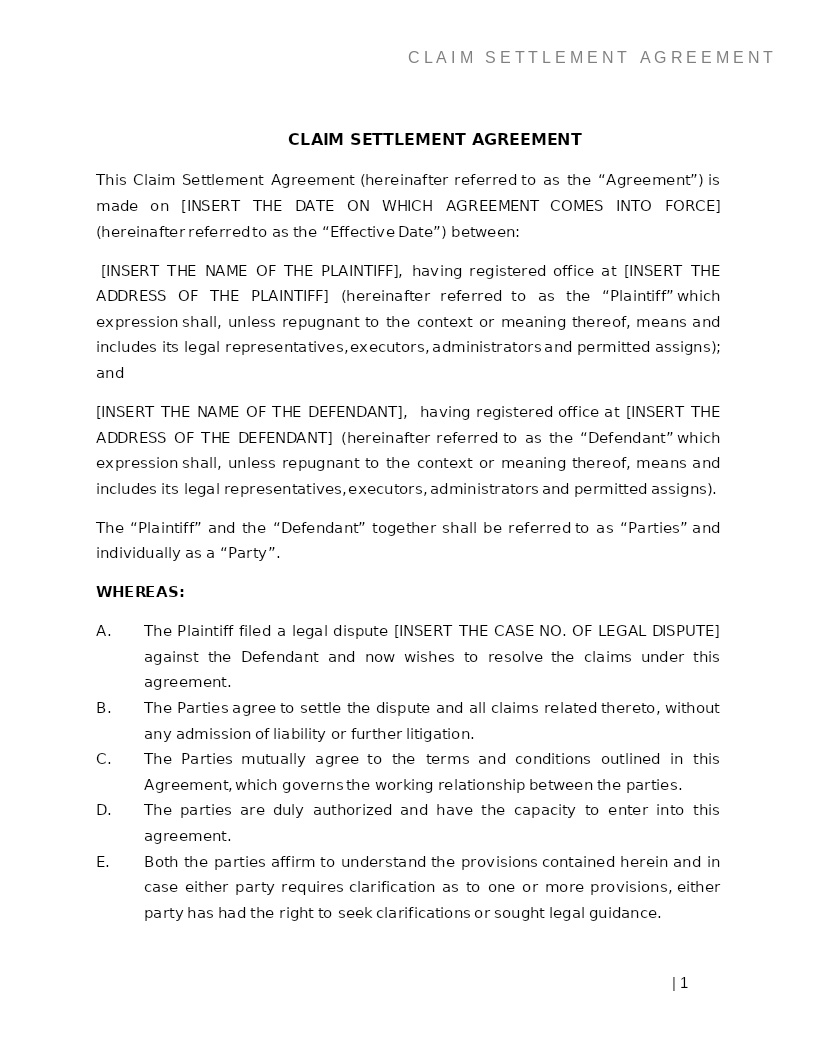
CLAIM SETTLEMENT AGREEMENT
How does it work?
1. Choose this template
Start by clicking on "Fill out the template"
2. Complete the document
Answer a few questions and your document is created automatically.
3. Save - Print
Your document is ready! You will receive it in Word and PDF formats. You will be able to modify it.
Formalizing the Resolution of Disputes Through Claim Settlement Arrangements
When parties become involved in a dispute whether arising from a contract, property damage, employment matters, business transactions, personal injury, or other legal claims it is often beneficial to resolve the matter without litigation. A Claim Settlement Agreement serves this purpose. It documents the terms under which the parties voluntarily settle their dispute, exchange consideration, and release one another from liability, all in accordance with U.S. contract law, federal and state settlement standards, and applicable regulations governing releases, waivers, and dispute resolution.
By entering into a Claim Settlement Agreement, the parties create a binding legal instrument that clarifies the settlement amount, defines the scope of the release, outlines confidentiality requirements, and specifies the obligations of each party. Such agreements help avoid costly litigation, mitigate risk, and ensure that disputes are resolved in a final and enforceable manner.
Where Claim Settlement Agreements Are Commonly Used
Claim Settlement Agreements are utilized across a wide range of legal, commercial, and personal contexts, including:
- Contract disputes and unpaid financial obligations
- Property damage, negligence claims, and insurance matters
- Employment-related disputes, wage issues, or wrongful termination claims
- Business disputes involving vendors, partners, or customers
- Personal injury matters (excluding those requiring attorney involvement under state law)
- Real estate, landlord-tenant, or security deposit disputes
- Loan or debt repayment disagreements
- Consumer complaints or service-related issues
Any time parties seek to resolve a claim without court intervention, a Claim Settlement Agreement provides the governing legal framework.
Different Types of Claim Settlement Agreements You May Encounter
1. General Release Agreements: Provide a broad release of all known and unknown claims between the parties.
2. Limited-Claim Settlement Agreements: Resolve only specific disputes identified in the document.
3. Mutual Release Agreements: Require both parties to release one another from liability.
4. Confidential Settlement Agreements: Include non-disclosure provisions restricting discussion of settlement terms.
5. Structured Settlement Agreements: Involve installment payments or long-term financial arrangements.
When Legal Guidance Becomes Helpful
Legal counsel may be advisable when:
- The dispute involves significant financial exposure or complex claims
- State laws impose specific requirements for releases (e.g., employment claims)
- The agreement includes confidentiality, non-disparagement, or non-compete provisions
- Insurance carriers or third parties are involved
- The settlement may impact future rights or legal remedies
- One party is represented by counsel or legal proceedings have already begun
- The release must comply with federal or state consumer, employment, or injury laws
Legal review helps ensure the agreement meets U.S. legal requirements and is enforceable in court.
How to Work with This Template
- Identify the parties and describe the underlying dispute or claim
- Specify the settlement amount and payment structure
- Define the scope of the release and any mutual waivers
- Address confidentiality, non-disparagement, and non-admission clauses
- Outline deadlines, responsibilities, and final obligations
- Select governing law and dispute-resolution procedures
- Review applicable state-specific requirements for settlement and release
- Execute the agreement through written or electronic signatures
This template aligns with widely recognized U.S. settlement practices and is compatible with e-signature platforms and legal documentation systems.
Frequently Asked Questions
Q1. What is a Claim Settlement Agreement, and why is it important?
A Claim Settlement Agreement is a legally binding document used to resolve disputes without litigation. It is important because it establishes finality, outlines financial terms, releases liability, and protects both parties from future claims related to the dispute.
Q2. Does a Claim Settlement Agreement need to be in writing?
Yes. A written agreement is essential for enforceability and clarity. It ensures both parties understand the terms, prevents misunderstandings, and provides proof of the settlement in case of future disputes.
Q3. What claims can be resolved with a settlement agreement?
Most civil disputes such as contract issues, property claims, unpaid financial obligations, or certain employment-related claims can be settled through a written agreement, subject to statutory restrictions.
Q4. What is a release of claims?
A release is a clause in the agreement stating that one or both parties give up the right to pursue further legal action related to the dispute. The release should be clear, comprehensive, and compliant with state law.
Q5. Can the settlement agreement include confidentiality terms?
Yes. Many agreements include clauses requiring the parties to keep the settlement amount and related details confidential. These provisions should be clear and legally enforceable.
Q6. Is the settlement payment taxable?
Taxability depends on the nature of the claim. Some compensation may be taxable, while others such as certain physical injury settlements may not be. The agreement should clarify the parties’ tax responsibilities.
Q7. What happens if a party breaches the settlement agreement?
The non-breaching party may pursue enforcement through legal action, including seeking the settlement amount, damages, attorney’s fees, or specific performance depending on the agreement’s terms.
Q8. Are electronic signatures valid for Claim Settlement Agreements?
Yes. Under the ESIGN Act, electronic signatures are fully enforceable for settlement documents, provided both parties consent to electronic execution.
Q9. Can the settlement be rescinded or revoked?
Once executed, settlement agreements are generally final. Rescission may be permitted only in limited circumstances, such as fraud, duress, or statutory rescission periods applicable to certain claims.
Q10. Do both parties need legal representation?
Not always, but legal representation is recommended especially for complex or high-value disputes to ensure the agreement protects the party’s interests and complies with applicable laws.