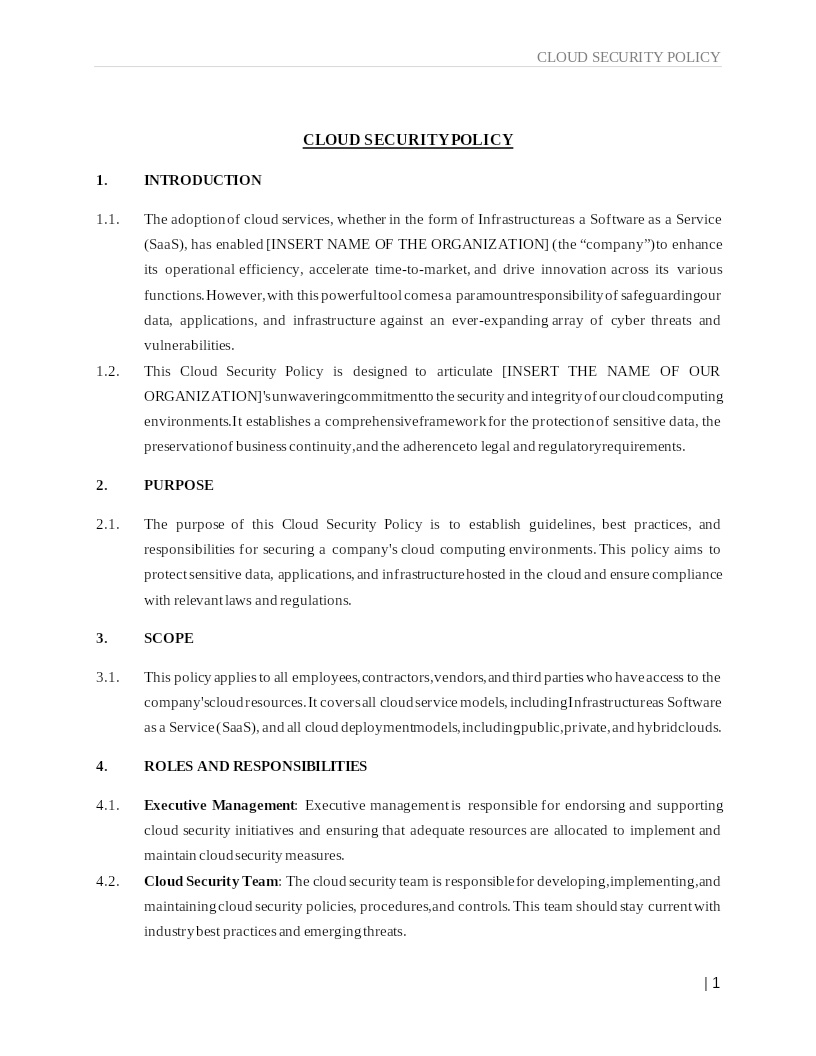
CLOUD SECURITY POLICY
How does it work?
1. Choose this template
Start by clicking on "Fill out the template"
2. Complete the document
Answer a few questions and your document is created automatically.
3. Save - Print
Your document is ready! You will receive it in Word and PDF formats. You will be able to modify it.
Enhancing Data Protection, Compliance, and System Integrity Through a Cloud Security Policy
A Cloud Security Policy is an organizational governance document that establishes the legal, technical, and administrative requirements for securing data, systems, and services hosted in cloud environments. Created in accordance with U.S. cybersecurity laws and regulatory standards, including the National Institute of Standards and Technology (NIST) cloud security frameworks, the Federal Trade Commission (FTC) Act governing unfair or deceptive security practices, applicable state data-privacy and breach-notification laws, and industry-specific mandates such as HIPAA for healthcare data and GLBA for financial institutions, this policy sets forth the controls and responsibilities necessary to safeguard sensitive information stored, transmitted, or processed within cloud platforms. It articulates the organization’s duty to implement secure configurations, encryption protocols, vendor due diligence, access controls, monitoring tools, and incident-response procedures to reduce technological risk and maintain compliance with federal and state requirements.
A comprehensive Cloud Security Policy clearly defines authorized cloud service models such as Software-as-a-Service (SaaS), Platform-as-a-Service (PaaS), and Infrastructure-as-a-Service (IaaS) and outlines the shared-responsibility model governing security obligations between the organization and cloud service providers. It details requirements for identity and access management, including multi-factor authentication, least-privilege access, privileged-account monitoring, and role-based access controls. The policy further requires encryption of data in transit and at rest, establishment of secure network configurations, the use of approved cloud vendors compliant with SOC 2, ISO 27001, FedRAMP, or comparable security certifications, and the implementation of logging and continuous monitoring tools to detect and respond to unauthorized access, malware, or anomalous activity. It also describes procedures for onboarding and offboarding cloud services, risk assessments, vendor due diligence, and documentation requirements for regulatory audits. By adopting this policy, organizations strengthen their cybersecurity posture, promote operational resilience, protect confidential information, and reduce exposure to security incidents involving cloud environments.
Where Cloud Security Policies Are Commonly Used
Cloud Security Policies are critical across industries that rely on cloud-based technologies, including:
- Technology companies, SaaS platforms, and cloud-native service providers
- Healthcare organizations hosting electronic health records or telehealth applications
- Financial institutions governed by GLBA security mandates
- Government contractors required to meet FedRAMP or NIST standards
- Educational institutions using cloud platforms for student data and remote learning
- Retail and e-commerce companies managing payment systems and customer data
- Manufacturing and logistics companies using cloud systems for automation and IoT
- Nonprofits collecting donor or beneficiary information through cloud applications
Any organization that stores or processes information in the cloud benefits from a Cloud Security Policy.
Different Types of Cloud Security Policies
1. Cloud Access and Authentication Policies: Define access-control requirements and identity verification processes.
2. Cloud Data Protection Policies: Address encryption, retention, privacy, and secure handling of sensitive information.
3. Cloud Vendor Management Policies: Regulate the selection, evaluation, and contractual oversight of cloud service providers.
4. Cloud Configuration and Monitoring Policies: Set standards for secure configuration, logging, and continuous monitoring tools.
5. Cloud Incident Response and Breach Management Policies: Outline procedures for identifying, containing, and reporting cloud security incidents.
When Legal Guidance Becomes Helpful
Legal counsel should be consulted when:
- Cloud systems contain regulated data (PHI, financial data, student records, biometric data, etc.)
- Multi-state operations trigger overlapping privacy and breach-notification requirements
- Vendor contracts include data-processing, cybersecurity liability, or SLA guarantees
- Incident-response procedures require coordination with regulators or law enforcement
- Cloud infrastructure supports government contracts subject to FedRAMP or NIST controls
- The organization must comply with HIPAA, GLBA, SOX, FERPA, or other industry-specific laws
- Data migration, cross-border transfers, or subcontractor access raise legal risks
Legal review ensures compliance with U.S. cybersecurity, privacy, and contractual requirements.
How to Work with This Template
- Define the cloud services covered by the policy (SaaS, IaaS, PaaS)
- Document access-control standards, authentication rules, and user responsibilities
- Require encryption of all sensitive and regulated data
- Establish approved cloud-vendor criteria and due-diligence processes
- Outline secure configuration rules, including network segmentation and monitoring
- Provide instructions for reporting, analyzing, and responding to cloud incidents
- Clarify data-retention, deletion, and backup procedures
- Include requirements for vendor contracts and SLA terms involving data security
- Require periodic security audits and compliance assessments
- Mandate training for employees using or administering cloud systems
- Update the policy regularly to reflect evolving threats and regulatory changes
This template ensures alignment with U.S. cybersecurity standards and best practices.
Frequently Asked Questions
Q1. What is a Cloud Security Policy, and why is it important?
A Cloud Security Policy defines the rules and controls for securing cloud-based systems and data. It is essential to ensure regulatory compliance, reduce cybersecurity risk, and protect sensitive information from unauthorized access.
Q2. Does the policy apply to all cloud platforms?
Yes. The policy applies to all approved cloud systems, including SaaS, PaaS, and IaaS platforms used by the organization.
Q3. What types of data are protected under this policy?
The policy covers all business data, including personal information, financial data, intellectual property, customer records, and regulated information such as PHI or student data.
Q4. Does the policy require encryption?
Absolutely. Encryption of data in transit and at rest is a core requirement consistent with U.S. data-protection standards.
Q5. How are cloud security incidents handled?
Incidents are managed through documented response procedures involving containment, investigation, remediation, and legal reporting obligations.
Q6. Are employees allowed to use unauthorized cloud services?
No. Use of unapproved cloud applications (shadow IT) is prohibited due to security and compliance risks.
Q7. Does the policy address vendor selection?
Yes. Only vetted vendors meeting recognized cybersecurity certifications and regulatory requirements may be used.
Q8. Can employees access cloud systems from personal devices?
Yes, but only if the device meets security standards such as MFA, device encryption, and approved anti-malware protections.
Q9. How often should a Cloud Security Policy be updated?
Regularly, at least annually or whenever cloud technology, legal requirements, or organizational needs change.
Q10. Should legal counsel review the Cloud Security Policy?
Yes. Legal review ensures compliance with cybersecurity laws, vendor contracts, and industry-specific regulations.