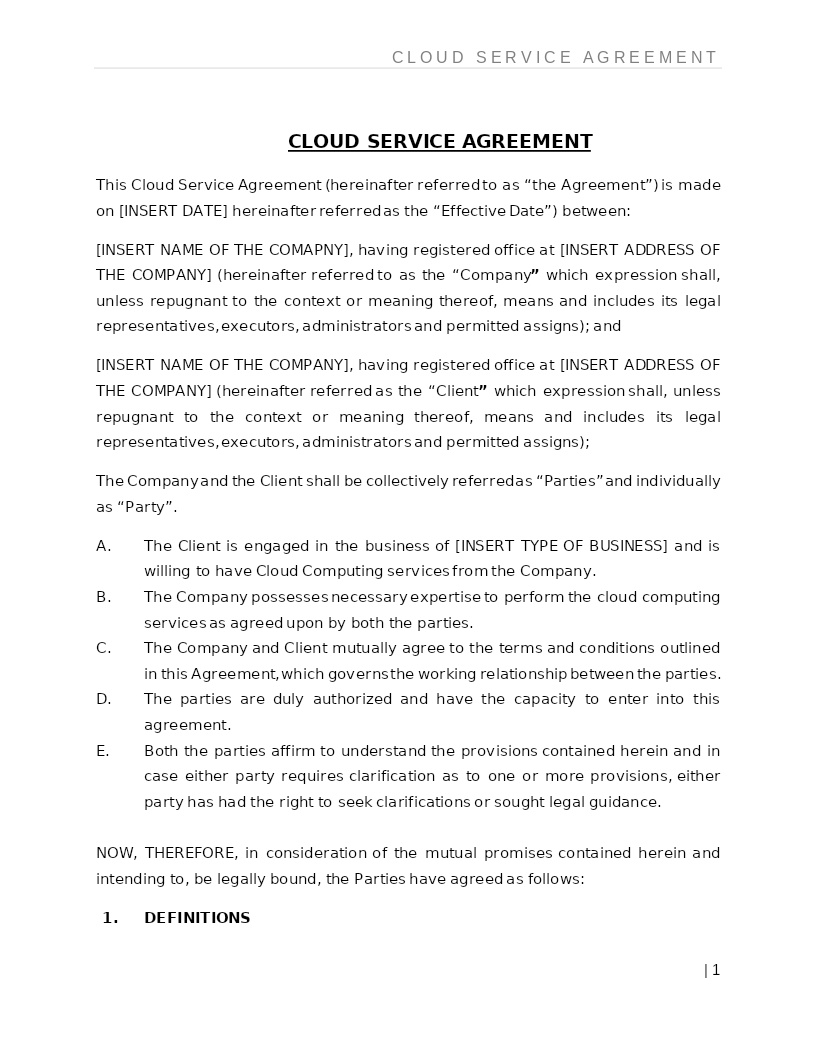
CLOUD SERVICE AGREEMENT
How does it work?
1. Choose this template
Start by clicking on "Fill out the template"
2. Complete the document
Answer a few questions and your document is created automatically.
3. Save - Print
Your document is ready! You will receive it in Word and PDF formats. You will be able to modify it.
Defining Cloud-Based Service Obligations in Technology Deliverables
As businesses increasingly rely on cloud-based platforms to support their operations, it becomes essential to establish a legally sound framework governing the provision, access, management, and use of those services. A Cloud Service Agreement accomplishes this by setting forth the terms and conditions under which a Service Provider furnishes cloud hosting, storage, computing resources, software access, or related digital services to a client, in accordance with U.S. contract law, data-protection requirements, and applicable cybersecurity regulations.
By entering into a Cloud Service Agreement, the parties create a binding understanding that outlines service availability, data ownership, security obligations, limitations of liability, and performance metrics. The agreement ensures that cloud-based operations are conducted in a compliant, secure, and predictable manner while safeguarding both parties’ commercial and technological interests.
Where Cloud Service Agreements Are Commonly Used
Cloud Service Agreements are widely implemented in various technological and commercial environments, including:
- Hosting websites, applications, and digital platforms
- Cloud storage, data archiving, and document management
- SaaS, PaaS, and IaaS service models
- Enterprise resource planning (ERP) and customer relationship management (CRM) solutions
- Virtualized computing environments and remote server operations
- Cybersecurity monitoring, threat detection, and system resilience
- Data analytics, machine learning, and AI tool hosting
- Business continuity, failover systems, and disaster recovery arrangements
Any time a business relies on third-party cloud infrastructure, a Cloud Service Agreement governs the legal and operational relationship.
Different Types of Cloud Service Agreements You May Encounter
1. Software-as-a-Service (SaaS) Agreements: Grant access to a hosted software platform without transferring ownership.
2. Infrastructure-as-a-Service (IaaS) Agreements: Provide virtualized computing resources such as servers, networks, or storage.
3. Platform-as-a-Service (PaaS) Agreements: Furnish development environments, frameworks, or tools for building applications.
4. Managed Cloud Services Agreements: Cover ongoing support, monitoring, and administration of cloud resources.
5. Hybrid or Multi-Cloud Service Agreements: Integrate multiple service providers or environments into one operational framework.
When Legal Guidance Becomes Helpful
Legal review may be advisable when:
- The cloud services involve sensitive, confidential, or regulated data
- Data residency, cross-border transfers, or third-party integrations are involved
- The agreement includes complex service-level obligations or uptime guarantees
- The Client relies heavily on the cloud service for mission-critical operations
- Intellectual property rights must be defined for hosted applications or content
- The Provider retains broad termination or data-access rights
- Cybersecurity, encryption, and incident-response requirements must meet regulatory standards
Legal counsel ensures that the agreement is compliant with U.S. privacy laws, security regulations, and contractual norms.
How to Work With This Template
- Identify the Service Provider and Client
- Describe the scope of cloud services being provided
- Set forth service levels, uptime commitments, and incident-response protocols
- Outline data ownership, confidentiality, and security requirements
- Specify payment terms, billing schedules, and additional fees
- Address limitations of liability, indemnification, and warranty disclaimers
- Select governing law and jurisdiction
- Review the agreement for compliance with applicable U.S. regulations
- Execute the agreement electronically or in printed form
This template adheres to U.S. cloud-services contracting practices and is compatible with major e-signature platforms.
Frequently Asked Questions
1. What is a Cloud Service Agreement, and why is it important?
A Cloud Service Agreement is a legally binding contract that governs how a Service Provider delivers cloud-based hosting, storage, computing, or software services to a client. It is important because it clarifies security obligations, performance metrics, data rights, and liability limitations—all critical for maintaining safe and reliable cloud operations.
2. Does a Cloud Service Agreement address data security and privacy?
Yes. These agreements typically include detailed provisions regarding encryption, access control, data handling, and security measures to comply with U.S. privacy and cybersecurity standards.
3. Who owns the data stored or processed in the cloud?
Most agreements confirm that the Client retains ownership of its data, while the Provider receives only limited rights necessary to deliver the services. Data ownership should always be expressly stated.
4. What service levels are typically included?
Service levels often include uptime guarantees, response times, escalation procedures, and maintenance windows. These terms are usually documented in a Service Level Agreement (SLA) incorporated into the contract.
5. Are there limitations on the Provider’s liability?
Yes. Cloud Service Agreements typically include limitations of liability, warranty disclaimers, and exclusions for indirect or consequential damages. These provisions help balance the risks associated with cloud operations.
6. Can the Provider access the Client’s data?
Limited access may be necessary to perform support, maintenance, or troubleshooting. The agreement should specify when and how such access may occur, along with confidentiality obligations.
7. What happens if the service is interrupted or unavailable?
The agreement should define remedies, such as service credits or escalated support, and specify whether extended downtime constitutes a breach. Uptime guarantees are often central to cloud agreements.
8. Are electronic signatures valid for Cloud Service Agreements?
Yes. Under the U.S. ESIGN Act, electronic signatures are fully enforceable and commonly used for technology agreements, including cloud services.
9. Can the Client terminate the cloud service early?
Termination rights depend on the agreement’s terms. Some contracts allow termination with notice, while others impose cancellation fees or require payment through the end of the term.
10. Are subcontractors or third-party service providers involved?
Cloud providers may use third-party infrastructure or subcontractors. The agreement should require such parties to comply with the same security and confidentiality obligations.
11. Does the agreement address data retrieval upon termination?
Yes. A well-drafted agreement specifies data-export requirements, transition assistance, and timelines for retrieving or deleting data at the end of the service period.