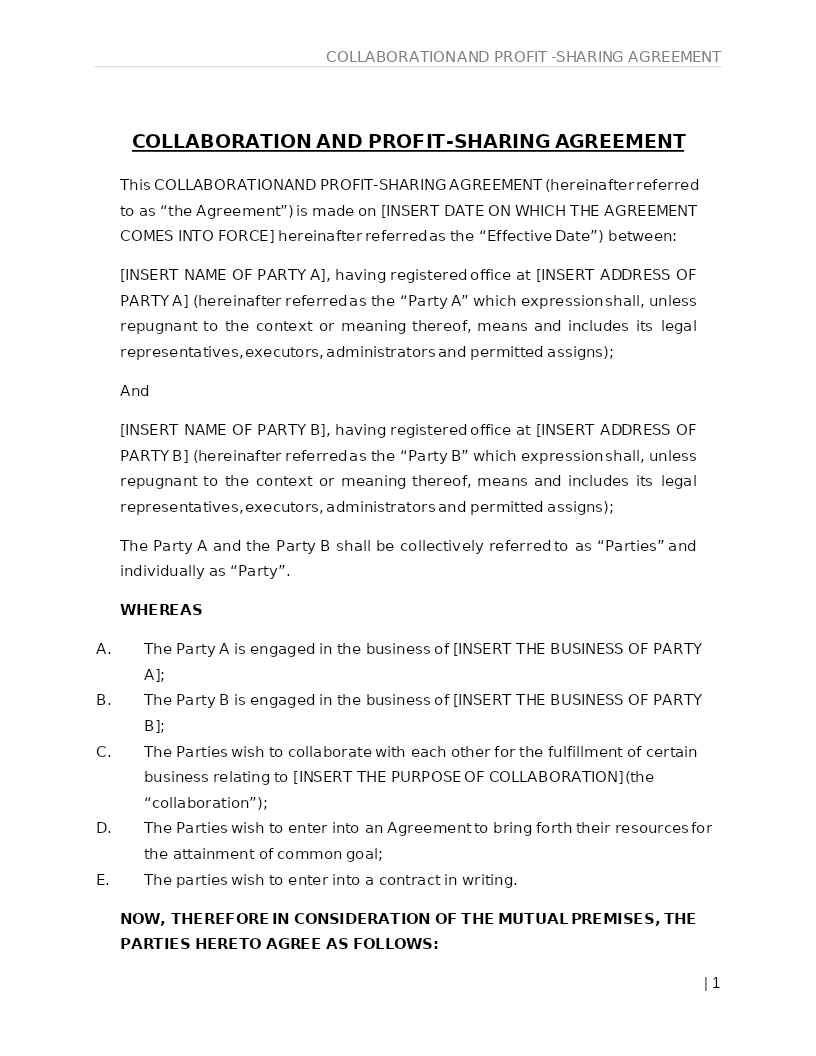
COLLABORATION AND PROFIT-SHARING AGREEMENT
How does it work?
1. Choose this template
Start by clicking on "Fill out the template"
2. Complete the document
Answer a few questions and your document is created automatically.
3. Save - Print
Your document is ready! You will receive it in Word and PDF formats. You will be able to modify it.
Ensures clarity and transparency by defining what each party will contribute
Businesses, creators, professionals, and organizations often work together to develop projects, products, intellectual property, or joint ventures that generate revenue. To ensure that each party’s contributions, rights, responsibilities, and profit entitlements are clearly defined, a Collaboration and Profit-Sharing Agreement establishes the legal framework for the partnership. It sets frameworks and outlines project objectives, roles, ownership structures, management authority, revenue distribution formulas, expense allocation, confidentiality requirements, dispute-resolution mechanisms, and termination rights.
This Agreement ensures clarity and transparency by defining what each party will contribute, whether capital, labor, intellectual property, technology, marketing efforts, or specialized skills, and how profits, losses, and responsibilities will be allocated. It also addresses important elements such as intellectual property ownership, decision-making authority, confidentiality obligations, deliverables, performance standards, and timelines.
Collaboration and Profit-Sharing Agreements are widely used across joint creative ventures, business partnerships, product development initiatives, influencer collaborations, startup co-creation, co-branded projects, consulting partnerships, and strategic alliances. Whenever parties combine resources or efforts to pursue a shared objective, this agreement ensures legal compliance, protection of interests, and fair distribution of financial gains.
Where Collaboration and Profit-Sharing Agreements Are Commonly Used
These agreements are frequently used in contexts such as:
- Co-development of products, mobile apps, software, or digital tools
- Collaboration between influencers, creators, and brands for content monetization
- Joint ventures for new business lines or revenue-generating projects
- Co-branded marketing or promotional campaigns
- Partnerships between consultants, agencies, and freelancers
- Creative collaborations in music, film, art, photography, and media production
- Research-and-development collaborations between companies or institutions
- Licensing or joint exploitation of intellectual property
- Revenue-sharing arrangements in franchises, distribution networks, or referral systems
Any time two or more parties contribute to a shared commercial activity, a written Collaboration and Profit-Sharing Agreement protects all involved.
Types of Collaboration and Profit-Sharing Agreements
- Joint Venture Collaboration Agreement: For formal, structured partnerships with shared management.
- Project-Based Collaboration Agreement: Used for time-limited or single-purpose initiatives.
- Creative Collaboration Agreement: For content creation, media production, and artistic partnerships.
- Licensing and Royalty-Sharing Agreement: For collaborative use or exploitation of intellectual property.
- Influencer/Brand Collaboration Agreement: Defines revenue share from campaigns, endorsements, and co-created content.
- Research or Technology Collaboration Agreement: Used for innovations, prototypes, and IP-heavy projects.
When Legal Guidance Becomes Helpful
Legal review is strongly recommended when:
- Intellectual property (IP) is created, shared, or merged
- Payment structures or revenue splits are complex
- Trade secrets, business plans, or confidential data are exchanged
- Regulatory compliance affects the project (finance, healthcare, tech, etc.)
- Cross-border collaborations are involved
- Liabilities, warranties, or indemnities may arise
- Profit-sharing formulas depend on accounting methods
- One party performs activities on behalf of the other
A carefully structured agreement prevents conflict and ensures enforceability.
How to Work With This Template
- Define the parties and the purpose of the collaboration
- Describe contributions, roles, deliverables, and timelines
- Specify the profit-sharing formula and accounting methodology
- Outline IP ownership, licensing, and usage rights
- Identify confidentiality obligations, liabilities, and indemnities
- Include decision-making protocols and governance structures
- Establish dispute resolution and termination procedures
- Sign electronically or in hard copy
Frequently Asked Questions (FAQs)
1. What is the primary purpose of a Collaboration and Profit-Sharing Agreement?
The Agreement ensures that all parties have a clear, written understanding of:
- what they are contributing,
- what they are receiving in return,
- how decisions will be made,
- how profits and losses will be distributed,
- how intellectual property will be owned and handled, and
- how disputes or disagreements will be resolved.
It prevents misunderstandings, protects contributions, and creates transparency around financial rights and obligations.
2. How are profit-sharing percentages determined?
Profit-sharing can be based on financial contributions, time and labor, IP or technology contributions, marketing efforts or audience reach, risk assumed by each party, mutual negotiation, or industry norms. The Agreement must clearly define the formula, for example, net profit after expenses, gross revenue, or tiered percentage structures, and specify the accounting standards to be applied.
3. What expenses are deducted before profit distribution?
Typical deductions may include production costs, marketing expenses, transaction fees, third-party service costs, platform commissions, taxes and regulatory fees, and operational expenses agreed upon by the parties. The Agreement should specify who bears which costs and how they affect profit calculations.
4. How is intellectual property handled in collaborative projects?
IP ownership is a major consideration. The Agreement should clarify whether:
- IP created jointly is co-owned.
- each party retains ownership of pre-existing IP,
- newly created IP is assigned to one party with licenses to others,
- parties enjoy non-exclusive or exclusive usage rights,
- royalties apply to jointly developed assets.
Failure to clearly define IP ownership is one of the most common causes of disputes.
5. Can one party unilaterally make decisions on behalf of the collaboration?
Only if expressly authorized. The Agreement may require unanimous consent, majority approval, designated decision-makers for operational matters, and escalation procedures for disagreements. Without clear governance rules, collaborations often face operational paralysis or conflict.
6. Are confidentiality obligations included in the Agreement?
Yes. A Collaboration Agreement typically incorporates NDA-style confidentiality clauses covering business strategies, financial information, client lists, proprietary materials, trade secrets, algorithms, formulas, or creative content. The Agreement may also require secure handling of information, restrictions on disclosure, and post-termination confidentiality.
7. What happens if one party fails to perform or breaches the agreement?
The Agreement should clearly outline remedies for non-performance, cure periods for remediation, rights to suspend profit distributions, indemnities for damages, termination rights, and obligations for ongoing confidentiality and IP return.
Breach provisions protect both parties and create predictable outcomes.
8. Can the agreement be terminated early?
Yes. Termination clauses may allow termination for cause, termination for convenience with notice, automatic termination upon completion of the project, and termination triggered by breach, insolvency, or regulatory issues. Post-termination responsibilities should also be clearly defined.
9. How is revenue tracked and reported?
The Agreement should specify accounting standards (GAAP, IFRS, etc.), reporting frequency (monthly, quarterly), audit rights for each party, access to financial records,
who controls financial accounts. Transparent reporting mechanisms prevent disputes over profit calculations.
10. Does the Agreement create a partnership entity?
Not automatically. The Agreement must state whether the collaboration creates a legal partnership, is merely a contract-based collaboration, forms a joint venture entity, or does not create fiduciary duties unless explicitly stated. Clarity prevents unintended tax or liability consequences.
11. Who owns customer data generated during the collaboration?
The Agreement must address ownership and permissible use of customer information, analytics data, marketing insights, and platform engagement metrics. Often, data is jointly owned or owned by the party primarily responsible for customer acquisition, subject to privacy laws.
12. Can profits be reinvested instead of distributed?
Yes, if mutually agreed. The Agreement may allow reserve funds for future expenses, reinvestment into product development, and reinvestment triggers based on thresholds.
These terms must be explicitly documented to avoid disputes.
13. What happens if the collaboration results in losses?
Loss allocation should be clearly stated. Options include equal sharing of losses, sharing losses proportionate to contributions, one party assuming financial liability, and capping maximum loss liability. Loss provisions are essential for risk management.
14. Can one party license or transfer their rights to a third party?
Only if permitted by the Agreement. Assignment provisions usually restrict transfers to prevent dilution of rights, unauthorized exploitation of IP, and introduction of unsuitable partners. Some agreements require prior written consent from all parties.
15. How are disputes between the parties resolved?
Disputes are resolved typically through good-faith negotiation, mediation, arbitration, and jurisdiction-specific litigation (as a last resort). Cross-border collaborations often prefer arbitration for enforceability and neutrality.