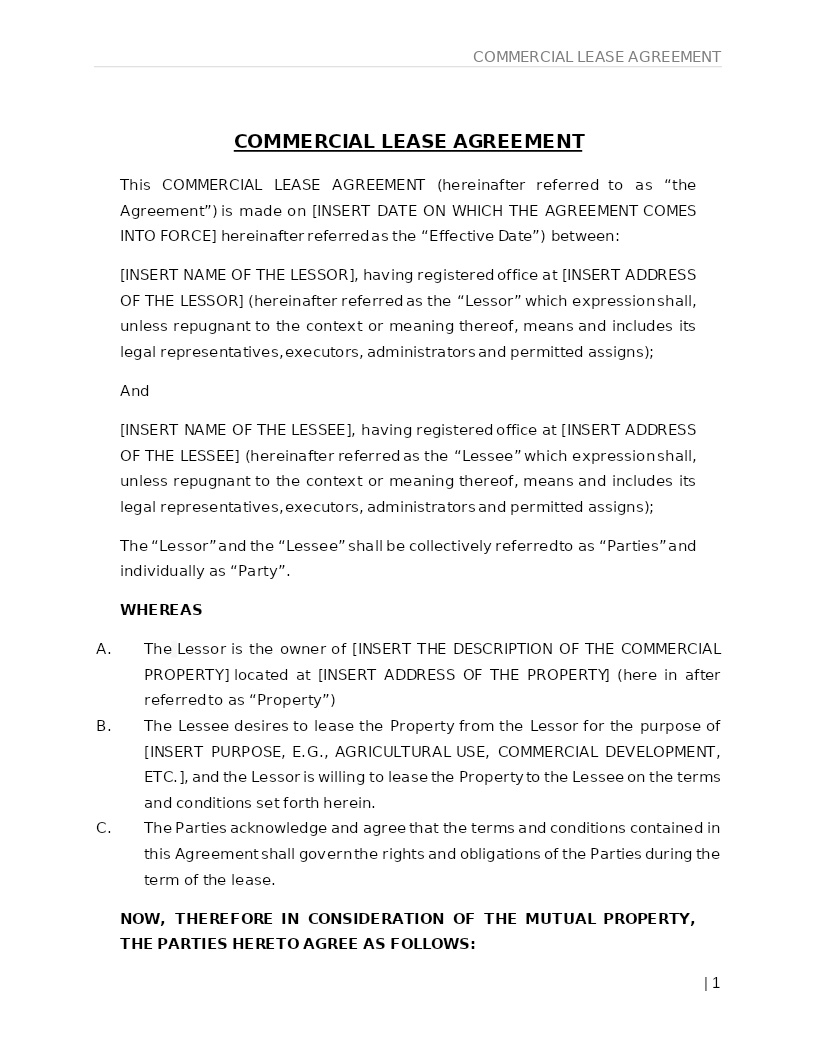
COMMERCIAL LEASE AGREEMENT
How does it work?
1. Choose this template
Start by clicking on "Fill out the template"
2. Complete the document
Answer a few questions and your document is created automatically.
3. Save - Print
Your document is ready! You will receive it in Word and PDF formats. You will be able to modify it.
Understanding Commercial Lease Agreements
A Commercial Lease Agreement is a legally binding contract between a landlord (the “Lessor”) and a business tenant (the “Lessee”) that outlines the terms under which commercial property, such as office space, retail units, warehouses, or industrial facilities, may be rented. The agreement establishes rent obligations, permitted use, maintenance responsibilities, lease duration, operating expenses, insurance requirements, and compliance obligations.
In the United States, Commercial Lease Agreements operate under state real estate laws, local zoning regulations, federal accessibility rules (ADA), environmental regulations, and industry-specific compliance standards. These agreements provide a clear legal framework to protect both parties and ensure predictable business operations throughout the lease term.
Where Commercial Lease Agreements Are Commonly Used
Commercial Lease Agreements are essential for nearly all business property arrangements, including:
- Office buildings and coworking spaces
- Retail stores, shopping centers, and specialty shops
- Restaurants, cafés, and food-service establishments
- Warehouses, logistics hubs, and distribution centers
- Manufacturing units and industrial spaces
- Medical clinics, wellness centers, and professional offices
- Startups and small businesses renting commercial space
Any time a business occupies space for commercial use, a Commercial Lease Agreement sets the rules, responsibilities, and financial obligations.
Different Types of Commercial Leases You May Encounter
- Gross Lease (Full-Service Lease): Tenant pays a fixed rent while the landlord covers most operating expenses.
- Net Lease (Single, Double, or Triple Net): Tenant pays rent plus certain operating costs such as taxes, insurance, or maintenance.
- Modified Gross Lease: Costs are shared between landlord and tenant based on negotiated terms.
- Percentage Lease: Common for retail; tenant pays base rent plus a portion of monthly sales.
- Industrial or Warehouse Lease: Structured for manufacturing or storage facilities with specific building requirements.
When Legal Guidance Becomes Helpful
Legal advice is recommended when:
- The lease involves long-term financial commitments or complex rent structures
- The property includes environmental compliance obligations (EPA, OSHA)
- Tenant improvements, renovations, or build-outs are required
- Negotiations involve exclusive-use clauses, co-tenancy rights, or subleasing
- The landlord requires personal guarantees or security deposits
- The tenant wants clarity on CAM charges, utilities, or maintenance obligations
- The lease spans multiple U.S. jurisdictions or involves corporate entities
A legally reviewed agreement helps avoid hidden costs, ensures transparency, and protects both parties throughout the lease term.
How to Work with This Template
- Identify the landlord and tenant, including business details
- Describe the commercial premises and permitted use
- Define rent structure, payment schedule, and operating expenses
- Specify maintenance duties, repairs, and improvement obligations
- Include insurance requirements and liability limitations
- Outline security deposit terms, renewal options, and subleasing rules
- Choose the governing U.S. state law
- Include procedures for inspections, property access, and dispute resolution
- Sign electronically or physically following applicable state requirements
This template follows standard U.S. commercial leasing practices and is compatible with major electronic signature platforms.
Frequently Asked Questions
Q1. What is a Commercial Lease Agreement and why is it important?
A Commercial Lease Agreement outlines the terms under which a business rents commercial property. It is important because it protects both parties, sets clear financial expectations, and ensures the tenant uses the property legally and responsibly.
Q2. Are Commercial Lease Agreements legally enforceable in the U.S.?
Yes. These agreements are enforceable under state real estate laws and contract regulations. A written lease helps prevent misunderstandings and gives both parties legal remedies in the event of disputes.
Q3. What should be included in a Commercial Lease Agreement?
A strong agreement includes rent terms, permitted use, operating expenses, repairs and maintenance duties, insurance requirements, lease duration, improvements, and termination rights. These provisions help create a fair and predictable leasing relationship.
Q4. Can a tenant negotiate the terms of a commercial lease?
Absolutely. Commercial leases are often negotiable, including rent, build-out allowances, maintenance obligations, renewal options, and exclusivity clauses. Negotiation ensures the lease aligns with the tenant’s business needs.
Q5. What are CAM charges in a commercial lease?
Common Area Maintenance (CAM) charges are fees tenants pay to cover shared services like landscaping, security, parking, and building upkeep. The agreement outlines how these charges are calculated and billed.
Q6. Who is responsible for repairs and maintenance?
Responsibilities vary based on the lease type. In many leases, the tenant handles interior maintenance while the landlord manages structural repairs. Net leases may shift more responsibilities to the tenant.
Q7. Can a tenant sublease the property?
Possibly. Some agreements allow subleasing with landlord approval, while others restrict it. Subleasing terms should be clearly outlined to avoid violating the lease.
Q8. Are electronic signatures valid for Commercial Lease Agreements?
Yes. Under the U.S. ESIGN Act and state e-signature laws, electronic signatures are legally enforceable for commercial real estate leases, unless a specific state requires a wet signature.
Q9. What happens if a tenant breaks the lease early?
Early termination may require paying penalties, forfeiting the security deposit, or covering rent until a new tenant is found. The agreement should clearly describe early-termination obligations to avoid disputes.
Q10. Is a Commercial Lease Agreement suitable for small businesses and startups?
Definitely. Whether renting retail space, office suites, or warehouses, small businesses rely on commercial leases to operate legally. A well-drafted agreement provides stability, protects business interests, and minimizes unexpected costs.