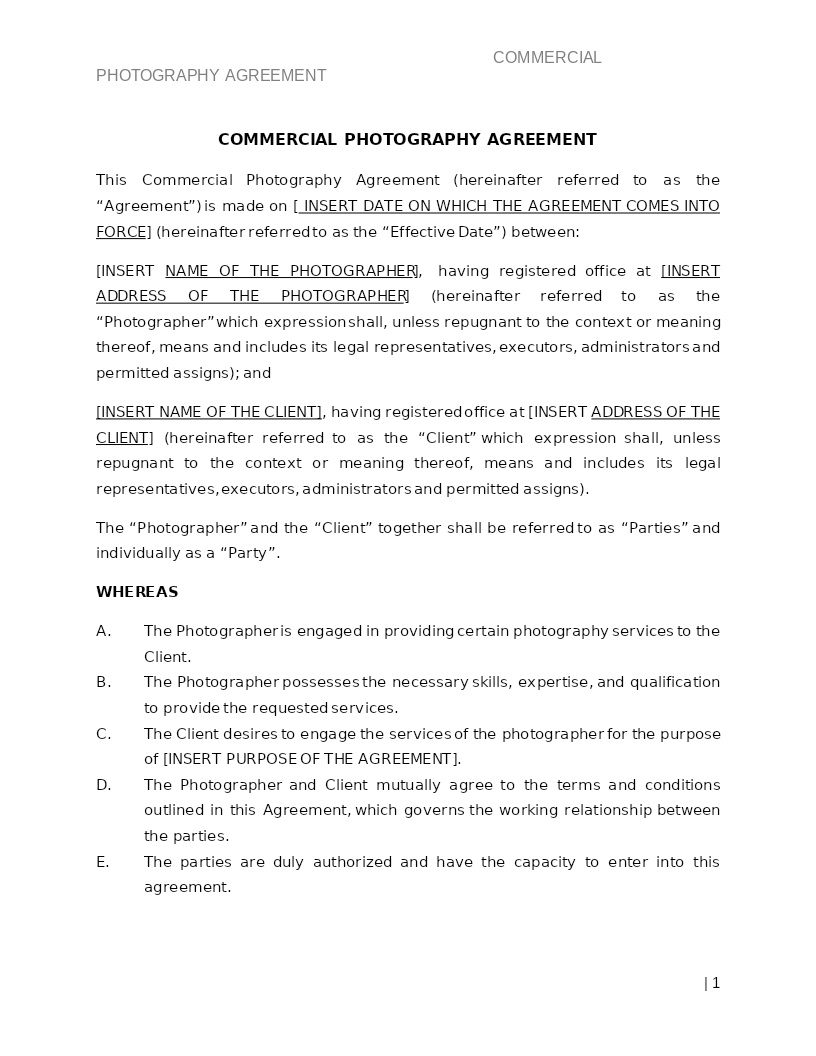
COMMERCIAL PHOTOGRAPHY AGREEMENT
How does it work?
1. Choose this template
Start by clicking on "Fill out the template"
2. Complete the document
Answer a few questions and your document is created automatically.
3. Save - Print
Your document is ready! You will receive it in Word and PDF formats. You will be able to modify it.
Understanding Commercial Photography Agreements
When a business, brand, or professional engages a photographer for a commercial project, it’s important to have a clear framework outlining what will be created, how the images may be used, and what rights each party retains. A Commercial Photography Agreement provides exactly that structure. It defines the scope of the assignment, the rights granted to the client, the photographer’s retained ownership, the fees and deliverables, and the expectations that will guide the working relationship from planning to final delivery.
Putting a Commercial Photography Agreement in place creates a professional foundation that allows both parties to collaborate confidently, knowing that usage rights, creative expectations, timelines, and financial terms are clearly defined and legally enforceable.
Where Commercial Photography Agreements Are Commonly Used
Commercial photography contracts are standard in a wide range of U.S. business settings, including:
- Branding and advertising campaigns for companies and agencies
- Product photography for e-commerce, catalogues, and retail marketing
- Corporate headshots, team photos, and executive portraits
- Real estate listings, architectural shoots, and construction portfolios
- Lifestyle photography for digital marketing and social media
- Editorial features, magazines, and sponsored content
- Commercial events, conferences, promotional shoots, and public relations campaigns
Any time a business relies on photographs that will be distributed publicly or commercially, this agreement sets clear boundaries around ownership, licensing, payment, and permitted usage.
Different Types of Commercial Photography Agreements You May Encounter
- Standard Commercial Photography Agreement: A general contract covering creative services, shoot details, licensing terms, and payment for commercial use.
- Limited-Use License Agreement: Used when the photographer retains ownership but grants the client specific, narrow usage rights for a defined period or purpose.
- Full Buyout Agreement: A more extensive contract where the client purchases complete ownership or broad usage rights, often required by larger brands or agencies.
- Work-for-Hire Agreement: Used in rare cases where the photographer’s work is legally classified as owned by the client from the outset; this requires specific statutory language to be enforceable in the U.S.
- Event or Campaign-Specific Agreement: Tailored for short-term or one-off marketing events, product launches, or seasonal advertising campaigns.
Why Businesses Need a Commercial Photography Agreement
A well-drafted Commercial Photography Agreement helps establish alignment from the beginning. It clarifies the creative direction, deliverables, retouching expectations, turnaround times, and the extent of rights the client receives. It also protects the photographer by formally documenting copyright ownership, licensing limits, cancellation terms, reshoot fees, overtime charges, and model release requirements.
The agreement promotes transparency, prevents misunderstandings, and offers a reliable mechanism for addressing issues such as late payments, unauthorized usage, missed deadlines, or scope changes. It ensures that commercial images valuable business assets are handled legally and responsibly under U.S. intellectual property laws.
When Legal Guidance Becomes Helpful
Most standard commercial shoots do not require extensive legal involvement. However, professional legal advice is especially valuable when:
- The images will appear in nationwide or high-value advertising campaigns
- The contract involves complex licensing structures, exclusivity periods, or full-rights buyouts
- Multiple models, influencers, agencies, or third-party rights holders are involved
- The shoot includes locations or subjects requiring special permits, releases, or compliance steps
- Photographs will be distributed across international markets or multi-jurisdictional platforms
- The agreement incorporates usage in regulated industries, such as healthcare or financial services
- The client requires specialized IP clauses, indemnity terms, or non-standard commercial warranties
Legal review ensures that both parties’ rights and liabilities are thoroughly understood and enforceable, especially where the financial value or risk profile of the project is high.
How to Work with This Template
- Identify the photographer and client, including business entities where applicable
- Clearly describe the scope of work type of shoot, hours, location, shot list, deliverables
- Specify licensing terms, including permitted usage, duration, territory, and exclusivity
- Confirm copyright ownership and limitations on altering or distributing the images
- Outline payment terms, deposits, cancellation policies, and additional fees
- Include timelines for the shoot, previews, revisions, and final delivery
- Attach or reference model releases, property releases, and usage approvals if required
- Select governing state law and include dispute resolution terms
- Review the agreement together before signing (legal review optional but recommended)
- Sign electronically or in hard copy; both formats are enforceable in the U.S.
The template aligns with standard commercial photography practices across the United States and is compatible with major e-signature platforms.
Frequently Asked Questions
Q1. What is a Commercial Photography Agreement?
A Commercial Photography Agreement is a legally binding contract that outlines how a photographer will provide creative services for a business or brand. It defines the project scope, deliverables, licensing terms, ownership rights, payment structure, and deadlines. This agreement ensures that both parties understand exactly how the images may be used and what rights are retained, creating clarity and legal protection throughout the project.
Q2. Who owns the photos under a commercial photography contract?
Under U.S. copyright law, the photographer automatically owns the images unless the agreement specifically assigns ownership or classifies the work as a lawful “work for hire.” Most commercial photography agreements grant the client a license to use the photos for defined commercial purposes while the photographer retains copyright. The contract clarifies what usage is allowed and whether additional licensing fees apply.
Q3. What types of usage rights can clients obtain?
Clients may obtain limited-use rights (such as online marketing only), broad commercial rights (digital + print), exclusive rights, or a full buyout. The contract explains the permitted formats, platforms, geographic areas, and time period. Describing usage clearly protects the client from accidental infringement and ensures the photographer is fairly compensated for the value of the license.
Q4. Why are licensing terms so important in commercial photography?
Licensing determines how widely and for how long a client can use the images. Because photos used in advertising or branding directly impact revenue, clear licensing avoids disputes over unauthorized usage, additional fees, or expired rights. Proper licensing language ensures that both parties’ business interests and intellectual property rights are protected under U.S. law.
Q5. Do commercial photography agreements cover editing and revisions?
Yes. The agreement typically specifies how many edited or retouched photos the client will receive, when previews will be delivered, and whether additional edits cost extra. Setting revision terms helps manage workload expectations and prevents disputes about how much editing is included in the contracted price.
Q6. Are cancellation and rescheduling terms included in the contract?
Most agreements include detailed clauses for cancellations, rescheduling, weather delays, location changes, and no-show fees. These terms protect the photographer from financial losses and help the client understand their financial obligations if plans change unexpectedly. Clear cancellation terms are especially important for time-sensitive campaigns or booked studio sessions.
Q7. Can the agreement include model or property releases?
Yes. When commercial images include identifiable people or private property, model and property releases may be required for legal usage. These can be incorporated into the photography agreement or attached separately. This ensures compliance with publicity rights, especially when the photos will be used in advertisements, branded content, or promotional materials.
Q8. Is a Commercial Photography Agreement enforceable if signed electronically?
Yes. Under the ESIGN Act and various state laws, electronic signatures are fully enforceable throughout the United States as long as both parties agree to sign electronically. Most photography businesses and agencies rely on e-signature platforms for convenience and recordkeeping.
Q9. What happens if the client uses the photos beyond the agreed scope?
Unauthorized use may constitute copyright infringement. The agreement usually requires the client to stop the misuse, pay additional licensing fees, or compensate the photographer for damages. Clear usage clauses, along with defined penalties for unauthorized distribution, reduce legal risks for both sides.
Q10. Do businesses need legal review for commercial photography contracts?
While not mandatory, legal review is recommended for high-value campaigns, national advertising, exclusive licenses, or projects involving multiple rights holders. Lawyers ensure the contract complies with U.S. intellectual property law, addresses industry-specific risks, and protects against disputes regarding ownership, usage, or compensation.