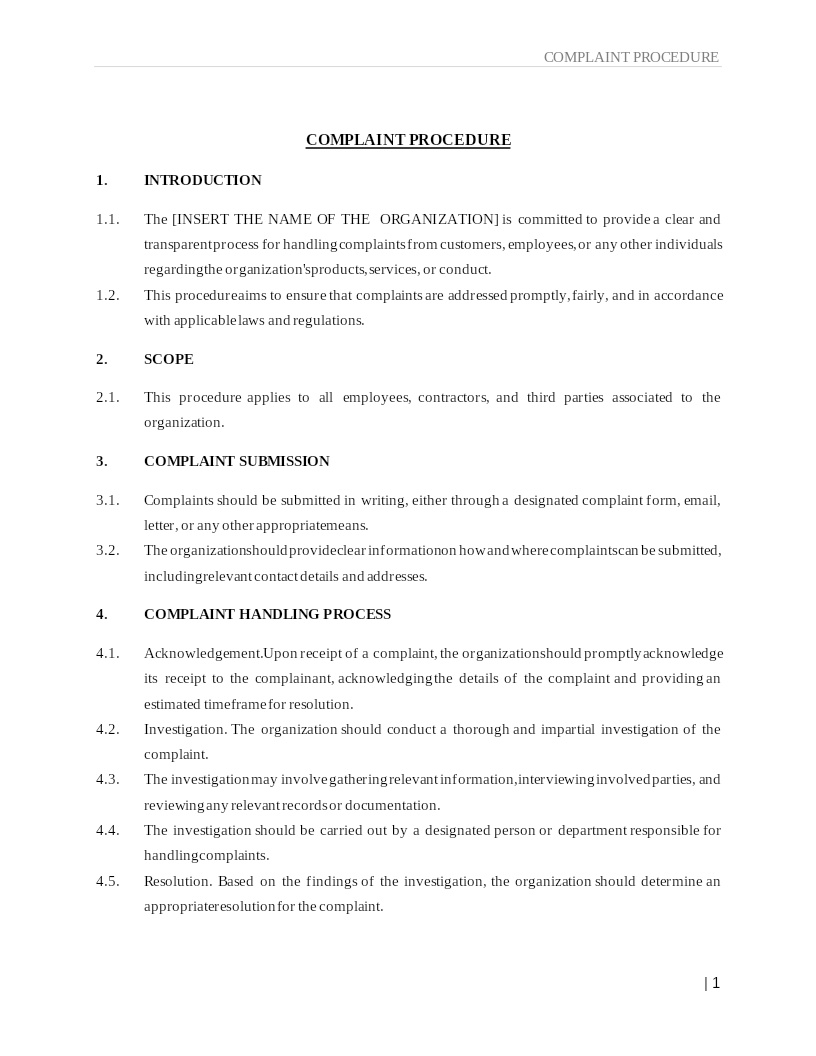
COMPLAINT PROCEDURE
How does it work?
1. Choose this template
Start by clicking on "Fill out the template"
2. Complete the document
Answer a few questions and your document is created automatically.
3. Save - Print
Your document is ready! You will receive it in Word and PDF formats. You will be able to modify it.
Supporting Fairness, Transparency, and Effective Conflict Resolution
When individuals raise concerns, grievances, or issues, whether employees, customers, or stakeholders, it becomes essential for an organization to have a clear framework for how those complaints will be handled. A Complaint Procedure provides that structure. It defines what qualifies as a complaint, outlines how submissions should be made, and establishes how the organization will investigate and resolve issues.
Putting a Complaint Procedure in place promotes fairness, builds trust, and demonstrates the organization’s commitment to resolving concerns promptly, respectfully, and consistently.
Where Complaint Procedures Are Commonly Used
Complaint protocols are widely implemented across numerous environments, including:
- Workplaces and human resource departments
- Customer service centers and support platforms
- Healthcare facilities and patient-service offices
- Educational institutions and student grievance systems
- Corporate compliance departments
- Nonprofit and community-based organizations
- Regulated industries requiring documented complaint handling
Any time individuals interact with an organization and may need to voice concerns, a structured complaint procedure ensures clarity, fairness, and accountability.
Different Types of Complaint Processes You May Encounter
- Internal Employee Complaints: Address issues related to workplace behavior, harassment, discrimination, conflicts, or policy violations.
- Customer or Client Complaints: Handle concerns about service quality, product issues, communication problems, or unmet expectations.
- Compliance and Ethical Complaints: Include allegations of misconduct, fraud, unethical behavior, or violations of laws or internal policies.
- Anonymous Complaints: Provide channels for individuals to report sensitive issues without revealing their identity.
- Escalation-Based Complaints: Implement structured levels of review—from supervisor to HR to senior leadership—based on severity.
When Legal or HR Guidance Becomes Helpful
Many routine complaints can be resolved internally, but expert guidance becomes valuable when:
- Allegations involve harassment, discrimination, retaliation, or safety violations
- The organization operates in a regulated industry requiring documented complaint management
- Issues involve sensitive or confidential information
- Formal investigations require neutrality, documentation, and compliance with labor laws
- Complaints may lead to legal claims, audits, or regulatory oversight
- The matter involves multiple jurisdictions or complex organizational relationships
Legal or HR review ensures the procedure aligns with federal and state laws, protects all parties, and reduces liability risks.
How to Work with This Template
- Identify the types of complaints covered under the procedure
- Outline how complaints can be submitted (email, portal, hotline, written form)
- Specify timelines for acknowledgment, investigation, and resolution
- Assign roles and responsibilities for those handling complaints
- Establish confidentiality and anti-retaliation safeguards
- Create a documentation and record-keeping process for all cases
- Train supervisors and managers to follow procedure consistently
- Review and update the process periodically to reflect organizational needs
This structure supports fairness, consistency, and compliance across U.S. organizational environments.
Frequently Asked Questions
Q1. Why is a Complaint Procedure important for U.S. organizations?
A Complaint Procedure provides a structured, transparent system for raising and resolving concerns. It ensures that issues are handled consistently and fairly, reducing the risk of conflict and miscommunication. By offering a formal process, organizations demonstrate accountability and commitment to addressing problems proactively. This helps strengthen trust among employees, customers, and stakeholders. It also reduces legal risk by documenting how complaints are managed.
Q2. Who can file a complaint under this procedure?
Eligibility to file a complaint typically includes employees, customers, clients, students, or any stakeholder directly affected by the organization’s actions. The policy makes it clear who is allowed to submit concerns, ensuring transparency and accessibility. Providing multiple channels helps ensure no one is excluded from raising legitimate issues. This inclusiveness supports fairness and encourages open communication. It also ensures concerns are documented and addressed promptly.
Q3. What types of complaints are typically covered?
Complaint Procedures generally cover workplace grievances, customer service issues, safety concerns, harassment allegations, discrimination claims, and policy violations. Clearly defining the scope helps individuals understand which issues fall under the procedure. It also helps the organization route complaints to the correct department or authority. This increases efficiency and ensures proper handling. A defined scope also prevents confusion and promotes consistency in the process.
Q4. How quickly will a complaint be acknowledged and resolved?
Organizations typically acknowledge complaints within a few business days, signaling that the concern has been received and will be reviewed. Resolution timelines depend on the complexity of the issue, but policies often specify clear time frames to ensure timely handling. This prevents frustration and helps maintain trust throughout the process. Providing updates during investigations also promotes transparency. Defined timelines ensure accountability for all involved parties.
Q5. Are complaints kept confidential?
Yes, complaints are handled with strict confidentiality to protect the privacy of all parties involved. Information is shared only with individuals responsible for resolving or investigating the matter. This safeguards sensitive details and helps prevent retaliation or bias. Confidentiality also encourages people to report concerns without fear. Maintaining privacy is essential to building trust and ensuring the procedure is used responsibly.
Q6. How does the organization ensure fairness in the investigation?
Fairness is achieved by assigning investigations to unbiased, trained personnel who follow consistent procedures. Each party involved is given an opportunity to present their perspective or evidence. Clear standards guide investigators to prevent favoritism or assumptions. Documentation is kept throughout the process to support transparency. These steps help ensure that every complaint receives an equitable and impartial review.
Q7. Can complaints be submitted anonymously?
Many organizations allow anonymous complaints, especially for sensitive issues such as misconduct or retaliation. Anonymous channels offer a safe way for individuals to report concerns without fear of exposure. However, limited information may restrict follow-up actions or verification. Despite this, anonymous reporting is a valuable tool for uncovering serious issues early. It helps organizations address concerns that may otherwise go unreported.
Q8. What happens if a complaint reveals misconduct or policy violations?
If the investigation confirms wrongdoing, the organization may take corrective measures that range from training and counseling to disciplinary action or termination. The goal is to address the issue promptly and prevent recurrence. Organizations also review relevant policies to determine whether updates or improvements are needed. Corrective action demonstrates the seriousness with which complaints are taken. It also reinforces a culture of accountability and ethical behavior.