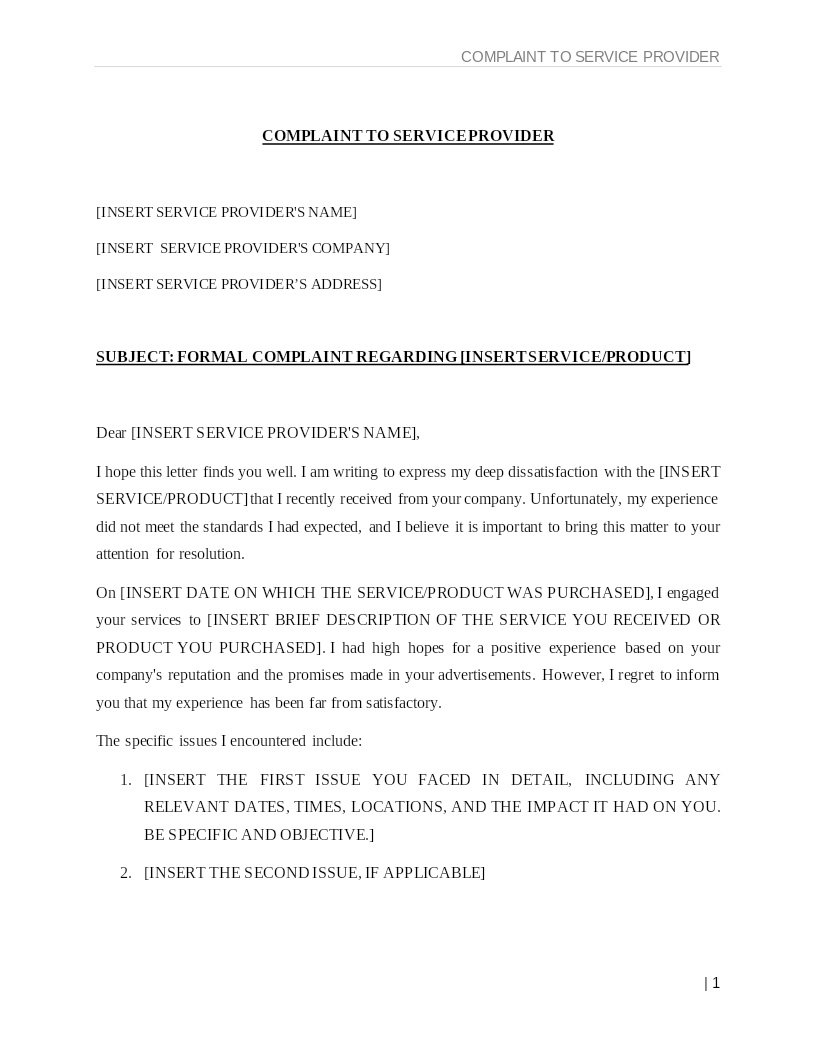
COMPLAINT TO SERVICE PROVIDER
How does it work?
1. Choose this template
Start by clicking on "Fill out the template"
2. Complete the document
Answer a few questions and your document is created automatically.
3. Save - Print
Your document is ready! You will receive it in Word and PDF formats. You will be able to modify it.
Understanding a Complaint to a Service Provider
A Complaint to a Service Provider is a formal written communication submitted by a customer, client, or user to address issues related to services received. This document outlines service-related problems, billing disputes, delays, breaches of contract, poor performance, or violations of agreed service standards, while requesting corrective actions or resolution.
In the United States, customer complaints may be governed by contract law, consumer protection laws, Federal Trade Commission (FTC) regulations, state service quality statutes, and industry-specific rules. A well-written complaint ensures the service provider understands the issue clearly and is given an opportunity to resolve the matter promptly and professionally.
Where Complaints to Service Providers Are Commonly Used
Complaints are frequently used across a wide range of industries and service categories, such as:
- Internet, cable, and telecommunications services
- Repair, maintenance, and installation companies
- Software and IT services, SaaS platforms, and digital tools
- Hospitality, travel, and transportation services
- Banking, insurance, and financial service providers
- Healthcare facilities and wellness providers
- Subscription services, online marketplaces, and delivery companies
Any time a service fails to meet contractual or expected standards, a formal complaint helps document the issue and request timely resolution.
Different Types of Complaints You May Encounter
- Service Quality Complaint: Issues related to poor performance, incomplete services, or unmet expectations.
- Billing or Payment Dispute: Concerns about overcharging, unauthorized fees, or incorrect invoices.
- Delay or Non-Delivery Complaint: Filed when services were not completed within the agreed timeline.
- Contract Breach Complaint: Issued when a provider violates agreed terms, obligations, or warranties.
- Customer Support Complaint: Raised when assistance, communication, or responsiveness is inadequate.
When Legal Guidance Becomes Helpful
Legal assistance may be useful when:
- The complaint relates to contract violations or damaged property
- The service provider refuses to resolve or acknowledge the issue
- The matter involves significant financial losses or business impact
- The provider’s actions violate consumer protection statutes
- The service terms include legal escalation procedures or arbitration
- The complaint may lead to termination of contract or legal claims
A clearly drafted complaint helps strengthen your position if further legal steps become necessary.
How to Work with This Template
- Identify your name, account details, and service provider’s information
- Clearly describe the issue, including dates, service failures, or specific incidents
- Refer to contract provisions, service terms, or guarantees (if applicable)
- Outline any financial loss, inconvenience, or damages suffered
- Request a remedy such as repair, refund, correction, or compensation
- Attach supporting evidence like invoices, screenshots, or emails
- Provide a timeline for response and resolution
- Submit the complaint through email, certified mail, or the provider’s complaint system
This template is aligned with U.S. consumer practices and can be used for personal or business-related complaints.
Frequently Asked Questions
Q1. What is a Complaint to a Service Provider?
A Complaint to a Service Provider is a formal document used to report issues with services received, such as poor quality, delays, billing errors, or contract breaches. It helps the provider understand the problem and initiate corrective action.
Q2. Is a written complaint necessary in the U.S.?
Yes. A written complaint provides a clear, documented record of the issue and your request for resolution. It is especially helpful if the matter escalates to a legal or regulatory claim.
Q3. What should be included in a complaint letter?
A strong complaint includes details of the issue, dates, supporting evidence, contract references, and a clear request for resolution. The more specific you are, the faster the provider can address the matter.
Q4. Can a complaint help resolve billing disputes?
Absolutely. Billing disagreements are among the most common service complaints. A written complaint helps request corrections, refunds, or clarification directly from the provider’s billing department.
Q5. How long does a service provider have to respond?
Response times vary by company and industry. Some providers outline response deadlines in their customer service policies. A reasonable timeframe in the U.S. is typically 7–14 business days.
Q6. What if the provider ignores my complaint?
If the provider does not respond, you may escalate the issue to:
• Consumer protection agencies
• The Better Business Bureau (BBB)
• State regulatory authorities
• Small claims court
• An attorney, if significant financial loss is involved
Q7. Can complaints be filed electronically?
Yes. Most U.S. companies accept complaints through email, support portals, web forms, or mobile apps. Electronic submissions also provide a timestamp and written record.
Q8. Should I reference the contract or terms of service?
Yes. Referring to specific contract clauses strengthens your complaint, especially when addressing missed deadlines, performance standards, or warranties.
Q9. Are complaints protected under consumer rights laws?
Yes. Under U.S. consumer protection laws, customers have the right to dispute charges, report service failures, and request fair resolution without retaliation.
Q10. Can this complaint be used for business-to-business service issues?
Definitely. This format is suitable for both personal and business complaints regarding IT services, logistics, marketing, consulting, or any other commercial services.