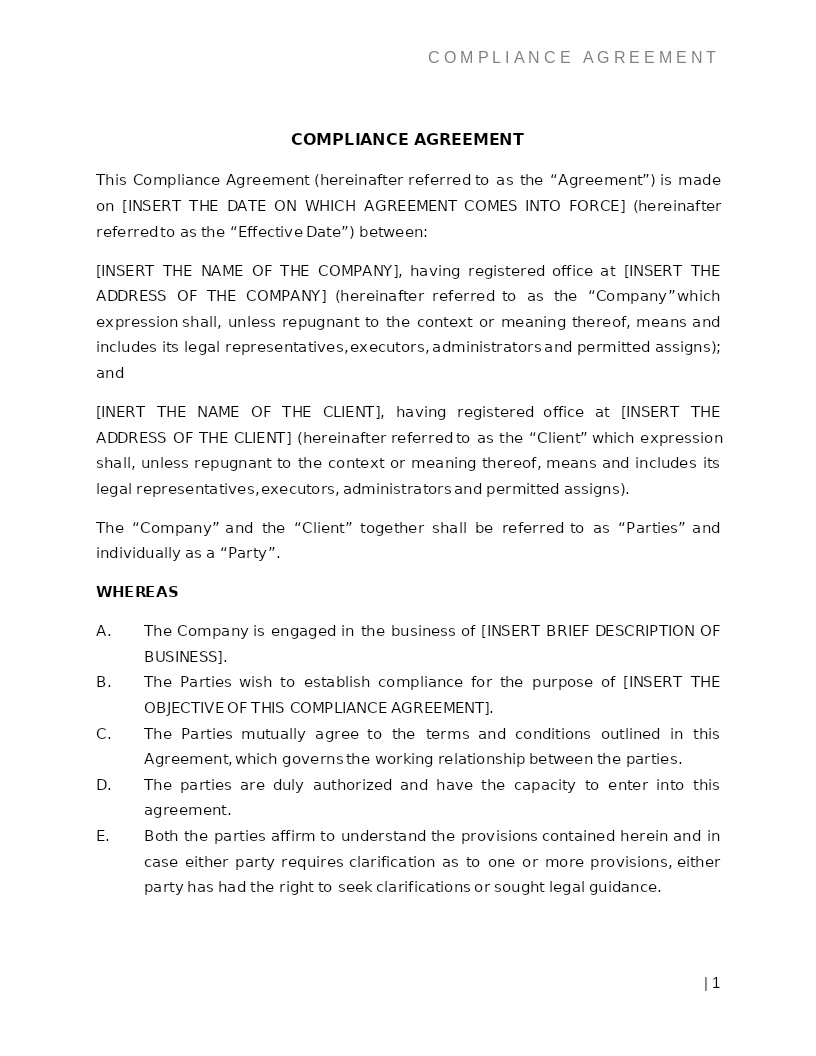
COMPLIANCE AGREEMENT
How does it work?
1. Choose this template
Start by clicking on "Fill out the template"
2. Complete the document
Answer a few questions and your document is created automatically.
3. Save - Print
Your document is ready! You will receive it in Word and PDF formats. You will be able to modify it.
Understanding the Compliance Agreement
When your organization operates in a regulated environment or handles activities subject to strict legal requirements, you need a clear framework that ensures ongoing adherence to applicable laws, policies, and standards. A Compliance Agreement provides that structure. It defines the legal, operational, and regulatory requirements a party must follow and clarifies how compliance will be monitored, documented, and enforced.
Putting a Compliance Agreement in place helps businesses maintain ethical operations, reduce legal exposure, and demonstrate accountability to regulators, partners, and customers.
Where Compliance Agreements Are Commonly Used
Compliance Agreements are widely used across industries where regulatory oversight or internal governance is critical, including:
- Healthcare organizations following HIPAA privacy and security rules
- Financial institutions complying with federal and state regulatory audits
- Technology companies managing data under U.S. privacy laws and GDPR
- Corporations implementing internal ethics, anti-corruption, and sanctions policies
- Government contractors who must follow agency-specific compliance frameworks
- Businesses undergoing remediation after regulatory violations
Whenever regulatory obligations or internal policies must be formally documented and adhered to, a Compliance Agreement provides clear expectations and accountability.
Different Types of Compliance Agreements You May Encounter
- Regulatory Compliance Agreement: Used when businesses must meet standards imposed by federal or state agencies, such as the SEC, FTC, HHS, or state data protection regulators.
- Corporate Governance & Ethics Compliance Agreement: Defines internal expectations for ethical conduct, conflict-of-interest rules, anti-bribery standards, and reporting protocols.
- Data Protection & Privacy Compliance Agreement: Covers obligations relating to personal data, cybersecurity standards, breach notifications, and third-party access (e.g., CCPA, GDPR, HIPAA).
- Industry-Specific Compliance Agreement: Tailored to specialized sectors such as healthcare, fintech, ed-tech, defense, or pharmaceutical operations.
- Remediation or Corrective Action Compliance Agreement: Used when an organization must fix past violations and remain monitored for continued compliance.
When Legal Guidance Becomes Helpful
Most routine compliance requirements can be managed internally, but legal insight becomes essential when:
- Regulatory bodies impose obligations, penalties, or audit requirements
- Your operations span multiple states or jurisdictions with conflicting laws
- Sensitive data (health, financial, personal, or proprietary) is involved
- You need to customize compliance terms for contractors, vendors, or partners
- Your industry has complex or evolving standards that require professional interpretation
- Non-compliance could expose the organization to significant liability
- The agreement includes technical or operational requirements that demand precision
- You require enforceable dispute mechanisms or industry-specific clauses
Legal guidance ensures that compliance obligations are correctly interpreted, enforceable, and aligned with U.S. regulatory expectations
How to Work with This Template
- Identify all parties responsible for maintaining compliance
- Clearly define the regulatory or internal standards the party must adhere to
- Specify compliance procedures, reporting duties, audits, and documentation requirements
- Select the governing U.S. state law relevant to your operations
- Outline monitoring mechanisms, performance expectations, and enforcement terms
- Review internally and with counsel to ensure alignment with industry regulations
- Sign digitally or in hard copy—electronic signatures are enforceable in the U.S.
This template follows commonly accepted compliance standards recognized across the United States and is compatible with major e-signature platforms
Frequently Asked Questions
Q1. What is a Compliance Agreement and why is it important for U.S. businesses?
A Compliance Agreement is a legally enforceable contract that requires a business or individual to follow specific laws, regulations, policies, or industry standards. For U.S. companies, it ensures ongoing adherence to federal and state rules, reduces regulatory risks, strengthens internal governance, and demonstrates a proactive commitment to ethical and lawful behavior.
Q2. What does a Compliance Agreement typically include?
Most agreements outline regulatory obligations, reporting requirements, audit rights, risk-management protocols, data protection standards, dispute resolution mechanisms, and consequences for non-compliance. The agreement may also include training obligations, internal controls, documentation standards, and corrective-action procedures.
Q3. Who needs a Compliance Agreement in the United States?
Businesses in healthcare, finance, insurance, cybersecurity, real estate, technology, education services, and government contracting frequently rely on Compliance Agreements. Any organization handling sensitive data or operating in a regulated industry benefits from having a formalized compliance framework.
Q4. Can a Compliance Agreement reduce legal liability?
Yes. By clearly defining obligations and documenting adherence, a Compliance Agreement helps minimize the risk of penalties, lawsuits, regulatory actions, and reputational damage. It acts as evidence that the organization took reasonable legal and operational measures to maintain compliance.
Q5. What happens if a party violates a Compliance Agreement?
Violations may trigger corrective-action requirements, breach notices, penalties, or even termination of the contract. Depending on the agreement, the non-compliant party may be required to implement remediation steps, participate in audits, or face regulatory reporting obligations. Legal remedies may also include damages or injunctive relief.
Q6. Is a Compliance Agreement enforceable if the parties are in different states?
Yes. Most U.S. Compliance Agreements select one state’s governing law, making them enforceable even if parties operate in multiple locations. This is particularly useful for companies with nationwide or cross-border operations.
Q7. Can a Compliance Agreement be customized for data privacy or cybersecurity requirements?
Absolutely. Compliance Agreements can be tailored for GDPR, CCPA, HIPAA, PCI-DSS, SOC-2, and other privacy and security frameworks. Customization ensures that data-handling practices, access controls, and reporting obligations match the exact risks of your business model.
Q8. Do U.S. regulators require Compliance Agreements?
In some cases, yes. Agencies such as the FTC, SEC, HHS, and state attorney generals may mandate Compliance Agreements after investigations or regulatory findings. These agreements ensure corrective actions, ongoing monitoring, and long-term adherence to legal standards.