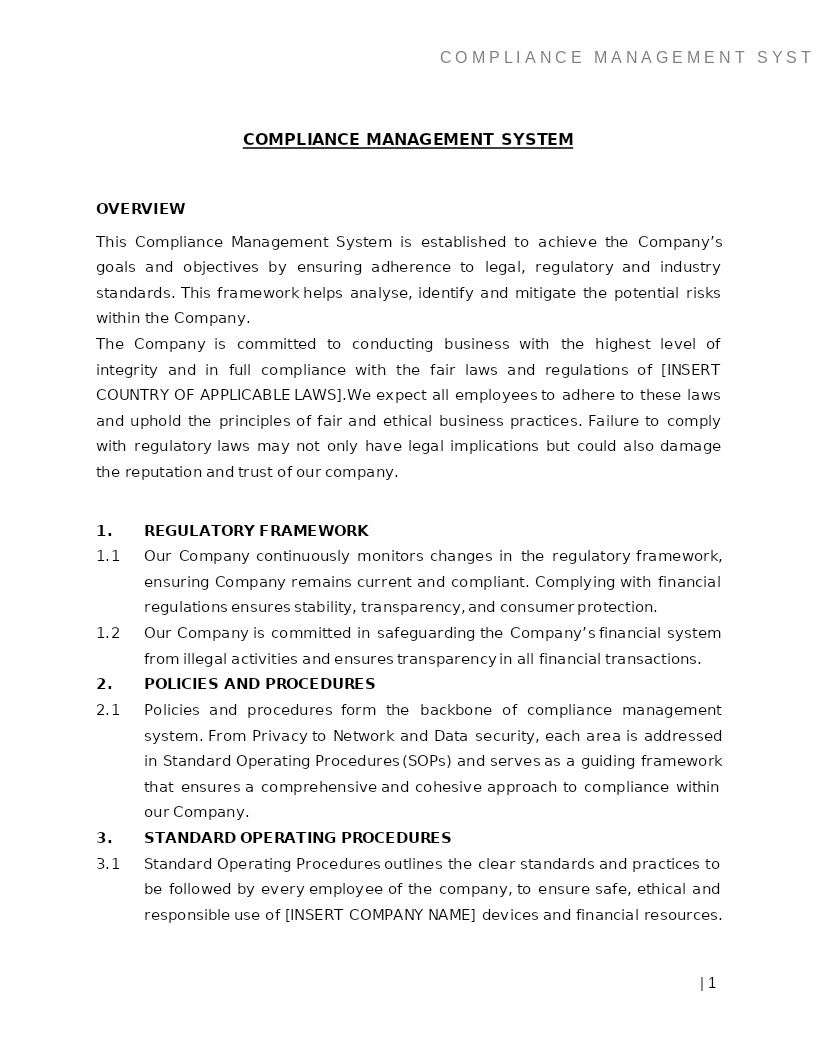
COMPLIANCE MANAGEMENT SYSTEM
How does it work?
1. Choose this template
Start by clicking on "Fill out the template"
2. Complete the document
Answer a few questions and your document is created automatically.
3. Save - Print
Your document is ready! You will receive it in Word and PDF formats. You will be able to modify it.
Understanding Compliance Management System in U.S.
A Compliance Management System (CMS) is a structured framework that enables U.S. businesses to meet legal, regulatory, and industry-specific requirements. It includes documented policies, employee training, internal controls, monitoring mechanisms, and corrective action processes. A CMS helps organizations maintain ethical standards, prevent legal violations, and minimize financial and operational risk. It also supports transparency, fosters accountability, and promotes a strong culture of compliance across all levels of the organization. By implementing a robust CMS, companies ensure adherence to U.S. federal and state regulations, reduce penalties, and protect their reputation.
Where a Compliance Management System Is Commonly Used
• Corporations and publicly traded companies
• Banks, financial institutions, and credit unions
• Healthcare providers and hospitals
• Technology firms and SaaS companies
• Manufacturing and supply chain operations
• Educational institutions and government agencies
• Insurance companies and professional service firms
• E-commerce, retail, and consumer service organizations
Any business that must comply with U.S. laws or industry standards benefits from a CMS.
Different Types of Compliance Management Systems
- Regulatory Compliance System: Ensures adherence to federal and state laws such as OSHA, HIPAA, SOX, GLBA, and FTC regulations.
- Corporate Governance Compliance System: Focuses on internal controls, board oversight, audits, and ethical business conduct.
- Data Privacy & Security Compliance System: Covers privacy laws like CCPA, CPRA, and cybersecurity requirements.
- Financial Compliance System: Oversees accounting accuracy, fraud prevention, anti–money laundering (AML), and financial reporting compliance.
- Operational Compliance System: Ensures compliance with internal policies, quality standards, and industry certifications (ISO, SOC 2, etc.).
When Legal Guidance Becomes Helpful
Legal review is crucial because compliance obligations differ widely across U.S. states and industries. Real-time lawyers and in-house counsel:
• Tailor compliance policies to your industry’s regulatory environment
• Draft precise obligations, rights, and liabilities for all parties involved
• Ensure alignment with evolving federal/state laws and enforcement standards
• Address complex risks such as privacy breaches, regulatory audits, and corporate liability
• Create enforceable documentation, reporting systems, and internal controls
• Advise on cross-border compliance, multi-jurisdictional issues, and sector-specific risks
• Strengthen dispute-resolution mechanisms and mitigate legal exposure
This ensures your CMS is compliant, enforceable, and fully aligned with the needs of your business.
How to Use This Compliance Management System
• Establish written policies and procedures that align with U.S. regulations
• Train employees regularly on compliance responsibilities
• Implement monitoring tools, audits, and reporting systems
• Document violations and corrective actions thoroughly
• Update the CMS as laws, risks, or business operations change
• Maintain clear accountability at leadership and operational levels
• Ensure transparency in compliance reporting and decision-making
Following these steps helps maintain a strong, legally compliant, and ethical workplace.
Frequently Asked Questions
Q1. Why is a Compliance Management System important for U.S. companies?
A CMS helps businesses meet federal and state regulations, reducing the risk of fines and legal violations. It also strengthens internal controls and ethical behavior. By creating standardized procedures, companies improve accountability, transparency, and operational efficiency, which enhances long-term sustainability.
Q2. Does a CMS help reduce legal and financial risks?
Yes. A CMS identifies potential compliance risks early and establishes mechanisms to prevent violations. It reduces exposure to lawsuits, penalties, and regulatory enforcement actions. With proper controls and documentation, businesses can demonstrate good-faith compliance efforts if audited or investigated.
Q3. Which U.S. laws typically influence Compliance Management Systems?
Depending on the industry, a CMS may address laws like OSHA (safety), HIPAA (health data), SOX (corporate governance), GLBA (financial data), FTC Act (consumer protection), and state privacy laws like CCPA/CPRA. Legal counsel ensures that your CMS incorporates all relevant regulatory obligations.
Q4. Who is responsible for maintaining a Compliance Management System?
Responsibility is shared across leadership, compliance officers, HR teams, and employees. Executive management sets the tone for compliance culture, while compliance officers oversee daily management. Employees must follow policies and report concerns, ensuring organization-wide participation.
Q5. How often should a Compliance Management System be updated?
A CMS should be reviewed at least annually or whenever laws, regulations, or business operations change. Periodic updates ensure that policies remain relevant and legally compliant. Regular internal audits also help identify gaps and areas needing improvement.
Q6. Can small businesses benefit from a CMS?
Absolutely. Small businesses face many of the same legal risks as large corporations. A CMS helps small organizations avoid fines, manage risks, improve governance, and strengthen customer trust. Even a simplified CMS offers significant protection and operational stability.
Q7. Should a lawyer help create or review a CMS?
Yes. Compliance requirements vary by industry and state, and legal advice ensures the CMS is accurate and enforceable. Lawyers can tailor the system to your risks, draft legally compliant policies, and help navigate complex regulations such as data privacy, safety, and financial reporting laws.
Q8. What elements should a strong Compliance Management System include?
A robust CMS includes written policies, internal controls, training programs, monitoring tools, reporting systems, and corrective-action procedures. It should also define roles, accountability mechanisms, risk assessments, and documentation standards to maintain compliance across all operations.