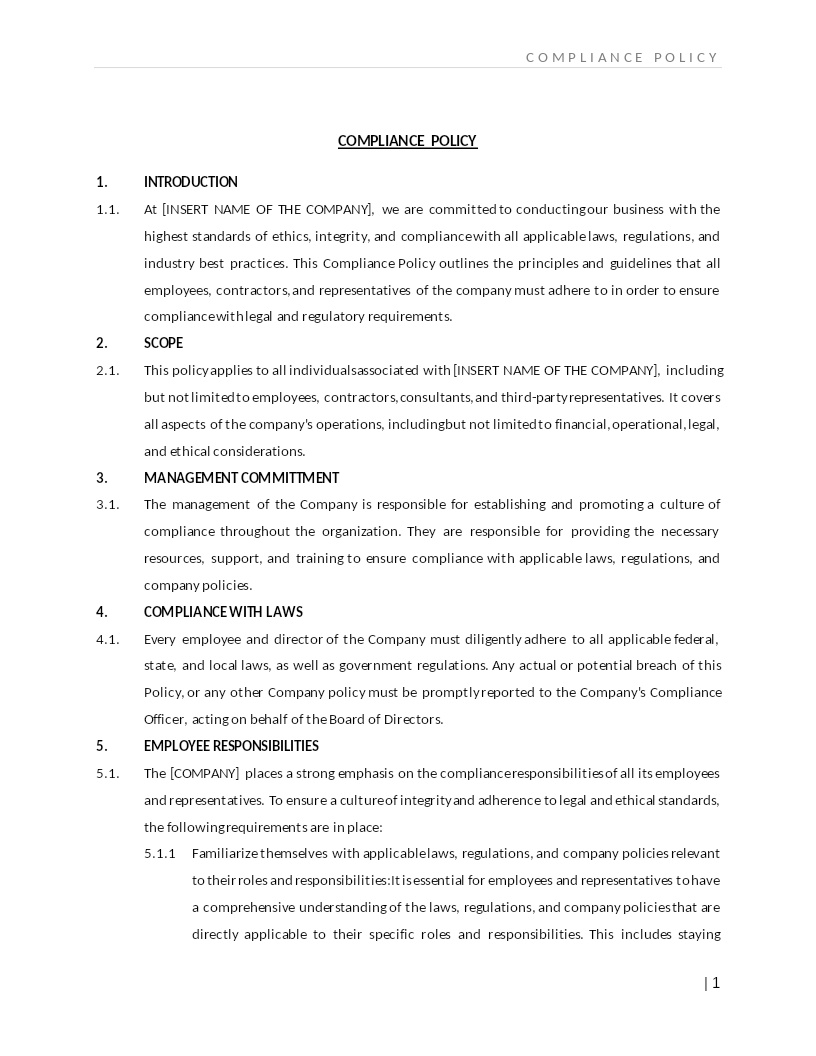
COMPLIANCE POLICY
How does it work?
1. Choose this template
Start by clicking on "Fill out the template"
2. Complete the document
Answer a few questions and your document is created automatically.
3. Save - Print
Your document is ready! You will receive it in Word and PDF formats. You will be able to modify it.
Understanding a Compliance Policy
A Compliance Policy establishes the rules, standards, and ethical expectations that employees and contractors must follow to ensure that the organization operates within applicable U.S. laws, regulations, industry standards, and internal procedures. It outlines the behaviors required to maintain legal compliance, prevent misconduct, protect corporate integrity, and reduce operational risk.
A strong Compliance Policy provides a framework for consistent decision-making, ensures adherence to federal and state regulatory requirements, and reinforces a culture of accountability across the organization.
Where Compliance Policies Are Commonly Used
Compliance Policies are essential across a wide range of industries and operational areas, including:
• Financial services, credit institutions, and fintech companies
• Healthcare entities regulated under HIPAA
• Businesses handling consumer data or operating under privacy laws
• Government contractors and regulated industries
• Corporate offices, manufacturing facilities, and logistics operations
• Technology companies subject to cybersecurity and data rules
• Organizations with anti-fraud, anti-corruption, or workplace ethics obligations
Any environment where employees must follow legal or ethical guidelines benefits from a clear Compliance Policy.
Different Types of Compliance Policies You May Encounter
- General Corporate Compliance Policies: Define day-to-day expectations for ethical behavior, reporting concerns, and following company rules.
- Regulatory Compliance Policies: Focus on industry-specific laws such as healthcare, finance, telecommunications, or energy.
- Data Privacy & Security Compliance Policies: Guide how an organization protects data under U.S. privacy laws and cybersecurity frameworks.
- Anti-Corruption & Anti-Bribery Policies: Ensure adherence to laws like the Foreign Corrupt Practices Act (FCPA).
- Operational Compliance Policies: Address compliance with safety, environmental, quality-control, and industry standards.
When Legal Guidance Becomes Helpful
Legal assistance is valuable when:
• The organization operates in a highly regulated sector
• Multiple states or jurisdictions apply different legal requirements
• The company handles sensitive customer or employee information
• Policies must reflect compliance with federal standards (FTC, OSHA, HIPAA, SEC, FDA, etc.)
• The business is implementing a new compliance program or responding to an audit
• Misconduct, fraud, or regulatory investigations have occurred
How to Work with This Template
• Identify applicable legal and regulatory requirements for your industry
• Define the responsibilities of employees, supervisors, and compliance officers
• Outline reporting channels for concerns or violations
• Specify disciplinary action for non-compliance
• Choose governing U.S. state law
• Ensure employees review and acknowledge the policy
• Store signatures electronically or in hard copy
Frequently Asked Questions
Q1. What is the purpose of a Compliance Policy?
A Compliance Policy helps ensure that employees follow applicable laws, regulations, and internal standards. It establishes expectations, promotes ethical behavior, and protects the organization from legal risks and penalties.
Q2. Is a Compliance Policy legally required in the U.S.?
While not always mandatory, many industries such as healthcare, finance, and government contracting require documented compliance programs. Even in non-regulated sectors, a Compliance Policy strengthens risk management and reduces liability.
Q3. What should be included in a Compliance Policy?
A complete policy should outline employee responsibilities, prohibited conduct, reporting procedures, disciplinary actions, documentation requirements, and references to relevant laws. Clear guidelines help prevent misconduct and ensure accountability.
Q4. Who is responsible for enforcing the Compliance Policy?
Typically, enforcement is handled by compliance officers, HR, supervisors, and management teams. However, all employees share responsibility for adhering to the policy and reporting violations.
Q5. How often should the Compliance Policy be updated?
Policies should be reviewed annually or whenever legal requirements change. Major updates may be necessary when new regulations, technologies, or organizational structures impact compliance obligations.
Q6. Does a Compliance Policy protect the organization from liability?
While it does not eliminate liability, a well-implemented policy significantly reduces risk by demonstrating proactive governance, preventing violations, and creating a defensible legal framework if issues arise.
Q7. Should employees be trained on the Compliance Policy?
Yes. Regular training ensures that employees understand legal requirements, company expectations, and reporting procedures. Training also supports compliance with U.S. regulatory standards.
Q8. What happens if an employee violates the Compliance Policy?
Consequences may include warnings, retraining, disciplinary action, termination, or legal consequences depending on the severity. Clear enforcement rules strengthen the policy’s effectiveness.
Q9. Is a Compliance Policy necessary for small businesses?
Absolutely. Even small businesses face legal and regulatory obligations. A Compliance Policy helps maintain professionalism, protect customer trust, and reduce risk exposure especially when handling sensitive data.
Q10. Can a Compliance Policy be signed electronically?
Yes. Under the U.S. ESIGN Act, electronic signatures are fully valid. Businesses commonly use digital signature tools to distribute and collect policy acknowledgments.