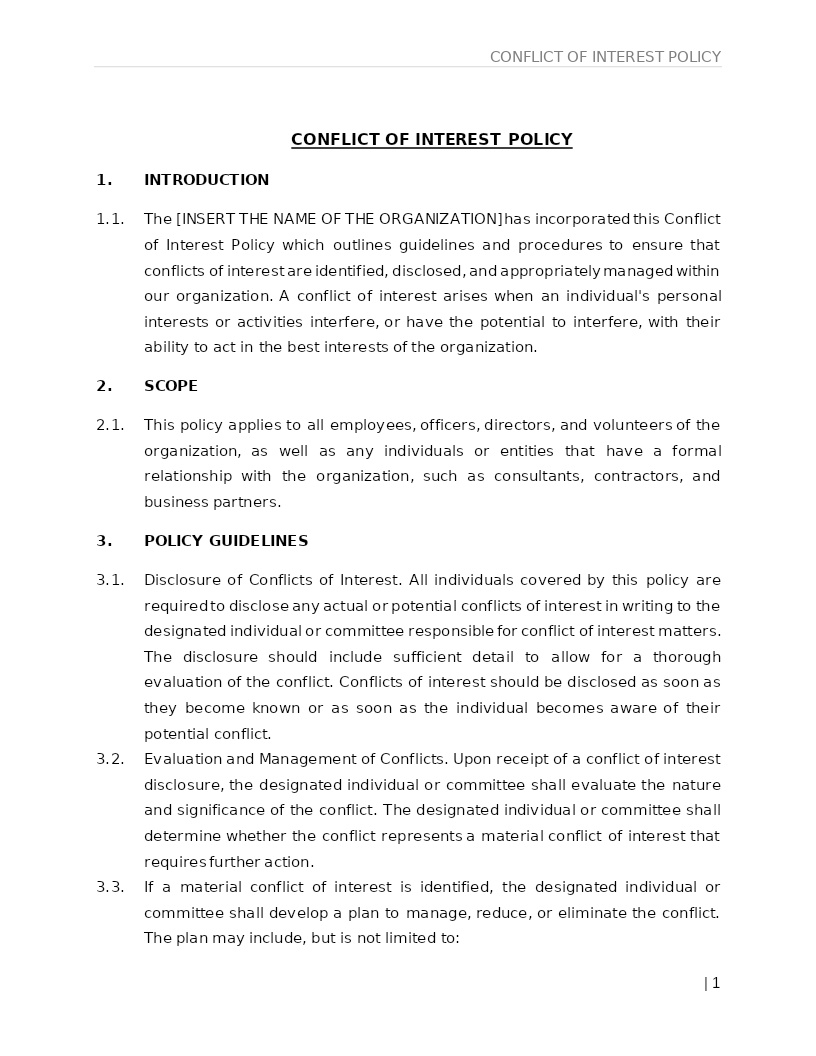
CONFLICT OF INTEREST POLICY
How does it work?
1. Choose this template
Start by clicking on "Fill out the template"
2. Complete the document
Answer a few questions and your document is created automatically.
3. Save - Print
Your document is ready! You will receive it in Word and PDF formats. You will be able to modify it.
Promoting Ethical Conduct and Organizational Integrity Through a Conflictmof Interest Policy
A Conflict of Interest Policy is an essential governance document that establishes the standards, obligations, and procedures employees, officers, directors, contractors, and other affiliated individuals must follow to avoid actual, potential, or perceived conflicts between personal interests and organizational duties. Drafted in accordance with U.S. corporate-governance regulations, employment-law standards, IRS nonprofit compliance rules, SEC and public-company ethics mandates, and industry-specific ethical guidelines, this policy ensures that decisions made on behalf of the organization are based on objectivity, transparency, and loyalty, free from undue influence, favoritism, or improper personal gain. It outlines behaviors that may compromise professional judgment, including financial interests, outside employment, family relationships, vendor dealings, gifts and entertainment, or other circumstances that could impair impartiality. By formalizing these rules, organizations reduce legal exposure, protect corporate reputation, and reinforce public trust.
A comprehensive Conflict of Interest Policy defines the circumstances that constitute a conflict, outlines employee duties to disclose relevant personal or financial interests, and establishes formal procedures for reviewing and addressing conflicts. It includes mechanisms such as disclosure statements, review by an ethics committee or compliance officer, recusal requirements, supervisory controls, and documentation standards to ensure consistent enforcement. The policy identifies prohibited conduct, including undisclosed financial ties, acceptance of inappropriate gifts, misuse of proprietary information, self-dealing transactions, and outside activities that interfere with job duties. Additionally, the policy describes non-retaliation protections for employees who report conflicts in good faith and provides guidance on acceptable business practices, gift thresholds, vendor relationships, and participation in outside boards or organizations. Through implementation of this policy, organizations foster ethical decision-making, mitigate regulatory risks, and strengthen internal accountability.
Where Conflict of Interest Policies Are Commonly Used
Conflict of Interest Policies are widely adopted across industries, including:
- Corporations and publicly traded companies subject to SEC governance requirements
- Nonprofits complying with IRS Form 990 disclosure obligations
- Healthcare entities governed by HIPAA, Stark Law, and anti-kickback rules
- Government contractors required to meet federal ethical standards
- Educational institutions managing staff–student relationships and vendor contracts
- Financial institutions subject to fiduciary and lending regulations
- Professional service firms handling client confidentiality and independence requirements
- Technology companies protecting intellectual property and proprietary information
Any organization seeking to ensure ethical integrity benefits from a Conflict-of-Interest Policy.
Different Types of Conflict-of-Interest Policies You May Encounter
1. Corporate Conflict of Interest Policies: Address board governance, executive conduct, and fiduciary duties.
2. Employee Conflict of Interest Policies: Define acceptable conduct for staff across roles and departments.
3. Nonprofit Conflict of Interest Policies: Required to satisfy IRS governance standards and public transparency expectations.
4. Vendor and Procurement Conflict Policies: Regulate relationships between employees and external suppliers or contractors.
5. Professional Ethics Conflict Policies: Apply to lawyers, accountants, healthcare professionals, and others bound by ethical rules.
When Legal Guidance Becomes Helpful
Legal counsel should be consulted when:
- Conflicts involve board members, executives, or individuals with fiduciary duties
- The organization is subject to IRS, SEC, HIPAA, or federal procurement standards
- Conflicts relate to financial transactions or contracts subject to regulatory review
- Reporting obligations emerge from whistleblower activity or internal investigations
- Conflict disclosures intersect with confidentiality laws or privacy regulations
- Enforcement actions could result in termination, litigation, or regulatory penalties
Legal review ensures the policy complies with U.S. governance, ethics, and employment laws and protects the organization from liability.
How to Work with This Template
- Define what constitutes a conflict of interest, including financial and non-financial conflicts
- Require employees and leaders to disclose conflicts annually or as they arise
- Establish review procedures, ethics committees, or compliance oversight
- Define prohibited activities such as self-dealing, undisclosed vendor relationships, or acceptance of improper gifts
- Address outside employment, consulting, and board service restrictions
- Provide recusal procedures for decision-making involving a conflict
- Include gift-acceptance thresholds and disclosure requirements
- Outline discipline for policy violations and protections against retaliation
- Emphasize training and annual reaffirmation of policy obligations
- Require regular updates to reflect evolving regulatory and ethical standards
This template reflects best practices for ethical governance and organizational compliance.
Frequently Asked Questions
Q1. What is a Conflict of Interest Policy, and why is it important?
A Conflict of Interest Policy establishes rules to prevent employees or leaders from allowing personal interests to influence organizational decisions. It is important because it protects integrity, transparency, and legal compliance.
Q2. Who must comply with the policy?
All employees, officers, directors, contractors, and affiliated individuals must follow the policy and disclose conflicts.
Q3. What is considered a conflict of interest?
Any personal, financial, or relational interest that could impair impartial judgment—such as outside employment, vendor relationships, family ties, or financial stakes.
Q4. Are gifts and entertainment regulated under the policy?
Yes. Most policies limit gift value, require disclosure, or prohibit gifts that could influence professional decisions.
Q5. Does the policy apply to outside employment or consulting?
Absolutely. Employees must disclose any outside work that may interfere with job duties or create competing interests.
Q6. What should an employee do if they identify a conflict?
Employees must disclose the conflict immediately to a supervisor, HR, or the compliance officer and comply with review procedures.
Q7. Are there consequences for failing to disclose a conflict?
Yes. Violations may result in disciplinary action, including termination, depending on severity.
Q8. Does this policy protect whistleblowers?
Yes. Employees reporting conflicts in good faith are protected from retaliation under federal and state laws.
Q9. Are board members subject to conflict-of-interest rules?
Yes. Board members must adhere to strict disclosure and recusal procedures consistent with fiduciary duties.
Q10. Should legal counsel review the Conflict of Interest Policy?
Yes. Legal review ensures compliance with corporate governance laws, ethical standards, and regulatory rules applicable to the organization.