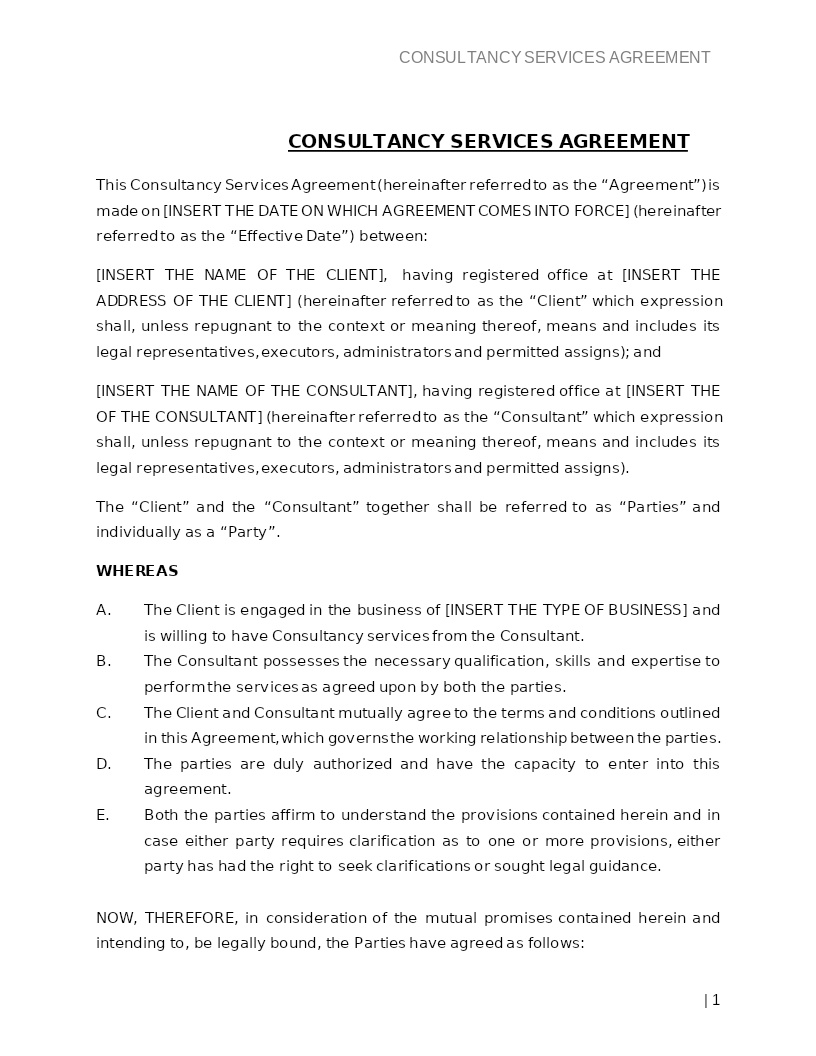
CONSULTANCY SERVICES AGREEMENT
How does it work?
1. Choose this template
Start by clicking on "Fill out the template"
2. Complete the document
Answer a few questions and your document is created automatically.
3. Save - Print
Your document is ready! You will receive it in Word and PDF formats. You will be able to modify it.
Providing Professional Expertise and Guidance in Business Engagements
When you engage an external consultant, whether to assist with strategy, operations, technology, marketing, finance, HR, compliance, or any specialized expertise, it’s essential to have a clear, legally enforceable framework that governs the services, deliverables, timelines, compensation, intellectual property, confidentiality, and liabilities involved. A Consultancy Services Agreement provides that structure.
This Agreement defines what services the consultant will perform, how they will be compensated, how deliverables will be evaluated, and the rights and obligations of both parties under U.S. commercial law. It also establishes standards for confidentiality, data security, ownership of work product, and protections against misuse of sensitive information similar to the role an NDA plays, but with broader operational detail. Using a Consultancy Services Agreement helps businesses and consultants collaborate effectively, avoid misunderstandings, and align expectations from the outset.
Where Consultancy Services Agreements Are Commonly Used
Consulting contracts are widely used in the United States for a variety of commercial relationships, including:
- Strategic, management, or operational consulting engagements
- Marketing, branding, and digital advertising advisory services
- IT consulting, software implementation, and technology support
- HR, recruitment, and organizational development projects
- Financial and tax advisory engagements
- Legal-adjacent business consulting (non-legal professional advisory services)
- Compliance, audit preparation, and risk management consulting
- Startup advisory, product development, and growth strategy projects
- Creative consulting for design, copywriting, content, or media projects
- Fractional C-suite roles (Fractional CFO, Fractional COO, etc.)
Any time a consultant performs professional services as an independent contractor, not as an employee a written Consultancy Services Agreement ensures clarity and protection for both parties.
Different Types of Consultancy Agreements You May Encounter
- General Consultancy Agreement: Used for broad advisory or strategic services.
- Project-Based Consulting Agreement: For a specific scope of work, timeline, or deliverable.
- Retainer-Based Consulting Agreement: For month-to-month or ongoing advisory support.
- Technical or IT Consulting Agreement: Covers system integrations, cybersecurity, software setup, or troubleshooting.
- Creative Consulting Agreement: Includes branding, content creation, design, and creative strategy.
- Specialized Industry Consulting Agreement: For regulated fields such as healthcare, finance, real estate, or government contracting.
When Legal Guidance Becomes Helpful
While many standard consulting engagements can proceed with templates, legal advice is valuable when:
- The consultant accesses confidential data, proprietary systems, or trade secrets
- The consultant develops intellectual property, code, designs, or materials
- The engagement involves regulated industries (healthcare, finance, education)
- Multi-state or cross-border work affects jurisdictional issues
- The consultant may interact with customers, employees, or key stakeholders
- Payment structures include performance bonuses, revenue share, or commissions
- Liability concerns exist regarding professional advice or technical implementation
- The business wants non-solicitation or non-compete protections (where enforceable)
Legal review reduces risk, especially when financial or reputational stakes are high.
How to Work With This Template
- Identify all parties and specify the consultant’s legal business status (independent contractor)
- Clearly define the scope of work, deliverables, and timelines
- Outline compensation hourly, fixed-fee, retainer, or milestone-based
- Establish confidentiality, data protection, and intellectual property ownership
- Specify governing law (state-specific, under U.S. commercial contract law)
- Address termination rights, notice periods, and dispute resolution
- Sign electronically or in hard copy both forms are enforceable in the U.S.
This structure follows U.S. federal and state contract standards and is compatible with major e-signature platforms.
Frequently asked questions
Q1. What is a Consultancy Services Agreement in the U.S.?
A Consultancy Services Agreement is a binding U.S. contract that outlines the relationship between a business (the client) and an independent consultant (the contractor). It defines services to be performed, payment terms, confidentiality obligations, intellectual property ownership, liability limits, and termination rights.
This Agreement protects both parties by clarifying expectations, preventing misinterpretation, and ensuring that all work complies with federal and state laws.
Q2. Why is a written consulting contract necessary?
A written Agreement:
• clarifies scope and prevents scope-creep disputes,
• protects against unpaid invoicing issues,
• establishes whether the consultant owns or assigns intellectual property,
• sets expectations for communication, timelines, and quality standards,
• ensures compliance with IRS regulations regarding independent contractors, and
• reduces legal risk relating to confidentiality, liability, and deliverables.
Without a written contract, U.S. courts rely on conduct and verbal terms which increases uncertainty in a dispute.
Q3. Are consultants considered employees under U.S. law?
No, consultants are independent contractors. The Agreement must explicitly state that the consultant is not an employee, the consultant is responsible for their own taxes, insurance, and benefits, and the client does not control day-to-day work processes.
This classification prevents violations of IRS rules and state labor laws.
Q4. Who owns the intellectual property created by a consultant?
Under U.S. law, consultants typically own the work they create unless the Agreement includes a “work-for-hire” or IP assignment clause. A Consultancy Services Agreement should state whether IP is transferred to the client, whether the consultant retains ownership rights, or whether the client receives a license to use the consultant’s materials. This is especially important for software, creative work, proprietary methodologies, and technical deliverables.
Q5. How are U.S. consultants typically paid?
Common payment structures include hourly billing, fixed-fee project pricing, monthly retainers, milestone-based payments, performance-based bonuses, revenue-share or commission models. The Agreement must specify invoicing procedures, payment timelines, late-fee policies, and expense reimbursement rules.
Q6. Are confidentiality clauses required in consulting agreements?
Yes. Consultants often access sensitive business information such as financial data,
marketing strategies, trade secrets, customer lists, internal systems, software code or proprietary tools. A confidentiality clause similar to an NDA protects this information and prevents unauthorized disclosure or use.
Q7. What happens if a consultant fails to deliver or the client is dissatisfied?
The Agreement should include performance standards, procedures for requesting revisions, cure periods, rights to withhold payments, termination for breach, and dispute resolution mechanisms. Clear expectations reduce conflict and ensure accountability on both sides.
Q8. Can a consultancy services agreement be terminated early?
Yes. Most U.S. consulting agreements allow termination for convenience with written notice, immediate termination for breach or misconduct, termination for non-payment, or termination if the consultant fails to perform duties.
Termination sections should also address final payments, return of materials, and ongoing confidentiality duties.
Q9. Are electronic signatures valid for consulting agreements in the United States?
Yes. Under the ESIGN Act and UETA, electronic signatures are legally valid and enforceable across the U.S., provided both parties consent to electronic execution.
Q10. Is insurance required for consultants?
Some clients require consultants to carry professional liability insurance (errors & omissions), general business liability insurance, and cyber liability insurance (for IT consultants). While not always mandatory, insurance provides financial protection for both parties.
Q11. How should disputes be handled under U.S. consulting contracts?
Common methods include negotiation and escalation, mediation, arbitration (often preferred for cost and speed), or litigation under state law. The governing law and venue should be clearly specified to avoid conflicts.
Q12. Can consultants subcontract work?
Only if the Agreement permits it. If subcontractors are allowed, the contract should require identical confidentiality obligations, proper qualifications, and continued responsibility by the consultant for all work. Unauthorized subcontracting may constitute a material breach.