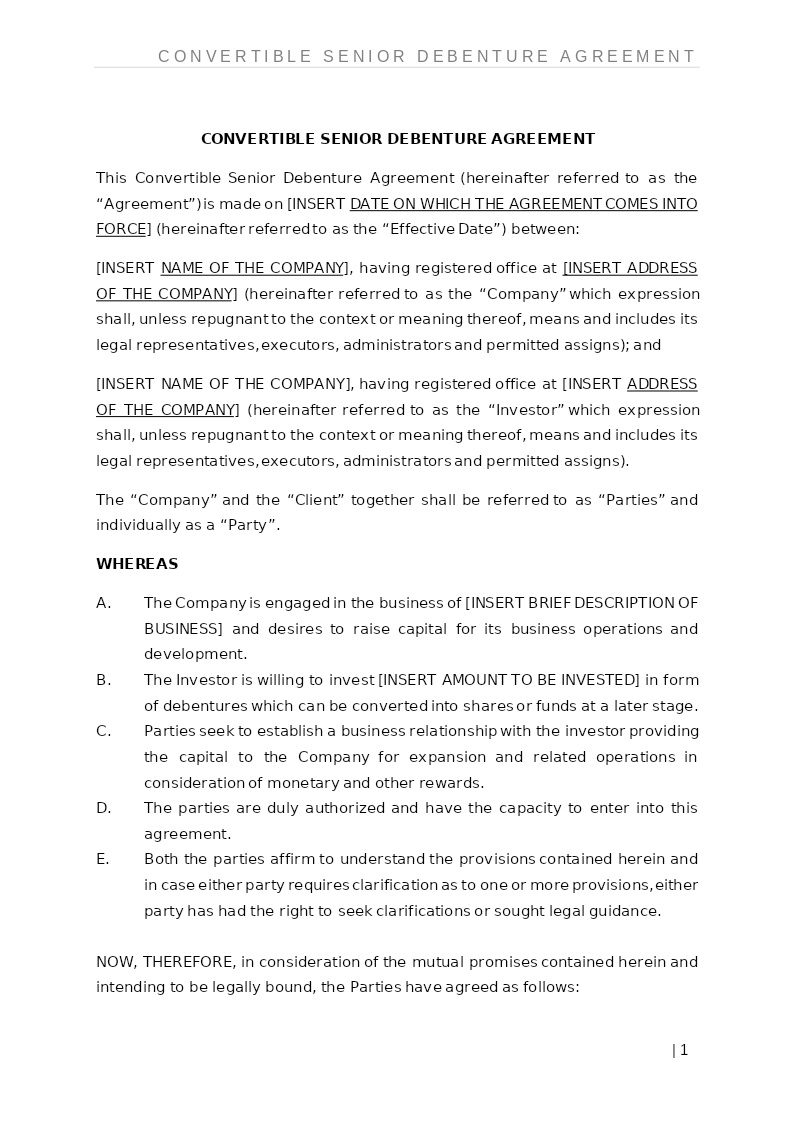
CONVERTIBLE SENIOR DEBENTURE AGREEMENT
How does it work?
1. Choose this template
Start by clicking on "Fill out the template"
2. Complete the document
Answer a few questions and your document is created automatically.
3. Save - Print
Your document is ready! You will receive it in Word and PDF formats. You will be able to modify it.
Structuring Convertible Senior Debenture Investments in U.S. Corporate Financing
A Convertible Senior Debenture Agreement outlines the terms under which a company issues debt that can later be converted into equity at a defined conversion rate. This contract explains interest obligations, maturity dates, conversion mechanics, and seniority rights, allowing investors to benefit from both fixed-income returns and potential equity upside.
By setting these terms in writing, companies can raise capital flexibly while providing investors with transparency, security, and the option to participate in future growth.
Where Convertible Senior Debenture Agreements Are Commonly Used
Such agreements are widely used across U.S. industries that seek capital without immediately diluting ownership, including:
- Technology startups and high-growth companies
- Public and private corporations planning expansion or acquisitions
- Businesses restructuring existing debt obligations
- Private equity transactions and bridge financing rounds
- Companies seeking hybrid investment instruments
- Strategic financings where investors want downside protection and upside potential
Any organization needing capital while maintaining control and operational flexibility commonly uses convertible senior debentures.
Different Types of Convertible Debenture Structures You May Encounter
- Traditional Convertible Senior Debentures: Provide fixed interest and allow conversion into common stock at a pre-set conversion price.
- Mandatorily Convertible Debentures: Automatically convert into equity after a certain period or upon meeting predefined triggers.
- Contingent Convertible Debentures (CoCos): Convert only if specific financial or market conditions occur, offering enhanced risk management for issuers.
- Zero-Coupon Convertible Debentures: Issued at a discount with no periodic interest, benefiting companies with limited cash flow.
- Convertible Exchangeable Debentures: Allow investors to convert into shares of a parent company, subsidiary, or affiliated entity.
When Legal Guidance Becomes Helpful
Although convertible debentures follow standard financing models, real-time legal counsel becomes essential when:
- Conversion pricing impacts shareholder rights or voting power
- The company operates across multiple U.S. states with varying securities laws
- Anti-dilution protections, reset provisions, or complex conversion formulas are involved
- Interest, tax treatment, or reporting obligations require compliance with federal regulations
- The transaction involves existing lenders, secured debts, or senior credit facilities
- The investment may trigger SEC filings, investor notices, or corporate approvals
Legal review ensures that the financial terms are enforceable, regulatory obligations are met, and both parties understand their rights and liabilities.
How to Work with This Template
- Identify the issuing company and the investor purchasing the debenture
- Define the purpose and terms of the investment
- Specify interest rates, maturity, conversion mechanics, and seniority rights
- Select the governing U.S. state law and applicable securities regulations
- Review repayment obligations, default clauses, and conversion triggers
- Finalize the terms collaboratively (legal review optional)
- Sign electronically or in hard copy for formal execution
This template aligns with U.S. corporate financing standards and supports compliance with commonly applied securities frameworks.
Frequently Asked Questions
Q1. Why is a Convertible Senior Debenture Agreement important for U.S. corporate financing?
This agreement formalizes the relationship between the company and the investor by outlining interest, repayment, and conversion rights. It provides clarity, reduces risk, and sets expectations for both parties. In U.S. markets, where investor protection and regulatory compliance matter, the agreement ensures transparency and financial stability.
Q2. How do convertible senior debentures balance risk and reward for investors?
Investors receive fixed-interest payments, ensuring steady returns even if equity values fluctuate. At the same time, conversion rights allow them to benefit from future stock appreciation. Seniority status also places investors ahead of other unsecured creditors in repayment priority, providing added protection.
Q3. Do companies benefit from issuing convertible senior debentures?
Yes. This financing option provides capital without immediate stock dilution, helping businesses maintain control. Companies also gain flexible repayment terms and attract investors who seek hybrid instruments. It is a practical solution for growth-stage companies, strategic expansions, or bridging financing rounds.
Q4. What makes a debenture “senior” in the U.S. context?
“Senior” status means the investor’s claim is prioritized over junior or subordinated debts if the company faces financial distress. Senior debenture holders are repaid before general unsecured creditors, reducing investment risk. This hierarchy is essential for investors who seek security and repayment assurance.
Q5. What does the conversion feature typically include?
The agreement specifies the conversion price, ratio, and conditions under which debt may convert into shares. It may also include anti-dilution protections, adjustment formulas, and conversion windows. These terms ensure investors know exactly how and when they can convert their debentures into equity.
Q6. Can conversion terms vary across different deals?
Absolutely. Conversion structures differ based on market conditions, company valuation, risk profile, and negotiation outcomes. Parties may negotiate discounts, valuation caps, triggers, or protective provisions. Customization ensures both issuer and investor benefit from fair and strategic terms.
Q7. Are electronic signatures valid for executing Convertible Senior Debenture Agreements in the U.S.?
Yes. Under federal laws like the ESIGN Act and corresponding state statutes, electronic signatures are enforceable. Companies and investors can execute debenture agreements digitally through secure platforms, making the process efficient and compliant with modern corporate standards.
Q8. Can this agreement be used for startups or newly formed companies?
Yes. Startups frequently use convertible senior debentures to raise early-stage capital without determining a valuation too early. The hybrid structure provides investors with protection and upside potential while giving the company access to funds needed to scale. It is widely accepted across U.S. venture and corporate financing landscapes.