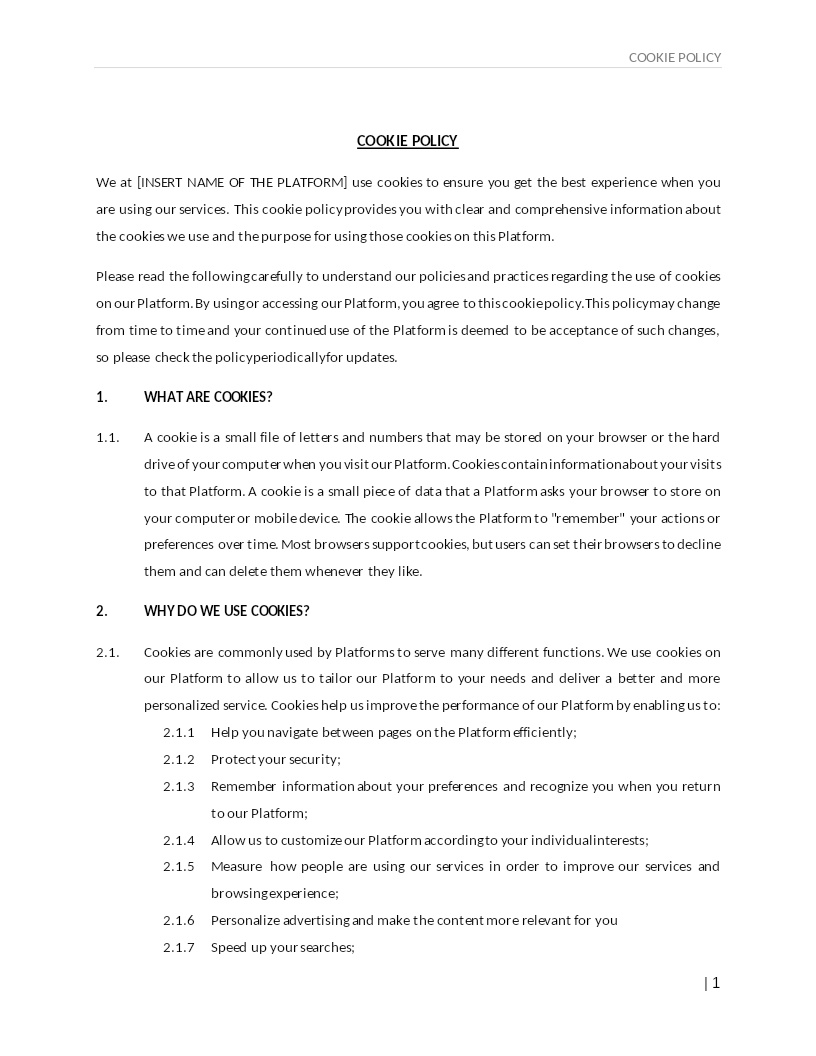
COOKIE POLICY
How does it work?
1. Choose this template
Start by clicking on "Fill out the template"
2. Complete the document
Answer a few questions and your document is created automatically.
3. Save - Print
Your document is ready! You will receive it in Word and PDF formats. You will be able to modify it.
Ensuring Transparency in Online Data Practices Through a Cookie Policy
A Cookie Policy is a formal legal notice used by websites and online platforms to disclose how cookies and similar tracking technologies collect, store, process, and use information about users. This policy is drafted in accordance with U.S. privacy laws, Federal Trade Commission (FTC) guidance on online tracking, state data-protection laws such as the California Consumer Privacy Act (CCPA) and California Privacy Rights Act (CPRA), and industry best practices governing digital transparency and user consent. It informs users of the types of cookies employed, their purposes, data-sharing practices, and the rights available to users regarding cookie-based data collection.
A robust Cookie Policy clarifies the website’s data-tracking methods, including session cookies, persistent cookies, analytical tools, advertising identifiers, and third-party tracking technologies. It outlines user-control options such as browser settings, opt-out mechanisms, and Do-Not-Track preferences and provides disclosure of how cookie data may be used for personalization, analytics, performance monitoring, or targeted advertising. By implementing a clear and comprehensive Cookie Policy, businesses enhance transparency, reduce legal exposure, foster user trust, and align their digital practices with evolving U.S. data-privacy expectations.
Where Cookie Policies Are Commonly Used
Cookie Policies are integral to the operation of websites, platforms, and digital services across many industries, including:
• E-commerce websites collecting behavioral and transactional browsing data
• SaaS platforms and web applications using tracking tools for performance monitoring
• Marketing and advertising platforms deploying analytics or retargeting pixels
• News, media, and publishing sites that rely on third-party ad networks
• Financial services websites with authentication and security-related cookies
• Healthcare and wellness platforms storing user preferences or portal session data
• Educational institutions offering online learning tools and student portals
• Corporate websites tracking visitor traffic, engagement metrics, or account activity
Any website or online service using cookies should maintain a compliant Cookie Policy.
Different Types of Cookie Policies
1. General Website Cookie Policies: Provide an overview of essential cookies, analytics tools, and user-control options.
2. Advertising and Retargeting Cookie Policies: Explain third-party ad tracking, pixel deployment, cross-device identifiers, and opt-out procedures.
3. Analytics and Performance Cookie Policies: Detail tools used for traffic measurement, site optimization, and user-engagement evaluation.
4. Consent-Management Cookie Policies: Common on large platforms requiring granular cookie-preference settings.
5. Industry-Specific Cookie Policies: Adapted for regulated sectors such as healthcare, finance, or education.
When Legal Guidance Becomes Helpful
Legal counsel may be necessary when:
• The website engages in behavioral-advertising practices regulated by FTC guidance
• The business is subject to state consumer-data laws such as CCPA/CPRA, CPA, CTDPA, or VCDPA
• Third-party vendors (e.g., analytics providers, ad platforms) collect user information
• Sensitive personal data or geolocation information is processed through cookies
• A company must coordinate cookie practices with a broader privacy policy or data-processing agreements
• The organization receives user requests to opt-out, delete data, or limit data use
• New tracking technologies (e.g., fingerprinting, device graphs) require disclosure
• The business operates internationally and must harmonize with GDPR or foreign laws
Legal review helps ensure that cookie-tracking disclosures comply with U.S. consumer-privacy laws and reduce regulatory exposure.
How to Work with This Template
• Identify the types of cookies used and classify them by purpose essential, analytical, functional, or advertising
• Disclose what data each cookie collects, how long the data is retained, and whether third parties have access
• Clarify whether cookies track personal information, device identifiers, or browsing behavior
• Provide instructions for users on adjusting browser settings or opting out of advertising tracking
• Reference the organization’s privacy policy and explain how cookie data integrates with broader data-processing practices
• Specify compliance with state data-privacy laws, including user rights concerning access, deletion, or opt-out
• Describe any consent-management tools or cookie-preference platforms used
• Include language regarding updates, effective dates, and user notifications
• Secure user acknowledgment when appropriate, consistent with U.S. e-signature and online-agreement standards
This template reflects widely accepted U.S. digital-privacy and online-tracking compliance practices for websites and online service providers.
Frequently Asked Questions
Q1. What is a Cookie Policy, and why is it important?
A Cookie Policy is a legal disclosure informing users of how cookies and tracking technologies are used on a website. It is important because it ensures transparency, enhances user trust, and supports compliance with state privacy laws and FTC guidelines.
Q2. Are cookie notices legally required in the United States?
While the U.S. does not mandate cookie banners at the federal level, states such as California (under CCPA/CPRA) require disclosure of tracking practices, especially for targeted advertising and data-sharing activities.
Q3. Do cookies collect personal information?
Certain cookies can collect personal information such as IP addresses, device IDs, or browsing histories. When they do, the Cookie Policy must disclose this clearly.
Q4. Can users disable cookies?
Yes. Users can disable cookies through browser settings, opt-out tools, or consent-management platforms. The policy should explain these options.
Q5. Are third-party cookies covered by the Cookie Policy?
Absolutely. Websites must disclose third-party tracking tools, analytics platforms, and advertising networks that process user data.
Q6. Do companies need user consent to use cookies in the U.S.?
Consent requirements vary. Many U.S. businesses rely on disclosure-based models, but certain activities such as targeted advertising may require opt-out choices under CCPA/CPRA.
Q7. How often should a Cookie Policy be updated?
At least annually, or whenever new cookies, technologies, or data-sharing partners are added.
Q8. Does a Cookie Policy replace a Privacy Policy?
No. A Cookie Policy is supplemental and must align with the broader Privacy Policy that governs all data practices.
Q9. Are analytic tools like Google Analytics required to be disclosed?
Yes. Any tool that collects user data or tracks online activity must be disclosed to comply with privacy-transparency requirements.
Q10. Should legal counsel review a Cookie Policy?
Yes. Because tracking technologies evolve rapidly and privacy laws differ across states, legal review helps ensure accuracy and compliance.