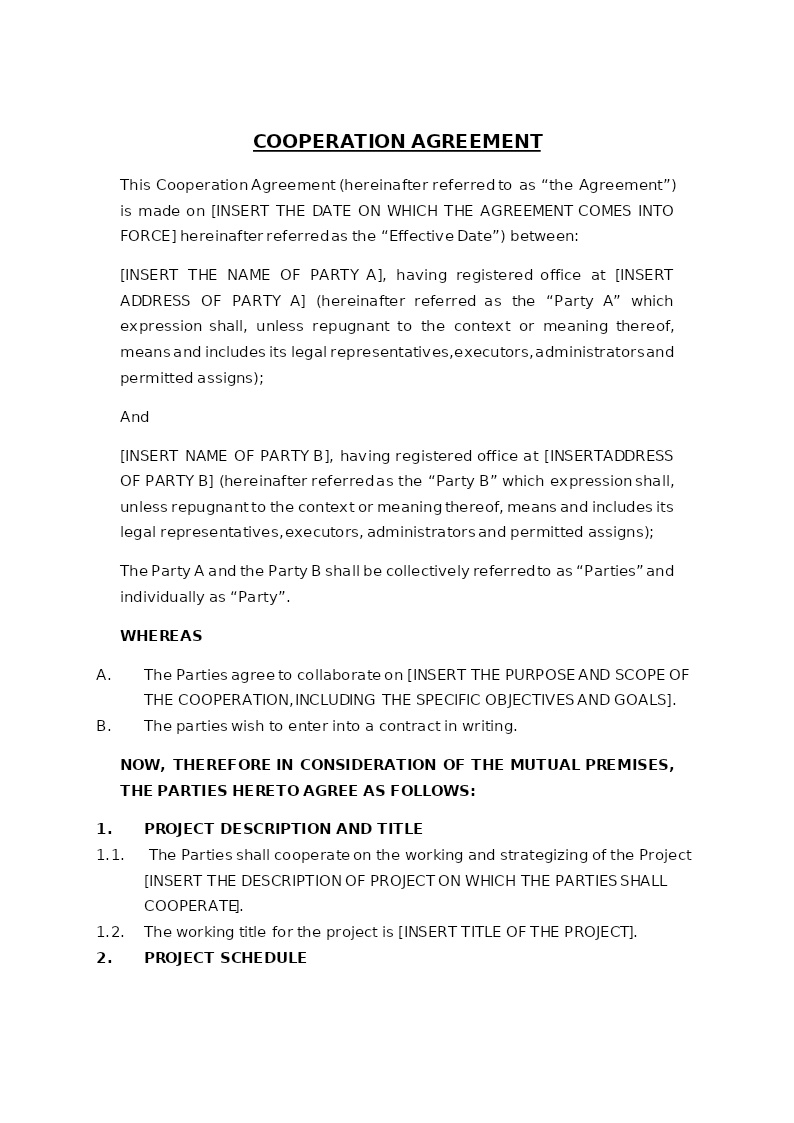
COOPERATION AGREEMENT
How does it work?
1. Choose this template
Start by clicking on "Fill out the template"
2. Complete the document
Answer a few questions and your document is created automatically.
3. Save - Print
Your document is ready! You will receive it in Word and PDF formats. You will be able to modify it.
Understanding Cooperation Agreements
When two or more parties intend to work together toward a shared objective such as developing a project, launching a business initiative, pursuing research, or coordinating resources they need a clear framework that governs how the collaboration will operate. A Cooperation Agreement provides this structure. It defines each party’s contributions, obligations, rights, and expectations while establishing how decisions will be made, how resources will be shared, and how the outcomes of the collaboration will be managed.
Putting a Cooperation Agreement in place creates clarity and trust. It allows all parties to communicate openly, coordinate efforts, share information responsibly, and work toward common goals without worrying about role confusion, unequal workloads, or disputes over ownership, profits, or responsibilities.
Where Cooperation Agreements Are Commonly Used
Cooperation Agreements are widely used across U.S. business environments, especially where two or more entities combine resources or expertise, including:
- Joint research and development projects
- Strategic partnerships between companies, nonprofits, or universities
- Multi-vendor collaborations on complex commercial projects
- Cross-border ventures and international business expansions
- Technology development, innovation initiatives, and pilot programs
- Public–private partnerships and government-funded collaborations
- Shared marketing, distribution, or co-branding campaigns
Any time multiple parties rely on one another to complete a shared project or achieve a common outcome, a Cooperation Agreement sets boundaries and expectations that guide the collaboration.
Different Types of Cooperation Agreements You May Encounter
- General Cooperation Agreement: A broad agreement that outlines the overall framework for collaboration, including goals, responsibilities, governance, and resource sharing.
- Project-Specific Cooperation Agreement: Tailored for a single initiative, research project, product launch, or short-term collaboration with defined timelines and deliverables.
- Joint Development Agreement: Used when parties collaboratively create technology, software, research data, or intellectual property, often including detailed IP ownership and licensing terms.
- Strategic Partnership Agreement: A long-term arrangement between businesses or organizations to pursue shared commercial or operational interests.
- Cross-Border or Multi-Jurisdictional Cooperation Agreement: Used when collaborating parties are located in different states or countries, requiring jurisdictional, tax, and regulatory considerations.
Why Businesses Need a Cooperation Agreement
A Cooperation Agreement helps establish a structured and balanced partnership from the start. It defines responsibilities, prevents overlap, safeguards intellectual property, outlines decision-making processes, and sets out how costs, profits, and resources will be shared. It also protects both sides against potential risks, including disputes, delays, confidentiality breaches, or changes in commitment.
For collaborations involving sensitive information, joint development work, or shared IP rights, the agreement ensures that contributions are recognized, outcomes are protected, and the partnership remains fair, legally compliant, and aligned with U.S. contract standards.
When Legal Guidance Becomes Helpful
Most simple collaborations can begin with a standard cooperation template, but legal guidance becomes important when:
- The project involves valuable intellectual property, proprietary materials, or confidential data
- Multiple jurisdictions, international partners, or government entities participate
- The collaboration will generate new IP requiring joint ownership or licensing
- Financial contributions, equity rights, or revenue-sharing structures are involved
- The parties work in regulated industries such as healthcare, finance, data security, or technology
- The agreement must include non-compete, non-solicitation, exclusivity, or complex liability terms
- There are negotiation points requiring real-time legal interpretation or clarification
Lawyers help ensure the agreement is enforceable, fair, and aligned with the parties’ long-term goals, especially when the collaboration involves significant investments, risks, or shared assets.
How to Work with This Template
- Identify the parties and define their relationship within the collaboration
- Clearly outline the purpose, objectives, and expected outcomes of the cooperation
- Define each party’s contributions financial, technical, operational, or intellectual
- Specify ownership and licensing rights for any existing or newly developed IP
- Establish governance procedures, decision-making authority, and communication protocols
- Outline cost-sharing arrangements, profit-sharing terms, or reimbursement structures
- Include confidentiality obligations, data-sharing rules, and non-interference commitments
- Determine dispute resolution methods, jurisdiction, governing law, and termination rights
- Review the agreement together before signing; legal review is optional but recommended
- Sign electronically or in hard copy both forms are enforceable across the United States
This template aligns with cooperation and partnership standards widely used in U.S. commercial, research, and nonprofit sectors.
Frequently Asked Questions
Q1. What is a Cooperation Agreement?
A Cooperation Agreement is a legally binding contract that outlines how two or more parties will collaborate on a shared project or objective. It defines each party’s responsibilities, contributions, resource commitments, and expectations. This agreement ensures that the cooperation is structured, transparent, and aligned with the project’s goals, reducing the risk of misunderstandings or disputes.
Q2. Why is a Cooperation Agreement important for businesses?
Businesses use Cooperation Agreements to protect their interests while collaborating with external parties. The agreement outlines ownership rights, decision-making procedures, resource allocations, confidentiality responsibilities, and financial terms. By documenting these details, businesses avoid confusion and ensure that their investments, data, and intellectual property remain protected throughout the collaboration.
Q3. Does a Cooperation Agreement include intellectual property rights?
Yes. Most Cooperation Agreements include detailed IP provisions because collaborations often involve shared innovation or development. The agreement specifies which party owns pre-existing IP, what happens to jointly created IP, and how licensing or usage rights will be granted. Clear IP terms prevent future disputes over ownership, usage, or commercialization.
Q4. Can a Cooperation Agreement define cost-sharing or profit-sharing terms?
Absolutely. Cooperation Agreements often include financial structures such as shared project costs, revenue distribution, milestone-based funding, or reimbursement schedules. These provisions make budgeting predictable and prevent disagreements over financial contributions or profit entitlements.
Q5. Is a Cooperation Agreement enforceable across U.S. states?
Yes. A Cooperation Agreement is fully enforceable across the U.S. as long as it complies with contract laws and includes clear terms. Parties typically select one state’s laws as the governing jurisdiction, ensuring consistency even if the collaborators are located in different states or countries.
Q6. How does the agreement address confidentiality and data sharing?
The agreement typically includes confidentiality clauses that protect sensitive information exchanged during the collaboration. It may also specify how data can be used, stored, or shared, especially if the project involves proprietary technology, client information, or regulated data. These clauses prevent unauthorized use or disclosure.
Q7. Can the agreement include termination conditions?
Yes. Most Cooperation Agreements include termination terms outlining when and how the collaboration can end, such as completion of the project, breach of contract, non-performance, or mutual agreement. The agreement may also describe the process for settling outstanding obligations, returning confidential information, and dividing jointly developed assets.
Q8. Do parties need a lawyer to draft a Cooperation Agreement?
While not always required, legal advice is highly beneficial, especially for complex projects involving valuable IP, cross-border partners, regulated industries, or large financial commitments. Lawyers ensure the agreement is legally enforceable, tailored to the project, and protective of each party’s long-term interests.