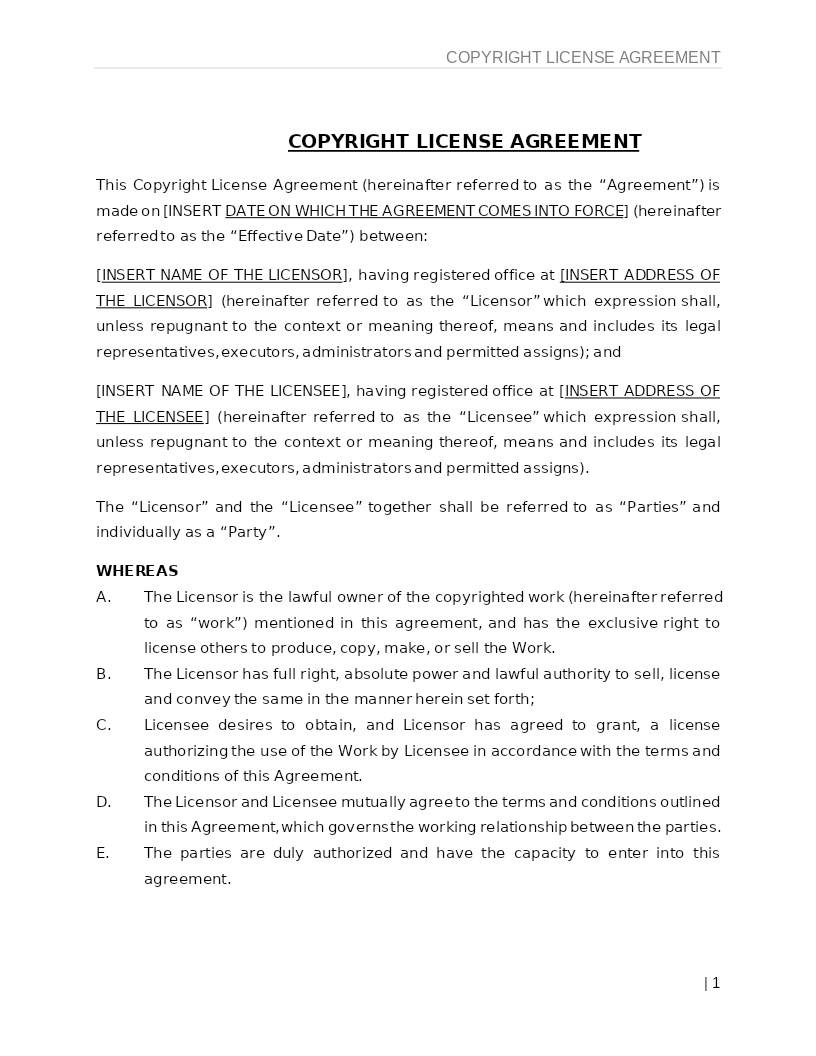
COPYRIGHT LICENSE AGREEMENT
How does it work?
1. Choose this template
Start by clicking on "Fill out the template"
2. Complete the document
Answer a few questions and your document is created automatically.
3. Save - Print
Your document is ready! You will receive it in Word and PDF formats. You will be able to modify it.
Understanding Copyright License Agreements
A Copyright License Agreement is a legally binding contract in which the copyright owner (the “Licensor”) grants another party (the “Licensee”) permission to use copyrighted material, such as artwork, written content, software, music, photographs, videos, or other creative works under specific conditions. It outlines the scope of the license, usage rights, restrictions, duration, territory, fees or royalties, and the ownership of the underlying copyrighted work.
In the United States, Copyright License Agreements operate under the U.S. Copyright Act, federal IP regulations, state contract laws, and digital commerce rules. These agreements help creators protect their intellectual property while allowing others to legally use their work for personal, commercial, or professional purposes.
Where Copyright License Agreements Are Commonly Used
Copyright License Agreements are widely used across creative, digital, and commercial industries, including:
- Artists licensing artwork for merchandise or prints
- Authors, photographers, and designers licensing their creative works
- Businesses licensing branding, marketing materials, or software
- Music producers licensing audio for videos or commercial use
- Film and media studios licensing footage or digital assets
- Content creators licensing assets for NFTs, digital marketplaces, or Web3 projects
- Educational institutions or publishers using licensed works in publications
Any time copyrighted content is shared, distributed, or monetized, a Copyright License Agreement ensures compliance and legal clarity.
Different Types of Copyright Licenses You May Encounter
- Exclusive License: Grants the Licensee exclusive rights to use the copyrighted work, preventing the Licensor from licensing it to others.
- Non-Exclusive License: Allows the Licensor to license the work to multiple users at the same time.
- Commercial License: Permits the Licensee to use the copyrighted material for revenue-generating activities.
- Personal Use License: Allows private, non-commercial use of the copyrighted content.
- Sublicense Rights: Grants the Licensee authority to allow third parties to use the copyrighted material.
When Legal Guidance Becomes Helpful
Legal advice is recommended when:
- The license involves valuable creative works, trademarks, or digital assets
- The agreement includes royalties, revenue sharing, or commercial licensing
- The copyrighted work will be used internationally or online
- The Licensee wants broad rights or sublicensing privileges
- The work is part of a collaborative project or joint ownership
- The license includes moral rights, attribution requirements, or modifications
- Enforcement, dispute resolution, or DMCA compliance is involved
Legal guidance ensures that rights are clearly defined and enforceable under U.S. copyright law.
How to Work with This Template
- Identify the Licensor and Licensee
- Describe the copyrighted material being licensed
- Define whether the license is exclusive or non-exclusive
- Specify permitted uses, restrictions, and commercial rights
- Include royalty terms, payment schedules, or flat fees
- Outline copyright ownership and rights reserved by the Licensor
- Add confidentiality, attribution, and modification rules
- Choose governing U.S. state law and applicable federal regulations
- Sign electronically or physically following contract standards
This template complies with common U.S. licensing practices and works with all major online signing platforms.
Frequently Asked Questions
Q1. What is a Copyright License Agreement and why is it important?
A Copyright License Agreement grants permission to use a copyrighted work under specific conditions. It is important because it protects the creator’s intellectual property while giving the Licensee legal rights to use the material for personal or commercial purposes.
Q2. Does a Copyright License Agreement transfer ownership of the work?
No. A license grants usage rights but does not transfer ownership. The Licensor keeps the copyright unless a separate assignment agreement is signed.
Q3. What types of uses can a Copyright License Agreement allow?
The license can authorize commercial use, marketing use, reproduction, distribution, modification, or personal use of the copyrighted material. All permitted uses must be clearly written in the agreement.
Q4. Are Copyright License Agreements enforceable in the U.S.?
Yes. They are enforceable under the U.S. Copyright Act and state contract laws. A written agreement protects both parties and makes enforcement easier in case of unauthorized use.
Q5. Can I use a copyrighted work commercially without a license?
No. Commercial use of copyrighted material without permission is copyright infringement and can lead to legal penalties. A Commercial Copyright License is required for business uses.
Q6. What happens if the Licensee violates the agreement?
Violations may result in license termination, legal damages, removal requests, or DMCA takedown notices. Clear enforcement terms help prevent dispute escalation.
Q7. Are royalties required in a Copyright License Agreement?
Not always. Some licenses involve one-time payments, while others include ongoing royalties or revenue sharing. Terms depend on the creator’s preferences and the value of the copyrighted material.
Q8. Can the Licensee create modified or derivative works?
Only if the license allows it. Many creators prohibit modifications without written permission to protect the integrity of their work.
Q9. Are electronic signatures valid for Copyright License Agreements?
Yes. Under the U.S. ESIGN Act, electronic signatures are legally binding. Most creators and businesses use digital platforms like Docu Sign or Adobe Sign.
Q10. Is a Copyright License Agreement suitable for digital assets like NFTs or online content?
Absolutely. Licensing copyrighted content is essential for NFTs, digital artwork, online media, and content posted on websites or social platforms. It defines usage rights and prevents unauthorized copying or distribution.