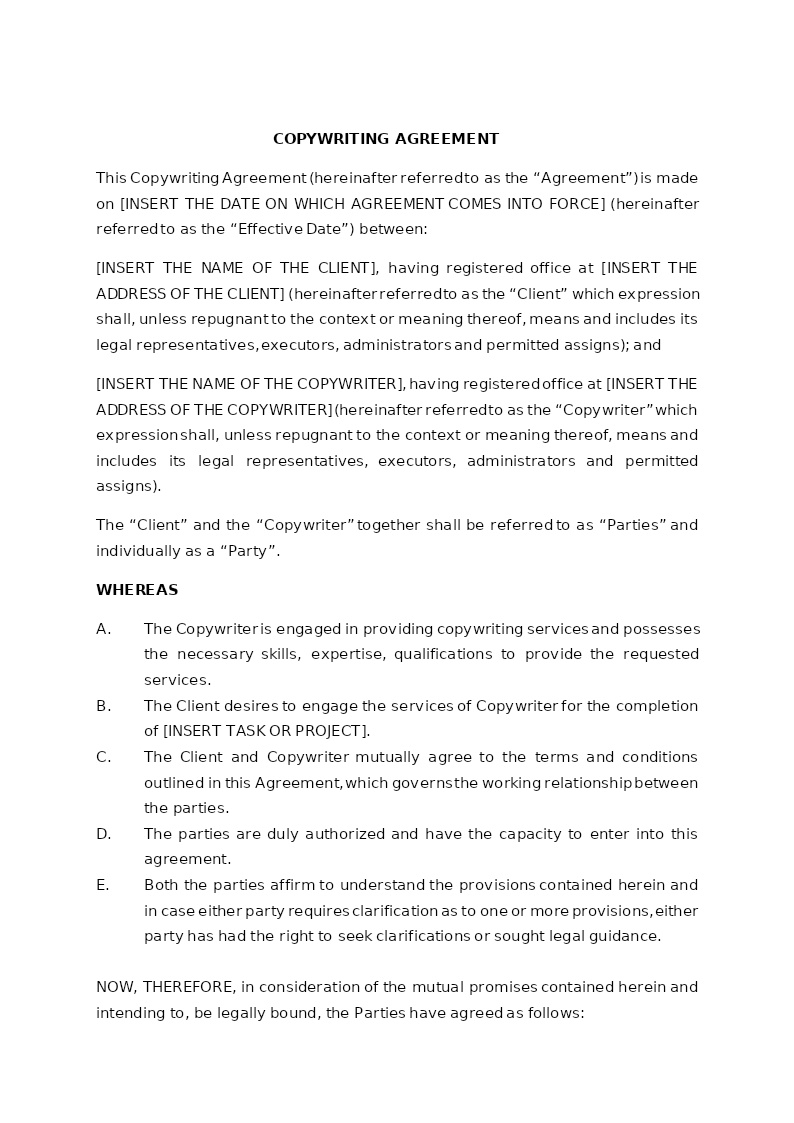
COPYWRITING AGREEMENT
How does it work?
1. Choose this template
Start by clicking on "Fill out the template"
2. Complete the document
Answer a few questions and your document is created automatically.
3. Save - Print
Your document is ready! You will receive it in Word and PDF formats. You will be able to modify it.
Defining Creative Content Obligations Through Formal Copywriting Service Agreements
Companies, agencies, and entrepreneurs frequently rely on independent copywriters to craft persuasive written content for marketing, branding, advertising, and operational communications. To ensure clarity, protect intellectual property, and avoid disputes, such relationships must be formalized through a written document. A Copywriting Agreement accomplishes this. It outlines the terms under which a copywriter provides creative and editorial services to a client, consistent with U.S. contract law, the U.S. Copyright Act, Federal Trade Commission (FTC) advertising standards, and independent-contractor regulations.
By entering into a Copywriting Agreement, both parties establish a clear legal foundation that governs deadlines, revisions, compensation, confidentiality, copyright ownership, and content usage rights. This agreement also defines the nature of the professional relationship by confirming that the copywriter is an independent contractor, thereby protecting both parties against IRS misclassification issues and ensuring compliance with applicable state and federal regulations.
Where Copywriting Agreements Are Commonly Used
Copywriting Agreements are employed across a wide array of marketing and content production environments, including:
- Marketing agencies and creative studios
- E-commerce stores requiring product descriptions or ad copy
- Corporate communications and internal messaging
- Influencer campaigns, brand storytelling, and advertising content
- SEO content creation, website pages, and landing-page optimization
- Email marketing, newsletters, and automated campaign copy
- Scriptwriting for promotional videos, podcasts, or social media
- Ghostwriting for executives, founders, or public figures
Any situation requiring a copywriter to provide original written content benefits from a formal agreement setting out expectations and legal protections.
Different Types of Copywriting Agreements You May Encounter
1. Project-Based Copywriting Agreements: Define services for a standalone project, such as website copy or a brand campaign.
2. Retainer or Ongoing Service Agreements: Apply when the copywriter delivers recurring content for a fixed monthly fee.
3. Ghostwriting or Attribution-Specific Agreements: Address authorship rights, anonymity, and ownership of editorial content.
4. Advertising and Marketing Compliance Agreements: Ensure content adheres to FTC truth-in-advertising rules and industry standards.
5. Technical Copywriting Agreements: Cover highly specialized content requiring industry expertise, research, and accuracy.
When Legal Guidance Becomes Helpful
Legal consultation may be advisable when:
- The content to be created involves complex intellectual property considerations
- The agreement includes extensive confidentiality or non-disclosure provisions
- FTC or industry-specific compliance rules apply to advertising content
- Compensation structures include royalties, usage fees, or long-term licensing
- The project includes ghostwriting or attribution-sensitive work
- State or federal contractor classification laws may be implicated
- The parties anticipate disputes relating to plagiarism, originality, or revisions
An attorney can ensure the agreement properly addresses ownership, compensation, compliance, and liability under U.S. law.
How to Work with This Template
- Identify the Client and the Copywriter and describe the scope of work
- Outline deliverables, deadlines, and revision processes in detail
- Specify compensation, invoicing, late-payment terms, and reimbursement allowances
- Establish ownership and usage rights (work-for-hire vs. licensed content)
- Include confidentiality, data protection, and non-disclosure provisions
- Define compliance obligations, including FTC truth-in-advertising requirements
- Outline termination rights, dispute-resolution procedures, and governing law
- Review the agreement regularly and ensure it aligns with U.S. copyright standards
- Execute the agreement electronically or in writing
This template reflects standard practices for U.S. copywriting engagements and is suitable for freelancers, agencies, and corporate clients.
Frequently Asked Questions
Q1. What is a Copywriting Agreement, and why is it necessary?
A Copywriting Agreement is a legally binding contract that outlines the terms under which a writer creates marketing or editorial content for a client. It is necessary because it clarifies payment, ownership, deadlines, revisions, confidentiality obligations, and usage rights, helping prevent misunderstandings or legal disputes.
Q2. Who owns the copy produced under the agreement?
Ownership depends on how the agreement is drafted. Many Copywriting Agreements designate the work as “work made for hire” under the U.S. Copyright Act, transferring all rights to the client upon payment. Others allow the writer to retain ownership while granting a license.
Q3. Does the agreement confirm independent-contractor status?
Yes. To comply with IRS regulations and avoid misclassification issues, the agreement should state that the copywriter is an independent contractor responsible for their own taxes, insurance, and expenses.
Q4. Can clients request revisions to the work?
Most agreements include a specified number of revisions at no additional cost, provided they fall within the original scope of work. Additional revisions may incur extra fees.
Q5. How is plagiarism handled under the agreement?
The agreement may require the copywriter to guarantee that all content is original, free from infringement, and not AI-generated without disclosure. Violations can result in termination or liability.
Q6. Are confidentiality provisions included?
Yes. Copywriters often gain access to marketing plans, product details, or proprietary information, necessitating strong confidentiality clauses to protect the client.
Q7. Are electronic signatures enforceable for Copywriting Agreements?
Yes. Under the ESIGN Act, electronic signatures are valid and enforceable, making digital execution widely used for freelance contracts.
Q8. What happens if a deadline is missed?
The agreement may specify remedies such as revised timelines, partial payment adjustments, or termination rights. Clear scheduling language minimizes disputes.
Q9. Can the copywriter reuse or repurpose the content?
Only if the agreement expressly permits it. Work-for-hire language generally prohibits reuse, while licensing-based contracts may allow limited repurposing.
10. Does the agreement address compliance with advertising laws?
Yes. A comprehensive Copywriting Agreement should require adherence to FTC truth-in-advertising standards, including accuracy, disclosure of endorsements, and avoidance of deceptive claims.