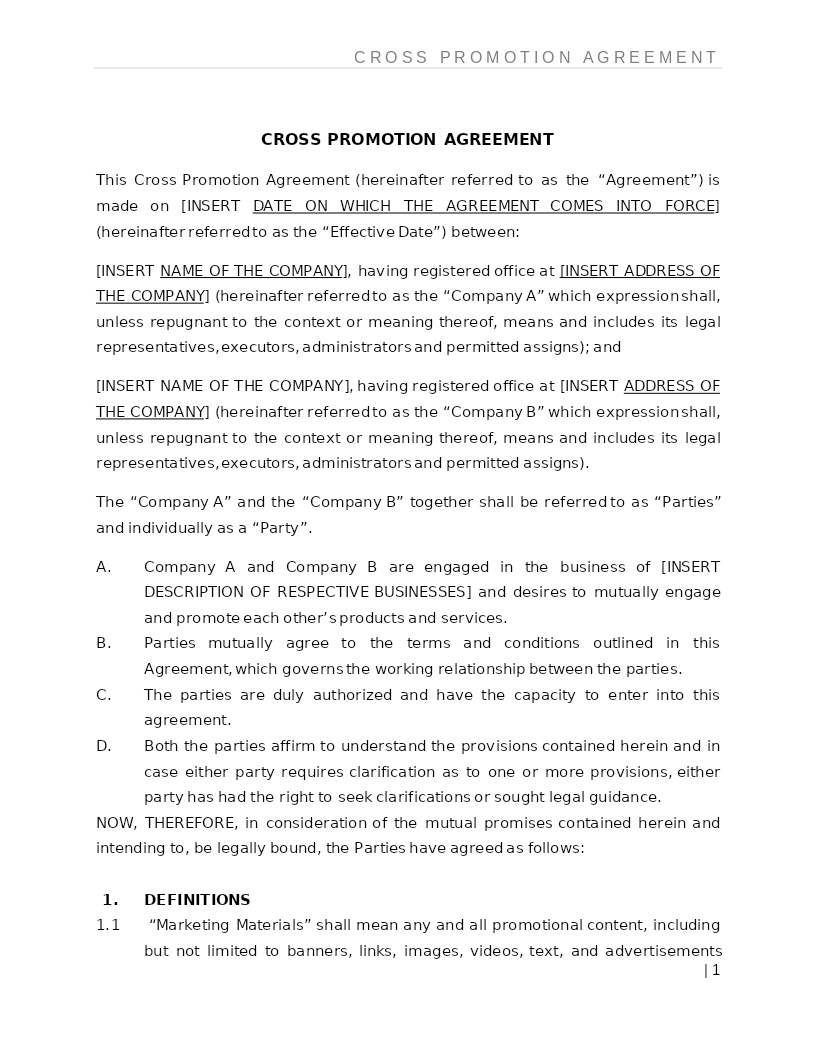
CROSS PROMOTION AGREEMENT
How does it work?
1. Choose this template
Start by clicking on "Fill out the template"
2. Complete the document
Answer a few questions and your document is created automatically.
3. Save - Print
Your document is ready! You will receive it in Word and PDF formats. You will be able to modify it.
Understanding Cross-Promotion Agreements
A Cross-Promotion Agreement establishes a structured collaboration between two businesses that agree to promote each other’s products, services, or brands. It outlines how the promotion will take place, what marketing assets will be used, the responsibilities of each party, and the terms governing the partnership.
Putting a Cross-Promotion Agreement in place creates clarity, avoids misunderstandings, and ensures both partners benefit fairly from the collaboration. It formalizes expectations around brand usage, timelines, approvals, and performance standards, helping both parties expand reach and strengthen their marketing efforts without unnecessary risk.
Where Cross-Promotion Agreements Are Commonly Used
Cross-promotion arrangements are standard in many industries, including:
• Brands collaborating on joint marketing campaigns
• Influencers promoting business services in exchange for exposure
• Software companies cross-promoting complementary tools
• Retailers and manufacturers sharing customer traffic
• Hospitality, travel, and lifestyle partnerships
• Content creators and businesses exchanging promotional placement
• Startups seeking cost-effective ways to grow visibility
Any time two organizations mutually promote each other’s offerings, a Cross-Promotion Agreement sets clear boundaries and mutual expectations.
Different Types of Cross-Promotion You May Encounter
- Co-Branded Campaigns: Both parties market a joint message or product together.
- Audience Exchange: Each business promotes the other to its existing followers or customers.
- Content Collaboration: Co-created blog posts, videos, guides, or webinars.
- Bundled or Paired Offers: Products or services marketed together as a package.
- Event-Based Promotion: Mutual promotion tied to conferences, launches, or live events.
When Legal Guidance Becomes Helpful
Legal review may be helpful when:
• The collaboration involves shared customer data or analytics
• There are specific brand usage rules that must be followed
• The arrangement includes financial incentives or commission-based referrals
• Multiple jurisdictions are involved (online promotions often cross state lines)
• The agreement includes exclusivity, non-compete, or territorial restrictions
• One party is using the other’s copyrighted content or trademarks
• Compliance with advertising laws, consumer protection rules, or FTC guidelines is required
How to Work with This Template
• Identify the collaborating parties and the purpose of the promotion
• Clearly define what each party will promote
• Specify promotional channels (social media, email, website placements, etc.)
• Include brand guidelines and approval workflows
• Set timelines and campaign deliverables
• Choose the governing state law
• Review the terms together (legal review optional but helpful)
• Sign electronically or in hard copy
Frequently Asked Questions
Q1. Why do businesses need a Cross-Promotion Agreement?
A written agreement ensures both parties understand their promotional responsibilities, timelines, and brand usage rules. It prevents misunderstandings and establishes a fair partnership that benefits both sides.
Q2. Is a Cross-Promotion Agreement enforceable in the U.S.?
Yes. These agreements are enforceable under standard contract law. They provide legal certainty regarding intellectual property rights, promotional obligations, and any financial contributions tied to the collaboration.
Q3. Does this agreement allow sharing of customer data?
Only if both parties explicitly agree and comply with U.S. privacy laws. Many cross-promotions exclude data sharing entirely or use anonymous analytics. Any data use must follow applicable privacy and advertising regulations.
Q4. What happens if one party fails to complete their promotional obligations?
The agreement typically allows the other party to pause, terminate, or renegotiate the collaboration. It may also outline remedies, such as requiring replacement promotions or reimbursement for lost exposure.
Q5. Can the agreement include exclusivity?
Yes. Some businesses prefer exclusive promotional partnerships for a specific industry or region. The agreement can clearly define exclusivity limits, duration, and any exceptions.
Q6. Are trademark and copyright permissions covered?
Yes. The agreement includes details about how logos, titles, images, and copyrighted content may be used during the promotion, ensuring both parties are protected under U.S. intellectual property laws.
Q7. Can financial incentives be included in a cross-promotion?
Absolutely. Cross-promotions may involve shared costs, revenue splits, referral commissions, or bonus incentives. These terms should be clearly documented to avoid future conflict.
Q8. How long do cross-promotion campaigns usually last?
Timelines vary. Some campaigns last a few days, while others run for months. The agreement typically includes start and end dates, renewal provisions, and conditions for extending the collaboration.
Q9. What channels can be used for cross-promotion?
Common channels include email campaigns, social media, blogs, video content, newsletters, websites, podcasts, and in-store promotions. The agreement specifies exactly which channels each party will use.
Q10. Can electronic signatures be used to execute this agreement?
Yes. Electronic signatures are fully enforceable under the U.S. ESIGN Act. Most businesses use digital signing tools to quickly finalize cross-promotion partnerships.