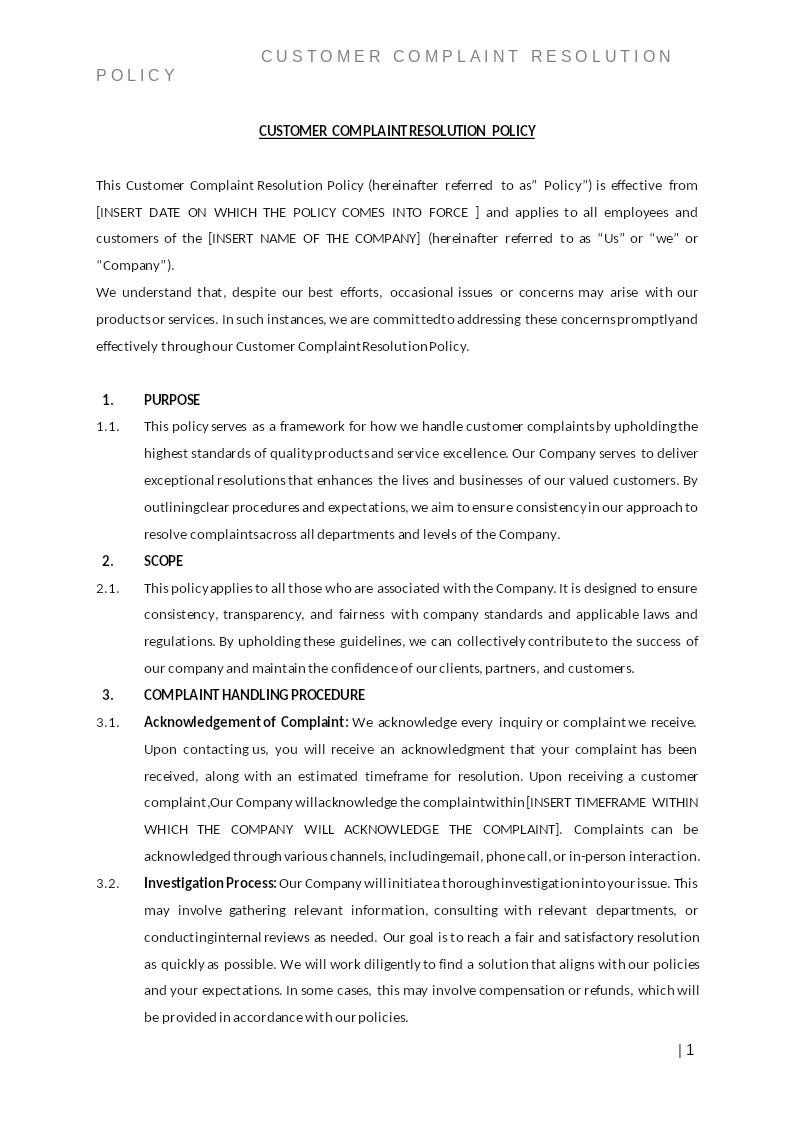
CUSTOMER COMPLAINT RESOLUTION POLICY
How does it work?
1. Choose this template
Start by clicking on "Fill out the template"
2. Complete the document
Answer a few questions and your document is created automatically.
3. Save - Print
Your document is ready! You will receive it in Word and PDF formats. You will be able to modify it.
Ensuring Accountability and Service Quality Through a Customer Complaint Resolution Policy
Businesses that provide goods or services to consumers must establish and maintain transparent procedures for receiving, investigating, and resolving customer complaints. A Customer Complaint Resolution Policy serves as a formal organizational framework that outlines how customer concerns are documented, escalated, addressed, and resolved in accordance with U.S. consumer-protection laws, Federal Trade Commission (FTC) guidelines, state unfair-practices laws, and industry-specific regulatory requirements. This policy helps ensure that all customer interactions are handled professionally, consistently, and in a manner that upholds the organization’s service standards and legal obligations.
A well-drafted Customer Complaint Resolution Policy provides structure for managing complaints related to product quality, service performance, billing issues, contractual matters, privacy concerns, or employee conduct. It establishes timelines for acknowledging complaints, identifies departments responsible for resolution, sets documentation standards, and outlines escalation procedures for complex issues. By implementing this policy, businesses demonstrate their commitment to fairness, transparency, and consumer rights, thereby strengthening customer trust while reducing legal risks arising from unresolved or improperly handled complaints.
Where Customer Complaint Resolution Policies Are Commonly Used
Customer Complaint Resolution Policies are widely adopted across a broad range of industries, including:
- Retail businesses addressing product returns, defects, or dissatisfaction
- Service providers such as telecommunications, utilities, or subscription platforms
- Financial institutions subject to strict federal consumer-reporting and billing regulations
- Healthcare providers addressing patient feedback, billing disputes, or service issues
- E-commerce companies resolving order discrepancies or delivery concerns
- Professional service firms managing client grievances or contractual disagreements
- Hospitality businesses responding to guest concerns, safety incidents, or service failures
- Technology companies addressing software defects, outages, or data-privacy complaints
Wherever consumer-facing interactions occur, an effective complaint-resolution policy ensures consistency and legal compliance.
Different Types of Customer Complaint Resolution Policies You May Encounter
1. General Consumer Complaint Policies: Cover day-to-day customer grievances related to goods or services.
2. Regulated-Industry Complaint Policies: Used in industries such as finance, healthcare, telecommunications, or insurance, where federal and state laws impose specific complaint-handling obligations.
3. Technical or Product-Support Complaint Policies: Address issues related to equipment, software, firmware updates, warranties, or defects.
4. Billing, Refund, and Transaction Dispute Policies: Handle financial disputes, unauthorized charges, and refund requests.
5. Privacy and Data-Use Complaint Policies: Cover complaints related to data protection, CCPA compliance, and privacy breaches.
When Legal Guidance Becomes Helpful
Legal counsel may be needed when:
- The complaint involves allegations of fraud, deceptive practices, or regulatory violations
- The business operates in a heavily regulated industry such as finance or healthcare
- Customer disputes escalate into potential litigation or require settlement agreements
- State or federal consumer-protection laws impose mandatory disclosure or response timelines
- Complaints involve privacy breaches subject to federal or state data-protection statutes
- The complaint relates to warranty rights under the Magnuson Moss Warranty Act
- A company must establish proper recordkeeping for audits or compliance investigations
- Dispute resolution mechanisms such as arbitration clauses must be incorporated
Legal review ensures the policy meets U.S. consumer laws, reduces legal exposure, and enhances operational reliability.
How to Work with This Template
• Define the scope of the policy and identify applicable customer groups
• Describe how customers may submit complaints (e.g., phone, email, web forms, mail)
• Establish timelines for acknowledging and resolving complaints
• Assign responsibility to specific departments or personnel
• Outline procedures for investigating, documenting, and tracking complaints
• Detail escalation procedures for unresolved or complex cases
• Include provisions regarding confidentiality and data-protection obligations
• Specify remedies available to customers based on the nature of the complaint
• Communicate the policy across the organization and require employee training
• Maintain detailed records for compliance audits and internal reviews
This template reflects standard U.S. industry practices for consumer complaint management and is suitable for businesses of all sizes, including service providers, retailers, e-commerce entities, and regulated organizations.
Frequently Asked Questions
Q1. What is a Customer Complaint Resolution Policy, and why is it important?
A Customer Complaint Resolution Policy is a formal document that outlines how customer grievances are received and resolved. It is important because it promotes fairness, transparency, legal compliance, and consistent customer service.
Q2. Are businesses legally required to maintain a complaint-resolution policy?
Not always, but many industries such as finance, insurance, healthcare, and telecommunications must maintain formal complaint procedures under federal and state law.
Q3. How quickly must complaints be addressed?
Timelines vary. Many policies require acknowledgment within a set number of business days, and resolution timelines depend on the complexity of the issue and regulatory requirements.
Q4. Are customer complaints considered confidential?
Yes. Complaints typically involve personal or confidential information, and businesses must comply with privacy laws such as CCPA and other applicable data-protection statutes.
Q5. Can customer complaints lead to legal action?
Yes. Unresolved complaints especially involving defective products, billing errors, or deceptive practices can escalate to regulatory investigations or lawsuits.
Q6. Should employees receive training on complaint-handling procedures?
Absolutely. Proper training ensures consistency, adherence to company standards, and compliance with legal requirements.
Q7. Can a business deny a complaint if it believes it is unfounded?
While the business may dispute the complaint, policies typically require all complaints to be investigated and documented before determining validity.
Q8. Does the policy cover refund or billing disputes?
Yes. Many complaints relate to financial transactions, and the policy should address refund eligibility, chargeback procedures, and billing-error resolution.
Q9. Can customers submit complaints anonymously?
Some businesses allow anonymous complaints, especially related to ethical or safety issues. However, anonymity may limit the organization’s ability to investigate fully.
Q10. Should legal counsel review complex or high-risk complaints?
Yes. When complaints involve safety concerns, legal exposure, regulatory issues, or contractual disputes, legal review is strongly advised.