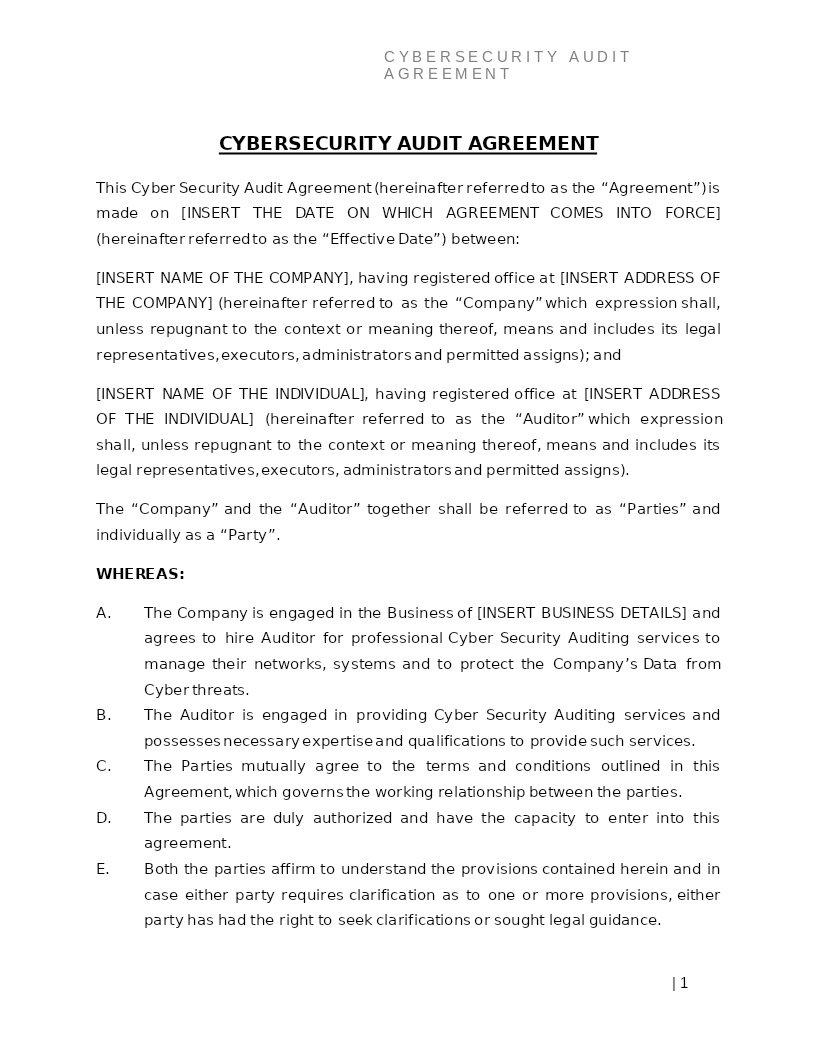
CYBERSECURITY AUDIT AGREEMENT
How does it work?
1. Choose this template
Start by clicking on "Fill out the template"
2. Complete the document
Answer a few questions and your document is created automatically.
3. Save - Print
Your document is ready! You will receive it in Word and PDF formats. You will be able to modify it.
Protects the organization from unauthorized access, misuse of security findings, and unintended disruptions to operations.
In an environment where organizations increasingly rely on digital systems, cloud infrastructures, and interconnected networks, it is essential to establish a clear legal framework governing how cybersecurity assessments, system inspections, and vulnerability audits will be conducted. A cybersecurity audit agreement provides for that framework, which defines the scope of the audit, identifies what systems and data the auditor may access, specifies the methodologies permitted, and outlines the obligations, responsibilities, and restrictions applicable to both the organization undergoing the audit and the cybersecurity auditor.
Putting a cybersecurity audit agreement in place establishes a foundation of trust that allows both parties to engage in technical review activities, exchange system information, and evaluate vulnerabilities without compromising the integrity, confidentiality, or security of the organization’s infrastructure. The agreement ensures that sensitive technical details, system logs, credentials, and assessment findings are handled safely and used solely for the authorized purpose of strengthening cybersecurity safeguards.
Cybersecurity Audit Agreements are widely used in industries such as finance, healthcare, technology, e-commerce, manufacturing, transportation, government, education, and any sector that processes sensitive or regulated data. Whenever an external auditor, consultant, or third-party firm examines internal systems, networks, codebases, or operational security controls, a cybersecurity audit agreement provides the legal boundaries necessary to safeguard both parties and minimize risk.
Where Cybersecurity Audit Agreements Are Commonly Used
Cybersecurity Audit Agreements are standard across a wide range of operational and compliance scenarios, including:
- Penetration testing and ethical hacking engagements
- Network vulnerability assessments and security posture evaluations
- Cloud security assessments (AWS, Azure, Google Cloud, etc.)
- Compliance-driven audits (ISO 27001, SOC 2, HIPAA, PCI-DSS, GDPR)
- Vendor risk assessments and third-party due diligence
- Code reviews, application security testing, and DevSecOps audits
- Incident response or forensic investigations post-breach
- Infrastructure assessments for mergers, acquisitions, or onboarding
- Red team/blue team simulation exercises
Any time privileged access to systems or sensitive information is granted, a Cybersecurity Audit Agreement sets strict boundaries around what the auditor is permitted to do.
Types of Cybersecurity Audit Agreements
1. Network Security Audit Agreement: Focused on firewalls, routers, network architecture, and traffic analysis.
2. Application Security Audit Agreement: Used when reviewing web, mobile, or software applications.
3. Cloud Security Audit Agreement: Tailored for cloud-hosted infrastructures and SaaS products.
4. Penetration Testing Agreement: Defines ethical hacking rules, testing windows, and authorized attack vectors.
5. Compliance Audit Agreement: Used for certification-based or regulatory-driven audits.
6. Incident Response or Forensic Audit Agreement: Applies after a breach or cyber incident requiring system analysis and evidence capture.
When Legal Guidance Becomes Helpful
Professional legal review becomes essential when:
- The auditor is given elevated access, admin credentials, or privileged accounts
- Multiple jurisdictions, data protection laws, or international transfers apply
- Sensitive or classified information may be exposed
- The audit involves regulated data (health records, financial data, children’s data, etc.)
- The organization requires strong confidentiality, indemnity, or liability protections
- The engagement may disrupt live systems, operations, or business continuity
- Penetration testing involves simulated attacks that could trigger alerts, logs, or automated defenses.
Legal guidance ensures that risk is minimized and that the rights and obligations of both parties are clearly established.
How to Work With This Template
- Identify the parties and clearly state the purpose of the audit
- Define the systems, networks, or environments included in the audit scope
- Specify permitted methodologies, testing hours, and prohibited activities
- Set data handling, confidentiality, and breach response requirements
- Establish reporting timelines, deliverables, and remediation expectations
- Select governing law and dispute resolution mechanisms
- Review terms jointly (legal review strongly recommended)
- Sign electronically or in hard copy
This structure follows widely recognized cybersecurity audit and risk management standards.
Frequently Asked Questions
1. Is a Cybersecurity Audit Agreement necessary even for preliminary assessments?
Yes. Even initial evaluations may require system access or exposure to sensitive configuration details.
2. Can the same agreement be reused for future audits?
Yes, but the scope and technical parameters should be updated for each audit cycle.
3. What if an auditor refuses certain restrictions?
The organization should maintain boundaries and restrict access until both parties agree on safe and compliant limitations.
4. Are electronic signatures enforceable?
Yes. Cybersecurity Audit Agreements may be executed electronically under federal and state laws.
5. Does the agreement protect confidential system information?
Yes. It includes strong confidentiality obligations and limits use of audit findings strictly to authorized security purposes.
6. Can this agreement cover penetration testing?
Yes. Pen-testing engagements require specific permission frameworks, which the agreement can explicitly define.
7. How long does the agreement apply?
Typically for the duration of the audit and a retention period for deliverables, unless otherwise stated.
8. Is this agreement suitable for consultants, agencies, and freelancers?
Yes. Any external party performing cybersecurity work should be bound by it.
9. What happens if the auditor breaches the agreement?
The organization may suspend access, demand immediate deletion of data, and pursue legal or injunctive relief.
10. Does the agreement cover verbal technical disclosures?
Only if included in the definition of protected information. Written documentation is strongly recommended.
11. Can the auditor subcontract any testing activities?
Only if expressly permitted, and such subcontractors must be bound by equal or stronger obligations.
12. Does the agreement address liability for system outages or disruptions caused by testing?
Yes. It typically includes disclaimers, indemnities, and operational precautions.
13. Is this agreement valid for cross-border auditors?
Yes, provided that governing law, data transfer mechanisms, and regulatory compliance are clearly specified.
14. What if new systems or environments are added later?
They can be incorporated through addenda or revised statements of work.
15. Must internal IT teams also comply with the agreement?
Yes. Internal staff supporting the audit must maintain confidentiality and follow operational safeguards.